
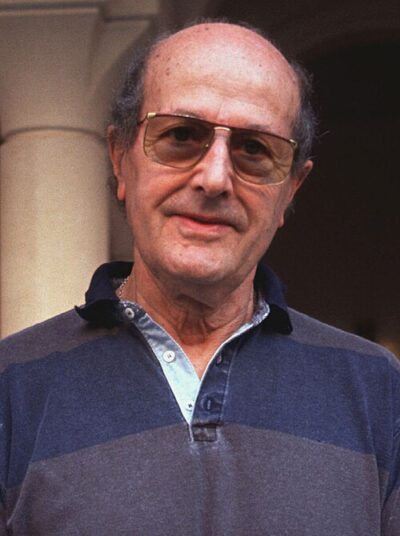
Manoel de Oliveira
Manoel de Oliveira was a Portuguese film director. Born December 11, 1908, in Porto. Died April 2, 2015, in Porto. Known for Past and Present and Aniki-Bóbó. Awards include Commander of the Order of Ouissam Alaouite, honorary doctorate of the University of Porto and Grand Cross of the Military Order of Saint James of the Sword.
Facts
35 facts · 2 confirmed by two sources · 12 cited · 21 from one source
Where this comes from
Papalocal keeps its own record. It started from these sources; what each one said is kept here as it was copied, so a change on their side never changes this page by itself. Tap one to read its version.
What Wikidata says · copied November 16, 2026 · revision 2569038823
- Described as
- Portuguese film director (1908–2015)
- Other names
- Manoel Cândido Pinto de Oliveira, Manoel Candido Pinto De Oliveira
- Born
- December 11, 1908 · 6 references
- Died
- April 2, 2015 · 6 references
- Born in
- Porto · 2 references
- Died in
- Porto · 1 reference
- Buried in
- Cemetery of Agramonte · 1 reference
- Cause of death
- heart failure
- Name at birth
- Manoel Candido Pinto De Oliveira · 1 reference
- Citizen of
- Portugal
- Occupation
- screenwriter · 1 reference; film director · 2 references; cinematographer; film producer; film editor · 1 reference; actor · 1 reference; racing automobile driver · 1 reference; filmmaker · 1 reference
- Sport
- auto racing
- Known for
- Past and Present; Aniki-Bóbó
- Awards
- Commander of the Order of Ouissam Alaouite; honorary doctorate of the University of Porto (1989); Grand Cross of the Military Order of Saint James of the Sword · 1 reference; Grand Cross of the Order of Prince Henry · 1 reference; Sophia Awards; Golden Globes; European Film Academy Critics Award (1997) · 1 reference; honorary doctor from the NOVA University Lisbon (2002); Robert-Bresson Award (2004); Gold Medal of Merit in the Fine Arts (2007); European Film Academy Honorary Award (2007) · 1 reference; Honorary Palme d'Or (2008); Order of Cultural Merit (Brazil) (2009); honorary doctor of the University of Trás-os-Montes and Alto Douro (2011); honorary doctor of Paris 8 University (2012) · 1 reference
- Children
- Manuel Casimiro
- Wikipedias with a page
- 50
Wikidata item Q43264 (wikidata.org/wiki/Q43264), public domain (CC0). Copied November 16, 2026.
What Wikipedia says · copied November 16, 2026 · revision 1381146239
Manoel Cândido Pinto de Oliveira (Portuguese: [mɐnuˈɛl doliˈvɐjɾɐ]; 11 December 1908 – 2 April 2015) was a Portuguese film director and screenwriter born in Cedofeita, Porto. He first began making films in 1927, when he and some friends attempted to make a film about World War I. In 1931, he completed his first film Douro, Faina Fluvial, a documentary about his home city Porto made in the city-symphony genre. He made his feature film debut in 1942 with Aniki-Bóbó and continued to make shorts and documentaries for the next 30 years, gaining a minimal amount of recognition without being considered a major filmmaker.
In 1971, Oliveira directed his second feature narrative film, Past and Present, a social satire that both set the standard for his film career afterwards and gained him recognition in the global film community. He continued making films of growing ambition throughout the 1970s and 1980s, gaining critical acclaim and numerous awards. Beginning in the late 1980s, he was one of the most prolific working film directors and made an average of one film per year past the age of 100. In March 2008, he was reported to be the oldest active film director in the world. In world film history, Manoel de Oliveira was the only active filmmaker from the silent period into the digital age.
Among his numerous awards were the Golden Lion for Lifetime Achievement from the 61st Venice International Film Festival, the Special Lion for the Overall Work in the 42nd Venice International Film Festival, an Honorary Palme d'Or for his lifetime achievements in 2008 Cannes Film Festival, and the French Legion of Honor.
- Born, in its opening lines
- December 11, 1908
- Died, in its opening lines
- April 2, 2015
From the Wikipedia article “Manoel de Oliveira” (en.wikipedia.org/wiki/Manoel_de_Oliveira), by its contributors, under CC BY-SA 4.0 (creativecommons.org/licenses/by-sa/4.0/). Copied November 16, 2026; not changed.
Confirmed Two sources agree. Cited One source, and it names where it got it. One source One source, without a reference of its own. Sources disagree The sources disagree. We show the best-supported value and keep theirs below.
