
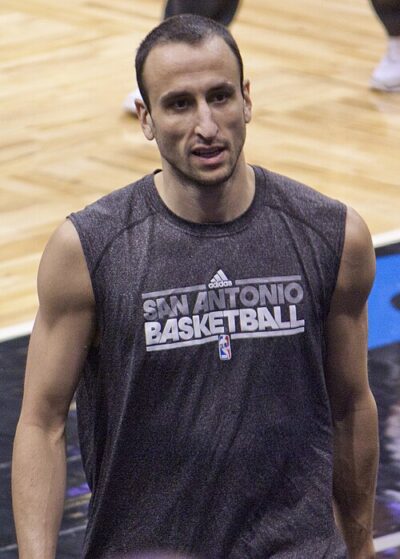
Manu Ginóbili
Manu Ginóbili is an Argentine basketball player. Born July 28, 1977, in Bahía Blanca. Positions held include UNICEF Goodwill Ambassador. Awards include diamond Konex award.
Facts
16 facts · 1 confirmed by two sources · 6 cited · 9 from one source
Where this comes from
Papalocal keeps its own record. It started from these sources; what each one said is kept here as it was copied, so a change on their side never changes this page by itself. Tap one to read its version.
What Wikidata says · copied November 16, 2026 · revision 2531085218
- Described as
- Argentine basketball player (born 1977)
- Other names
- Manu Ginobili, Emanuel Ginobili, Emanuel Ginóbili, Emanuel David Ginobili
- Born
- July 28, 1977 · 2 references
- Born in
- Bahía Blanca
- Citizen of
- Argentina · 2 references; Italy · 1 reference
- Occupation
- basketball player · 1 reference
- Positions held
- UNICEF Goodwill Ambassador
- Teams
- San Antonio Spurs (2002–2018); Viola Reggio Calabria (1998–2000); Estudiantes de Bahía Blanca (1996–1998); Virtus Pallacanestro Bologna (2000–2002); Argentina men's national basketball team (1998–2016) · 1 reference; Andino Sport Club (1995–1996)
- Sport
- basketball · 1 reference
- Awards
- diamond Konex award (2010) · 1 reference
- Height
- 1.87 m (6 ft 2 in)
- Website
- https://manuginobili.com · 1 reference
- Wikipedias with a page
- 47
Wikidata item Q213132 (wikidata.org/wiki/Q213132), public domain (CC0). Copied November 16, 2026.
What Wikipedia says · copied November 16, 2026 · revision 1385703709
Emanuel David "Manu" Ginóbili Maccari (English: MAN-oo jin-OH-blee, Spanish: [ˈmanu ʝiˈnoβili]; born 28 July 1977) is an Argentine former professional basketball player. During a 23-year professional career, Ginóbili played in Argentina, in Italy, and in the NBA; he also represented Argentina in international competition. A shooting guard, he is best known for playing for the San Antonio Spurs of the NBA from 2002 to 2018. Ginóbili, Tim Duncan, and Tony Parker became known as the Spurs' "Big Three"; together, the trio won four NBA championships. In April 2022, Ginóbili was announced as a first-ballot inductee into the Naismith Memorial Basketball Hall of Fame.
Coming from a family of professional basketball players, Ginóbili spent the early part of his career in Argentina and Italy, winning several individual and team honors. Ginóbili's stint with Italian club Kinder Bologna was particularly successful, as he won two Italian League MVP awards, the EuroLeague Finals MVP, the 2001 EuroLeague championship and the Triple Crown. After joining the San Antonio Spurs, Ginóbili was named an All-Star in 2005 and 2011 and was selected to the All-NBA Third Team twice. In the 2007–08 season, he was named the NBA Sixth Man of the Year. The Spurs made the playoffs in each of Ginóbili's 16 seasons. He is regarded as one of the greatest Latin American players, sixth men, and draft steals in NBA history. Ginóbili is also credited with popularizing the Euro step move in the NBA.
In international play, Ginóbili's achievements include leading Argentina to a gold medal at the 2004 Summer Olympics, where he was named FIBA Olympics Most Valuable Player. He also helped secure the historic feat of being a member of the only team in Olympic history (as of 2025) to ever eliminate the United States men's national basketball team since NBA players are allowed to participate (i.e. 1992). With Argentina's 2004 gold medal victory, Ginóbili became one of only two players (along with fellow Hall of Famer Bill Bradley) to have won a EuroLeague title, an NBA championship, and an Olympic gold medal.
In September 2021, the Spurs appointed Ginóbili as special advisor to basketball operations.
- Born, in its opening lines
- July 28, 1977
From the Wikipedia article “Manu Ginóbili” (en.wikipedia.org/wiki/Manu_Ginóbili), by its contributors, under CC BY-SA 4.0 (creativecommons.org/licenses/by-sa/4.0/). Copied November 16, 2026; not changed.
Confirmed Two sources agree. Cited One source, and it names where it got it. One source One source, without a reference of its own. Sources disagree The sources disagree. We show the best-supported value and keep theirs below.
