
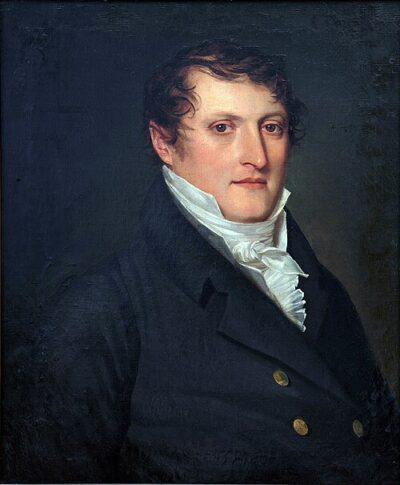
Manuel Belgrano
Manuel Belgrano was an Argentine politician and military leader. Born June 3, 1770, in Buenos Aires. Died June 20, 1820, in Buenos Aires. Educated at University of Salamanca and University of Valladolid.
Facts
20 facts · 2 confirmed by two sources · 8 cited · 10 from one source
Where this comes from
Papalocal keeps its own record. It started from these sources; what each one said is kept here as it was copied, so a change on their side never changes this page by itself. Tap one to read its version.
What Wikidata says · copied November 16, 2026 · revision 2554498441
- Described as
- Argentine politician and military leader
- Other names
- Manuel Jose Joaquin del Corazon de Jesus Belgrano y Gonzalez
- Born
- June 3, 1770 · 7 references
- Died
- June 20, 1820 · 6 references
- Born in
- Buenos Aires · 1 reference
- Died in
- Buenos Aires · 1 reference
- Buried in
- Santo Domingo convent
- Cause of death
- edema
- Citizen of
- Argentina
- Occupation
- lawyer · 1 reference; journalist; economist; politician · 1 reference; military personnel; jurist · 1 reference
- Education
- University of Salamanca · 2 references; University of Valladolid · 2 references
- Children
- Pedro Rosas y Belgrano
- Siblings
- Francisco Belgrano; Joaquín Belgrano
- Religion
- Catholicism
- Military rank
- general · 2 references
- Wikipedias with a page
- 51
Wikidata item Q315507 (wikidata.org/wiki/Q315507), public domain (CC0). Copied November 16, 2026.
What Wikipedia says · copied November 16, 2026 · revision 1377576345
Manuel José Joaquín del Corazón de Jesús Belgrano (3 June 1770 – 20 June 1820), usually referred to as Manuel Belgrano (Spanish pronunciation: [maˈnwel βelˈɣɾano]), was an Argentine public servant, economist, lawyer, politician, journalist, and military leader. He took part in the Argentine Wars of Independence and designed what became the flag of Argentina. Argentines regard him as one of the main Founding Fathers of the country. He was also a supporter of free trade.
Belgrano was born in Buenos Aires, the fourth child of Italian businessman Domingo Belgrano y Peri and of María Josefa González Casero. He came into contact with the ideas of the Age of Enlightenment while at university in Spain around the time of the 1789 French Revolution. In 1794 he returned to the Viceroyalty of the Río de la Plata, where he became a notable member of the criollo population of Buenos Aires; he tried to promote some of the new political and economic ideals, but found severe resistance from local peninsulares. This rejection led him to work towards greater autonomy for his country from the Spanish colonial regime. At first he unsuccessfully promoted the aspirations of Carlota Joaquina to become a regent ruler for the Viceroyalty during the period when the French imprisoned the Spanish King Ferdinand VII during the Peninsular War (1807–1814). Belgrano favoured the May Revolution, which removed the viceroy Baltasar Hidalgo de Cisneros from power on 25 May 1810. He was elected as a voting member of the Primera Junta that took power after the ouster.
As a delegate for the Junta, he led the ill-fated Paraguay campaign of 1810-1811. Belgrano's troops were beaten by Bernardo de Velasco at the battles of Paraguarí and Tacuarí. Though his army was defeated, the military campaign initiated the chain of events that led to the independence of Paraguay in May 1811. He retreated to the vicinity of Rosario, to fortify it against a possible royalist attack from the Eastern Band of the Uruguay River. While there, he developed the design of the flag of Argentina. The First Triumvirate did not approve the flag, but because of slow communications, Belgrano would only learn of that many weeks later, while reinforcing the Army of the North at Jujuy. There, knowing he was at a strategic disadvantage against the royalist armies coming from Upper Peru, Belgrano ordered the Jujuy Exodus, which evacuated the entire population of Jujuy Province to San Miguel de Tucumán. His counter-offensive at the Battle of Tucumán resulted in a key strategic victory, and it was soon followed by a complete victory over the royalist army of Pío Tristán at the Battle of Salta. However, his deeper incursions into Upper Peru ended with the defeats of Vilcapugio and Ayohuma, leading the Second Triumvirate to order his replacement as Commander of the Army of the North by the newly arrived José de San Martín. By then, the Asamblea del Año XIII had approved the use of Belgrano's flag as the national war flag.
Belgrano then went on a diplomatic mission to Europe along with Bernardino Rivadavia to seek support for the revolutionary government. He returned in time to take part in the Congress of Tucumán, which declared Argentine independence (1816). He promoted the Inca plan to create a constitutional monarchy with an Inca descendant as head of state. This proposal had the support of San Martín, Martín Miguel de Güemes, and many provincial delegates, but was strongly rejected by the delegates from Buenos Aires. The Congress of Tucumán approved the use of his flag as the national flag. After this, Belgrano again took command of the Army of the North, but his mission was limited to protecting San Miguel de Tucumán from royalist advances while San Martín prepared the Army of the Andes for an alternative offensive across the Andes. When José Gervasio Artigas and Estanislao López seemed poised to invade Buenos Aires, he moved his army southwards, but his troops mutinied in January 1820. Belgrano died of dropsy on 20 June 1820. His last words reportedly were: "¡Ay, Patria mía!" (Oh, my homeland!).
- Born, in its opening lines
- June 3, 1770
- Died, in its opening lines
- June 20, 1820
From the Wikipedia article “Manuel Belgrano” (en.wikipedia.org/wiki/Manuel_Belgrano), by its contributors, under CC BY-SA 4.0 (creativecommons.org/licenses/by-sa/4.0/). Copied November 16, 2026; not changed.
Confirmed Two sources agree. Cited One source, and it names where it got it. One source One source, without a reference of its own. Sources disagree The sources disagree. We show the best-supported value and keep theirs below.
