
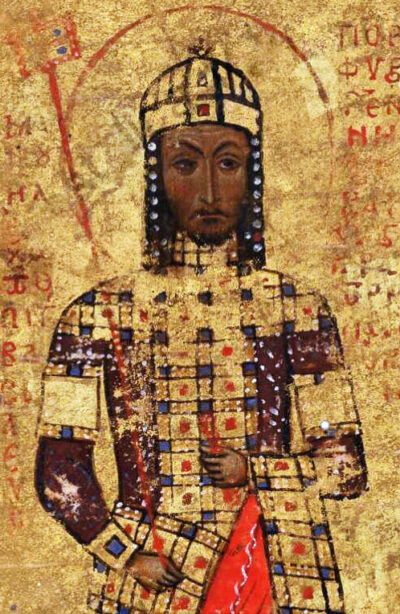
Manuel I Komnenos
Manuel I Komnenos was a Byzantine Emperor. Born November 28, 1118, in Constantinople. Died September 24, 1180, in Constantinople. Positions held include Byzantine emperor (1143–1180).
Facts
20 facts · 2 confirmed by two sources · 3 cited · 15 from one source
Where this comes from
Papalocal keeps its own record. It started from these sources; what each one said is kept here as it was copied, so a change on their side never changes this page by itself. Tap one to read its version.
What Wikidata says · copied November 16, 2026 · revision 2570026547
- Described as
- Byzantine Emperor
- Born
- November 28, 1118 · 1 reference
- Died
- September 24, 1180 · 1 reference
- Born in
- Constantinople · 3 references
- Died in
- Constantinople · 2 references
- Citizen of
- Byzantine Empire
- Occupation
- emperor · 1 reference
- Positions held
- Byzantine emperor (1143–1180)
- Spouse
- Maria of Antioch; Bertha of Sulzbach (1146–1159) · 1 reference
- Children
- Alexios II Komnenos; Maria Komnene; Alexios Komnenos
- Father
- John II Komnenos
- Mother
- Irene of Hungary
- Siblings
- Alexios Komnenos; Andronikos Komnenos; Isaac Komnenos; Eudokia Komnene · 1 reference; Maria Komnene · 1 reference; Theodora Komnene · 1 reference
- Wikipedias with a page
- 72
Wikidata item Q41610 (wikidata.org/wiki/Q41610), public domain (CC0). Copied November 16, 2026.
What Wikipedia says · copied November 16, 2026 · revision 1383946748
Manuel I Komnenos (Greek: Μανουήλ Κομνηνός, romanized: Manouḗl Komnēnós; 28 November 1118 – 24 September 1180) was a Byzantine emperor of the 12th century who reigned over a crucial turning point in the history of Byzantium and the Mediterranean. His reign saw the last flowering of the Komnenian restoration, during which the Byzantine Empire experienced a resurgence of military and economic power and enjoyed a cultural revival.
Eager to restore his empire to its past glories as the great power of the Mediterranean world, Manuel pursued an energetic and ambitious foreign policy. In the process he made alliances with Pope Adrian IV and the resurgent West. He invaded the Norman Kingdom of Sicily, although unsuccessfully, being the last Eastern Roman emperor to attempt reconquests in the western Mediterranean. The passage of the potentially dangerous Second Crusade through his empire was adroitly managed. Manuel established a Byzantine protectorate over the Crusader states of Outremer. Facing Muslim advances in the Holy Land, he made common cause with the Kingdom of Jerusalem and participated in a combined invasion of Fatimid Egypt. Manuel reshaped the political maps of the Balkans and the eastern Mediterranean, placing the kingdoms of Hungary and Outremer under Byzantine hegemony and campaigning aggressively against his neighbours both in the west and in the east.
However, towards the end of his reign, Manuel's achievements in the east were compromised by a serious defeat at Myriokephalon, which in large part resulted from his arrogance in attacking a well-defended Seljuk position. Although the Byzantines recovered and Manuel concluded an advantageous peace with Sultan Kilij Arslan II, Myriokephalon proved to be the final, unsuccessful effort by the empire to recover the interior of Anatolia from the Turks.
Manuel is known to have inspired intense loyalty in those who served him. He also appears as the hero of a history written by his secretary, John Kinnamos, in which every virtue is attributed to him. Manuel, who was influenced by his contact with western Crusaders, enjoyed the reputation of "the most blessed emperor of Constantinople" in parts of the Latin world as well. Some historians have been less enthusiastic about him, however, asserting that the great power he wielded was not his own personal achievement, but that of the Komnenos dynasty he represented. Further, it has also been argued that since Byzantine imperial power declined catastrophically after Manuel's death, it is only natural to look for the causes of this decline in his reign.
- Born, in its opening lines
- November 28, 1118
- Died, in its opening lines
- September 24, 1180
From the Wikipedia article “Manuel I Komnenos” (en.wikipedia.org/wiki/Manuel_I_Komnenos), by its contributors, under CC BY-SA 4.0 (creativecommons.org/licenses/by-sa/4.0/). Copied November 16, 2026; not changed.
Confirmed Two sources agree. Cited One source, and it names where it got it. One source One source, without a reference of its own. Sources disagree The sources disagree. We show the best-supported value and keep theirs below.
