
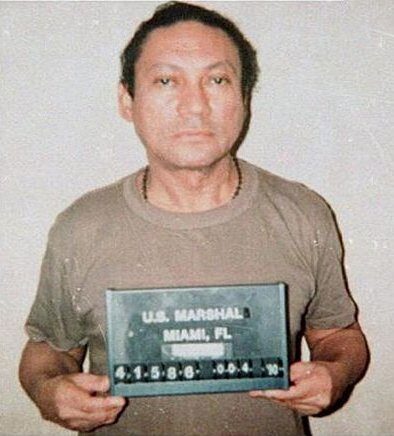
Manuel Noriega
Manuel Noriega was a Panamanian head of state. Born February 11, 1934, in Panama City. Died May 29, 2017, in Hospital Santo Tomas. Educated at Western Hemisphere Institute for Security Cooperation and Chorrillos Military School. Awards include Commander of the Legion of Honour.
Facts
18 facts · 2 confirmed by two sources · 5 cited · 11 from one source
Where this comes from
Papalocal keeps its own record. It started from these sources; what each one said is kept here as it was copied, so a change on their side never changes this page by itself. Tap one to read its version.
What Wikidata says · copied November 16, 2026 · revision 2558148798
- Described as
- Panamanian head of state (1934-2017)
- Other names
- Manuel Antonio Noriega Moreno
- Born
- February 11, 1934 · 4 references
- Died
- May 29, 2017 · 5 references
- Born in
- Panama City · 2 references
- Died in
- Hospital Santo Tomas · 1 reference
- Cause of death
- cerebral hemorrhage
- Name at birth
- Manuel Antonio Noriega Moreno
- Citizen of
- Panama · 3 references
- Occupation
- politician · 4 references; military personnel; drug lord; military engineer
- Political party
- Democratic Revolutionary Party
- Education
- Western Hemisphere Institute for Security Cooperation; Chorrillos Military School
- Awards
- Commander of the Legion of Honour (1987–)
- Religion
- Catholicism (1934–1990)
- Military rank
- general · 3 references; soldier
- Wikipedias with a page
- 66
Wikidata item Q192667 (wikidata.org/wiki/Q192667), public domain (CC0). Copied November 16, 2026.
What Wikipedia says · copied November 16, 2026 · revision 1384383662
Manuel Antonio Noriega Moreno ( mahn-WEL NOR-ee-AY-gə; Spanish: [maˈnwel noˈɾjeɣa]; February 11, 1934 – May 29, 2017) was a Panamanian military officer and dictator who was the de facto ruler of Panama from 1983 to 1989. He never officially served as president of Panama, instead ruling as an unelected military dictator through puppet presidents. Amassing a personal fortune through drug trafficking operations by the Panamanian military, Noriega had longstanding ties with American intelligence agencies before the United States invasion of Panama removed him from power.
Born in Panama City to a poor pardo family, Noriega studied at the Chorrillos Military School in Lima and at the School of the Americas. He became an officer in the Panamanian army, and rose through the ranks in alliance with Omar Torrijos. In 1968, Torrijos overthrew President Arnulfo Arias in a coup. Noriega became chief of military intelligence in Torrijos's government and, after Torrijos's death in 1981, consolidated power to become Panama's de facto ruler in 1983. Beginning in the 1950s, Noriega worked with U.S. intelligence agencies, and became one of the Central Intelligence Agency's most valued intelligence sources. He also served as a conduit for illicit weapons, military equipment, and cash destined for U.S.-backed forces throughout Latin America.
Noriega's relationship with the U.S. deteriorated in the late 1980s after the murder of Hugo Spadafora and the forced resignation of President Nicolás Ardito Barletta. Eventually, his relationship with intelligence agencies in other countries came to light, and his involvement in drug trafficking was investigated further. In 1988, Noriega was indicted by federal grand juries in Miami and Tampa, Florida, on charges of racketeering, drug smuggling, and money laundering. The U.S. launched an invasion of Panama following failed negotiations seeking his resignation and Noriega's annulment of the 1989 Panamanian general election. Noriega was captured and flown to the U.S., where he was tried on the Miami indictment, convicted on most of the charges, and sentenced to 40 years in prison, ultimately serving 17 years after a reduction in his sentence for good behavior. Noriega was extradited to France in 2010, where he was convicted and sentenced to seven years of imprisonment for money laundering. In 2011, France extradited him to Panama, where he was incarcerated for crimes committed during his rule for which he had been tried and convicted in absentia in the 1990s. Diagnosed with a brain tumor in March 2017, Noriega suffered complications during surgery, and died two months later.
Noriega's dictatorship was marked by repression of the media, an expansion of the military, and the persecution of political opponents, effectively controlling the outcomes of any elections. He relied upon military nationalism to maintain his support, and did not espouse a specific social or economic ideology. Noriega was known for his complicated relationship with the U.S., and was described as being its ally and adversary simultaneously.
- Born, in its opening lines
- February 11, 1934
- Died, in its opening lines
- May 29, 2017
From the Wikipedia article “Manuel Noriega” (en.wikipedia.org/wiki/Manuel_Noriega), by its contributors, under CC BY-SA 4.0 (creativecommons.org/licenses/by-sa/4.0/). Copied November 16, 2026; not changed.
Confirmed Two sources agree. Cited One source, and it names where it got it. One source One source, without a reference of its own. Sources disagree The sources disagree. We show the best-supported value and keep theirs below.
