
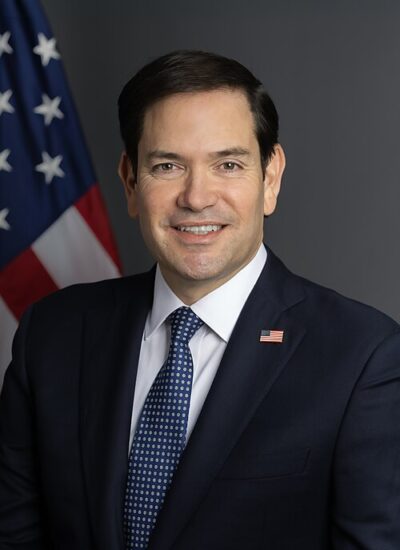
Marco Rubio
Marco Rubio is the 72nd United States Secretary of State since 2025. Born May 28, 1971, in Miami. Positions held include member of the Florida House of Representatives (2000–2008), majority leader (2003–2006) and Speaker of the Florida House of Representatives (2006–2008). Known for Senator Rubio's Letter to the National Institutes of Health, RE: "Woke Priorities". Educated at South Miami High School and Tarkio College. Awards include Commander of the Order of the Star of Romania, Time 100 and Order of Outstanding Merit.

Facts
36 facts · 1 confirmed by two sources · 14 cited · 21 from one source
Where this comes from
Papalocal keeps its own record. It started from these sources; what each one said is kept here as it was copied, so a change on their side never changes this page by itself. Tap one to read its version.
What Wikidata says · copied November 13, 2026 · revision 2568526077
- Described as
- 72nd United States Secretary of State since 2025
- Other names
- Marco Antonio Rubio, Sec. Marco Rubio, Sec. Rubio, Secretary Marco Rubio, Secretary Rubio, Senator Marco Rubio, Senator Rubio, Sen. Marco Rubio, Sen. Rubio, Marco A. Rubio
- Born
- May 28, 1971 · 3 references
- Born in
- Miami · 1 reference
- Name at birth
- Marco Antonio Rubio
- Citizen of
- United States
- Occupation
- lawyer · 1 reference; politician · 2 references; diplomat; jurist · 1 reference
- Positions held
- member of the Florida House of Representatives (2000–2008) · 1 reference; majority leader (2003–2006) · 1 reference; Speaker of the Florida House of Representatives (2006–2008); member (1998–2000) · 1 reference; United States senator (2011–2025) · 1 reference; United States Secretary of State (2025–); Administrator of the United States Agency for International Development (2025–); United States National Security Advisor (2025–) · 1 reference; senator · 1 reference
- Political party
- Republican Party · 1 reference
- Worked for
- Bob Dole presidential campaign, 1996; Florida International University (2008–)
- Education
- South Miami High School (1985–1989) · 1 reference; Tarkio College; Santa Fe College; University of Florida (–1993); University of Miami School of Law (–1996)
- Known for
- Senator Rubio's Letter to the National Institutes of Health, RE: "Woke Priorities"
- Awards
- Commander of the Order of the Star of Romania (2017) · 2 references; Time 100 (2026) · 1 reference; Order of Outstanding Merit (2026) · 1 reference
- Spouse
- Jeanette Dousdebes Rubio (1998–)
- Children
- Anthony Rubio
- Father
- Mario Rubio
- Mother
- Oriales Rubio
- Religion
- Catholicism
- Lived in
- Washington, D.C.
- Website
- https://marcorubio.com/
- Wikipedias with a page
- 87
Wikidata item Q324546 (wikidata.org/wiki/Q324546), public domain (CC0). Copied November 13, 2026.
What Wikipedia says · copied November 13, 2026 · revision 1385484597
Marco Antonio Rubio ( ROO-bee-oh; born May 28, 1971) is an American politician, attorney, and diplomat serving as the 72nd United States secretary of state since 2025. He is also serving as the 30th United States national security advisor. A member of the Republican Party, Rubio represented Florida in the United States Senate from 2011 to 2025.
Rubio was born and raised in Miami. He attended the University of Florida and the University of Miami's law school. After serving as a city commissioner for West Miami in the 1990s, he was elected in 2000 to represent the 111th district in the Florida House of Representatives. As the Republican majority leader, he was subsequently elected Speaker of the Florida House; he served for two years beginning in November 2006. Rubio left the Florida legislature in 2008 due to term limits, and began teaching at Florida International University. In a three-way race, Rubio was elected to the U.S. Senate in 2010. In April 2015, he launched a presidential bid instead of seeking reelection. He suspended his campaign for the presidency on March 15, 2016, after losing to Donald Trump in the Florida Republican primary. He then ran for reelection to the Senate and won a second term. Despite his criticism of Trump during his presidential campaign, Rubio endorsed him before the 2016 general election and was largely supportive of his presidency.
Due to his influence on U.S. policy on Latin America during the first Trump administration, he was described as a "virtual secretary of state for Latin America". He was also considered to have been one of Congress's most hawkish members with regard to China and the Chinese Communist Party. The Chinese government sanctioned him twice in 2020 and he was banned from entering China until he became Secretary of State. Rubio became Florida's senior senator in January 2019, following the defeat of former senator Bill Nelson, and was reelected to a third term in 2022, defeating Democratic nominee Val Demings in a landslide victory. Rubio endorsed Trump for president in 2024 days before the Iowa caucuses.
In November 2024, President-elect Trump announced his intention to nominate Rubio to be secretary of state in his second administration. Rubio was confirmed unanimously by the U.S. Senate and took office on January 21, 2025. On May 1, 2025, Trump announced that Rubio would become acting national security advisor, replacing Mike Waltz, while continuing to serve as secretary of state. This dual role was last held by Henry Kissinger from 1973 to 1975 (serving a combined tenure in one or both positions from 1969 to 1977) in the Nixon and Ford administrations. In February 2025, Rubio also became the acting archivist of the United States and the acting USAID administrator, holding these roles until February 2026 and August 2025, respectively. He is the first Latino to serve as secretary of state or national security advisor, making him the highest-ranking Hispanic American official in U.S. history.
- Born, in its opening lines
- May 28, 1971
From the Wikipedia article “Marco Rubio” (en.wikipedia.org/wiki/Marco_Rubio), by its contributors, under CC BY-SA 4.0 (creativecommons.org/licenses/by-sa/4.0/). Copied November 13, 2026; not changed.
Confirmed Two sources agree. Cited One source, and it names where it got it. One source One source, without a reference of its own. Sources disagree The sources disagree. We show the best-supported value and keep theirs below.
