
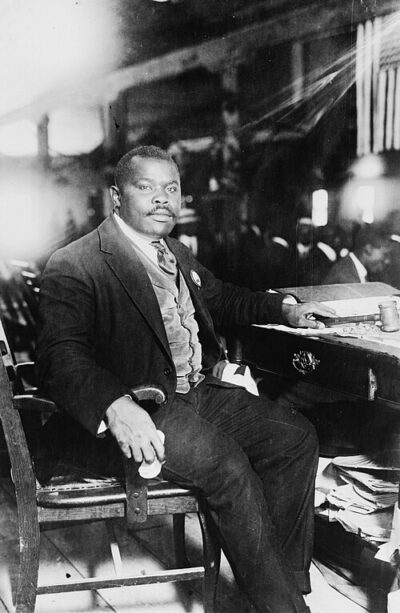
Marcus Garvey
Marcus Garvey was a Jamaica-born British political activist, Pan-Africanist, orator, and entrepreneur. Born August 17, 1887, in Saint Ann's Bay. Died June 10, 1940, in West Kensington. Educated at California State University, Fresno and Birkbeck, University of London. Awards include Order of National Hero and National Association of Black Journalists Hall of Fame.
Facts
26 facts · 2 confirmed by two sources · 9 cited · 15 from one source
Where this comes from
Papalocal keeps its own record. It started from these sources; what each one said is kept here as it was copied, so a change on their side never changes this page by itself. Tap one to read its version.
What Wikidata says · copied November 16, 2026 · revision 2568753689
- Described as
- Jamaica-born British political activist, Pan-Africanist, orator, and entrepreneur (1887-1940)
- Other names
- Maakos Gyaavi, Marcus Mosiah Garvey, Marcus Mosiah Garvey Jr.
- Born
- August 17, 1887 · 8 references
- Died
- June 10, 1940 · 7 references
- Born in
- Saint Ann's Bay
- Died in
- West Kensington
- Buried in
- National Heroes Park (1965–) · 1 reference
- Cause of death
- stroke
- Citizen of
- Colony of Jamaica
- Occupation
- journalist · 1 reference; entrepreneur; politician · 2 references; printer · 1 reference; sociologist · 1 reference; religious leader; civil rights advocate · 1 reference; author · 1 reference
- Political party
- People's Political Party
- Worked for
- Negro Factories Corporation; Negro World; Black Star Line
- Education
- California State University, Fresno; Birkbeck, University of London
- Member of
- Universal Negro Improvement Association and African Communities League
- Awards
- Order of National Hero; National Association of Black Journalists Hall of Fame (2004)
- Spouse
- Amy Jacques Garvey (1922–1940) · 1 reference; Amy Ashwood Garvey (1919–1922) · 1 reference
- Wikipedias with a page
- 65
Wikidata item Q272504 (wikidata.org/wiki/Q272504), public domain (CC0). Copied November 16, 2026.
What Wikipedia says · copied November 16, 2026 · revision 1385102458
Marcus Mosiah Garvey Jr. (17 August 1887 – 10 June 1940) was a Jamaican political activist. He was the founder and first President-General of the Universal Negro Improvement Association and African Communities League (UNIA-ACL, commonly known as UNIA), through which he declared himself Provisional President of Africa.
Ideologically a black nationalist and Pan-Africanist, Garvey's ideas are known as Garveyism. Garvey was born to a moderately prosperous Afro-Jamaican family in Saint Ann's Bay and was apprenticed into the print trade as a teenager. Working in Kingston, he became involved in trade unionism before living briefly in Costa Rica, Panama, and England. On returning to Jamaica, he founded UNIA in 1914. In 1916, he relocated to the United States and founded a UNIA branch in New York City's Harlem. Emphasising unity within the African diaspora, he campaigned to end European colonial rule in Africa and supported the continent's unification. He envisioned a unified Africa as a one-party state, led by himself, that would pass laws to promote black racial purity. Although he never visited Africa, he remained committed to the Back-to-Africa movement, arguing that part of the diaspora should migrate there. Garveyist ideas gained increasing popularity, and UNIA's membership expanded. As a black separatist, he established links with white racists such as the Ku Klux Klan (KKK) who shared his racial separatist views. This created a divide between Garvey and prominent African-American civil rights activists like W. E. B. Du Bois, who promoted racial integration. Believing that black people should be financially independent from white-dominated societies, Garvey launched various businesses in the US, including the Negro Factories Corporation and Negro World newspaper. In 1919, he became president of the Black Star Line shipping and passenger company, designed to forge a link between North America and Africa and facilitate African-American migration to Liberia. In 1923 Garvey was convicted of mail fraud for selling the company's stock, and was imprisoned in the United States Penitentiary, Atlanta for nearly two years. Garvey blamed Jews, claiming that they were prejudiced against him because of his links to the KKK.
After his sentence was commuted by US president Calvin Coolidge, Garvey was deported to Jamaica in 1927. Settling in Kingston with his wife Amy Jacques, Garvey established the People's Political Party in 1929, briefly serving as a city councilor. With UNIA in increasing financial difficulty, he relocated to London in 1935, where his anti-socialist stance distanced him from many of the city's black activists. He died there in 1940. In 1964 his body was returned to Jamaica for reburial in National Heroes Park in Kingston. Garvey was a controversial figure. Some in the African diasporic community regarded him as a pretentious demagogue, and were highly critical of his collaboration with white supremacists, his violent rhetoric, and his prejudice against mixed-race people and Jews. He received praise for encouraging a sense of pride and self-worth among Africans and the African diaspora amid widespread poverty, discrimination and colonialism. In Jamaica, he was the first person formally recognised as a National Hero. His ideas exerted a considerable influence on such movements as Rastafari, the Nation of Islam and the Black Power Movement.
- Born, in its opening lines
- August 17, 1887
- Died, in its opening lines
- June 10, 1940
From the Wikipedia article “Marcus Garvey” (en.wikipedia.org/wiki/Marcus_Garvey), by its contributors, under CC BY-SA 4.0 (creativecommons.org/licenses/by-sa/4.0/). Copied November 16, 2026; not changed.
Confirmed Two sources agree. Cited One source, and it names where it got it. One source One source, without a reference of its own. Sources disagree The sources disagree. We show the best-supported value and keep theirs below.
