
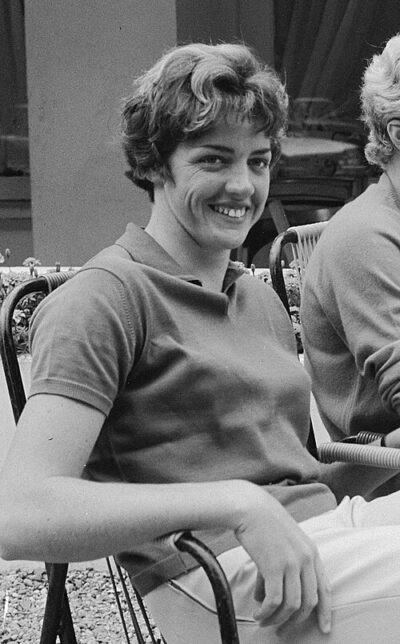
Margaret Court
Margaret Court is an Australian tennis player. Born July 16, 1942, in Albury. Teams include Australia Billie Jean King Cup team (1963–1970). Awards include Member of the Order of the British Empire, Australian Sports Medal and Officer of the Order of Australia.
Facts
19 facts · 1 confirmed by two sources · 12 cited · 6 from one source
Where this comes from
Papalocal keeps its own record. It started from these sources; what each one said is kept here as it was copied, so a change on their side never changes this page by itself. Tap one to read its version.
What Wikidata says · copied November 16, 2026 · revision 2558151312
- Described as
- Australian tennis player
- Other names
- Margaret Smith Court, Margaret Smith
- Born
- July 16, 1942 · 5 references
- Born in
- Albury · 2 references
- Name at birth
- Margaret Smith · 1 reference
- Citizen of
- Australia
- Occupation
- tennis player (1968–1975) · 1 reference
- Teams
- Australia Billie Jean King Cup team (1963–1970) · 1 reference
- Sport
- tennis · 1 reference
- Awards
- Member of the Order of the British Empire; Australian Sports Medal (2000) · 1 reference; Officer of the Order of Australia (2007) · 1 reference; Centenary Medal (2001) · 1 reference; Victorian Honour Roll of Women (2001) · 1 reference; International Tennis Hall of Fame; Companion of the Order of Australia (2021) · 1 reference; Philippe Chatrier Award (2006) · 1 reference; Australian Tennis Hall of Fame (1993–) · 1 reference
- Religion
- Pentecostalism · 1 reference
- Lived in
- Perth
- Height
- 1.75 m (5 ft 9 in)
- Wikipedias with a page
- 61
Wikidata item Q202342 (wikidata.org/wiki/Q202342), public domain (CC0). Copied November 16, 2026.
What Wikipedia says · copied November 16, 2026 · revision 1384051126
Margaret Court (née Smith; born 16 July 1942), also known as Margaret Smith Court, is an Australian former world number 1 tennis player. Her 24 women's singles major titles and total of 64 major titles (including 19 major women's doubles and 21 major mixed doubles titles) are the most in women's tennis history.
Court was born in Albury, New South Wales. In 1960, aged 17, she won the first of seven consecutive Australian Open singles titles. She completed the career Grand Slam in singles aged 21 with her victory at Wimbledon in 1963. Taking a brief hiatus in 1966 and 1967, Court played as an amateur until the advent of the Open Era in 1968. She completed the Grand Slam by winning all four major singles titles in 1970, part of a record six consecutive major singles victories. Court gave birth to her first child in 1972, but returned to tennis later in the year and won three major singles titles in 1973. She took similar breaks after her second and third children were born, retiring from the game in 1977.
Court is one of only three players in history (all women) to have won the "Boxed Set", consisting of every major title (the singles, doubles and mixed doubles). She is the only player in tennis history to complete a double Boxed Set. Court is also one of only six tennis players to win a double career Grand Slam in two disciplines, matching Roy Emerson, Martina Navratilova, Frank Sedgman, Doris Hart, and Serena Williams. She also won the Fed Cup with Australia on four occasions. The International Tennis Hall of Fame states "For sheer strength of performance and accomplishment there has never been a tennis player to match (her)." Evonne Goolagong called her the greatest female tennis player of all time.
Having grown up Catholic, Court became associated with Pentecostalism in the 1970s and became a Christian minister in that tradition in 1991. She later founded Margaret Court Ministries.
- Born, in its opening lines
- July 16, 1942
From the Wikipedia article “Margaret Court” (en.wikipedia.org/wiki/Margaret_Court), by its contributors, under CC BY-SA 4.0 (creativecommons.org/licenses/by-sa/4.0/). Copied November 16, 2026; not changed.
Confirmed Two sources agree. Cited One source, and it names where it got it. One source One source, without a reference of its own. Sources disagree The sources disagree. We show the best-supported value and keep theirs below.
