
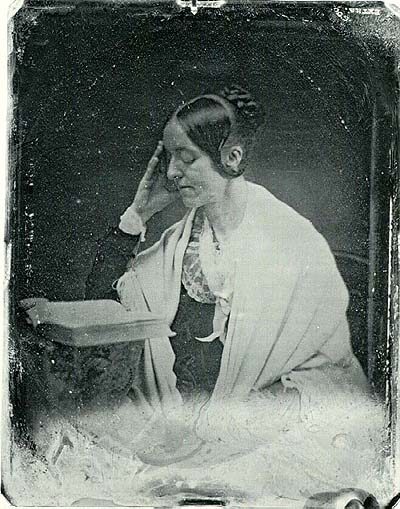
Margaret Fuller
Margaret Fuller was an American writer and women's activist. Born May 23, 1810, in Cambridge. Died July 19, 1850, in Fire Island. Known for Woman in the Nineteenth Century. Awards include National Women's Hall of Fame.
Facts
30 facts · 2 confirmed by two sources · 18 cited · 10 from one source
Where this comes from
Papalocal keeps its own record. It started from these sources; what each one said is kept here as it was copied, so a change on their side never changes this page by itself. Tap one to read its version.
What Wikidata says · copied November 13, 2026 · revision 2565598185
- Described as
- American writer and women's activist (1810–1850)
- Other names
- Sarah Margaret Fuller Ossoli, Margaret Fuller Ossoli, Sarah Margaret Fuller
- Born
- May 23, 1810 · 11 references
- Died
- July 19, 1850 · 10 references
- Born in
- Cambridge · 2 references
- Died in
- Fire Island
- Buried in
- Mount Auburn Cemetery · 1 reference
- Cause of death
- drowning
- Name at birth
- Sarah Margaret Fuller · 1 reference
- Citizen of
- United States · 1 reference
- Occupation
- journalist · 1 reference; translator; reporter; essayist; autobiographer; writer · 3 references; philosopher; women's rights activist · 1 reference
- Known for
- Woman in the Nineteenth Century · 1 reference
- Awards
- National Women's Hall of Fame (1995) · 1 reference
- Field
- essay
- Spouse
- Giovanni Angelo Ossoli · 1 reference
- Children
- Angelo Eugenio Filippo Ossoli · 1 reference
- Father
- Timothy Fuller · 2 references
- Mother
- Margaret Crane · 1 reference
- Siblings
- Arthur Buckminster Fuller · 1 reference; Ellen K. Channing · 1 reference; Richard Frederick Fuller · 1 reference
- Religion
- feminism; transcendentalism
- Lived in
- Cherry Street · 1 reference; Brattle Street · 1 reference
- Wikipedias with a page
- 58
Wikidata item Q257953 (wikidata.org/wiki/Q257953), public domain (CC0). Copied November 13, 2026.
What Wikipedia says · copied November 13, 2026 · revision 1384383975
Sarah Margaret Fuller (May 23, 1810 – July 19, 1850), sometimes referred to as Margaret Fuller Ossoli, was an American journalist, editor, critic, translator, and women's rights advocate associated with the American transcendentalism movement. She was the first American female war correspondent and full-time book reviewer in journalism. Her book Woman in the Nineteenth Century is considered the first major feminist work in the United States.
Born in Cambridgeport, Massachusetts, she was given a substantial early education by her father, Timothy Fuller, a lawyer who died in 1835 due to cholera. She later had more formal schooling and became a teacher before, in 1839, she began overseeing her Conversations series: classes for women meant to compensate for their lack of access to higher education. She became the first editor of the transcendentalist journal The Dial in 1840, which was the year her writing career started to succeed, before joining the staff of the New-York Tribune under Horace Greeley in 1844.
By the time she was in her 30s, Fuller had earned a reputation as the best-read person in New England, male or female, and became the first woman allowed to use the library at Harvard College. Her seminal work, Woman in the Nineteenth Century, was published in 1845. A year later, she was sent to Europe for the Tribune as its first female correspondent. She soon became involved with the revolutions in Italy and allied herself with Giuseppe Mazzini. She had a relationship with Giovanni Ossoli, with whom she had a child. All three members of the family died in a shipwreck off Fire Island, New York, as they were traveling to the United States in 1850. Fuller's body was never recovered.
Fuller was an advocate of women's rights and, in particular, women's education and the right to employment. Fuller, along with Samuel Taylor Coleridge, wanted to stay free of what she called the "strong mental odor" of female teachers. She also encouraged many other reforms in society, including prison reform and the emancipation of slaves in the United States. Many other advocates for women's rights and feminism, including Susan B. Anthony, cited Fuller as a source of inspiration. Many of her contemporaries, however, were not supportive, including her former friend Harriet Martineau, who said that Fuller was a talker rather than an activist. Shortly after Fuller's death, her importance faded. The editors who prepared her letters to be published, believing that her fame would be short-lived, censored or altered much of her work before publication.
- Born, in its opening lines
- May 23, 1810
- Died, in its opening lines
- July 19, 1850
From the Wikipedia article “Margaret Fuller” (en.wikipedia.org/wiki/Margaret_Fuller), by its contributors, under CC BY-SA 4.0 (creativecommons.org/licenses/by-sa/4.0/). Copied November 13, 2026; not changed.
Confirmed Two sources agree. Cited One source, and it names where it got it. One source One source, without a reference of its own. Sources disagree The sources disagree. We show the best-supported value and keep theirs below.
