
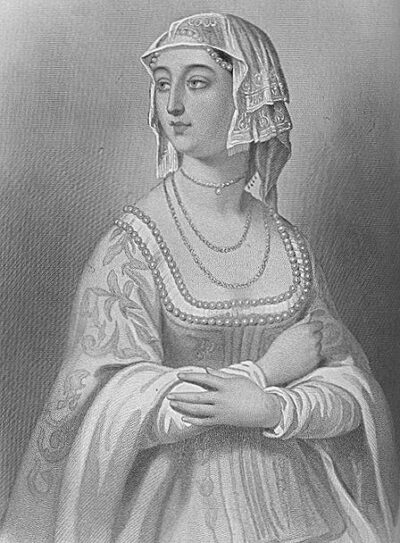
Margaret of Anjou
Margaret of Anjou was the 15th-century English royal consort. Born March 23, 1430, in Pont-à-Mousson. Died August 25, 1482, in Souzay-Champigny.
Facts
22 facts · 2 confirmed by two sources · 5 cited · 15 from one source
Where this comes from
Papalocal keeps its own record. It started from these sources; what each one said is kept here as it was copied, so a change on their side never changes this page by itself. Tap one to read its version.
What Wikidata says · copied November 16, 2026 · revision 2567395197
- Described as
- 15th-century English royal consort (1430-1482)
- Other names
- Margaret, Queen consort of England, La petite créature, Queen Margaret of England
- Born
- March 23, 1430 · 3 references
- Died
- August 25, 1482 · 2 references
- Born in
- Pont-à-Mousson · 2 references
- Died in
- Souzay-Champigny
- Buried in
- Angers Cathedral · 1 reference
- Citizen of
- Kingdom of France · 1 reference
- Occupation
- politician · 1 reference; aristocrat · 1 reference; consort
- Spouse
- Henry VI of England (1445–1471) · 4 references
- Children
- Edward of Westminster · 2 references
- Father
- René of Anjou · 3 references
- Mother
- Isabella, Duchess of Lorraine · 2 references
- Siblings
- Yolande of Anjou · 1 reference; Isabel of Anjou · 1 reference; Ann of Anjou · 1 reference; John II, Duke of Lorraine · 1 reference; Louis of Anjou, Marquis of Pont-à-Mousson · 1 reference; Nicolas of Anjou · 1 reference; Charles of Anjou · 1 reference; René of Anjou · 1 reference
- Religion
- Catholicism · 1 reference
- Wikipedias with a page
- 53
Wikidata item Q231145 (wikidata.org/wiki/Q231145), public domain (CC0). Copied November 16, 2026.
What Wikipedia says · copied November 16, 2026 · revision 1375695951
Margaret of Anjou (French: Marguerite; 23 March 1430 – 25 August 1482) was Queen of England by marriage to King Henry VI from 1445 to 1461 and again from 1470 to 1471. Through marriage, she was also nominally Queen of France from 1445 to 1453. Born in the Duchy of Lorraine into the House of Valois-Anjou, Margaret was the second eldest daughter of René of Anjou, King of Naples, and Isabella, Duchess of Lorraine.
Margaret was one of the principal figures in the series of dynastic civil wars known as the Wars of the Roses and at times personally led the Lancastrian faction. Some of her contemporaries, such as John de la Pole, 2nd Duke of Suffolk, praised "her valiant courage and undaunted spirit", and the 16th-century historian Edward Hall described her personality in these terms: "This woman excelled all other, as well in beauty and favour, as in wit and policy, and was of stomach and courage, more like to a man, than a woman".
Owing to her husband's frequent bouts of insanity, Margaret ruled the kingdom in his place. It was she who called for a Great Council in May 1455 that excluded the Yorkist faction headed by Richard of York, 3rd Duke of York. This provided the spark that ignited a civil conflict that lasted for more than 30 years, decimated the old nobility of England, and caused the deaths of thousands of men, including her only son, Edward of Westminster, Prince of Wales, at the Battle of Tewkesbury in 1471.
Margaret was taken prisoner by the victorious Yorkists after the Lancastrian defeat at Tewkesbury. In 1475, she was ransomed by her cousin, King Louis XI of France. She went to live in France as a poor relation of the French king, and she died there at the age of 52.
- Born, in its opening lines
- March 23, 1430
- Died, in its opening lines
- August 25, 1482
From the Wikipedia article “Margaret of Anjou” (en.wikipedia.org/wiki/Margaret_of_Anjou), by its contributors, under CC BY-SA 4.0 (creativecommons.org/licenses/by-sa/4.0/). Copied November 16, 2026; not changed.
Confirmed Two sources agree. Cited One source, and it names where it got it. One source One source, without a reference of its own. Sources disagree The sources disagree. We show the best-supported value and keep theirs below.
