
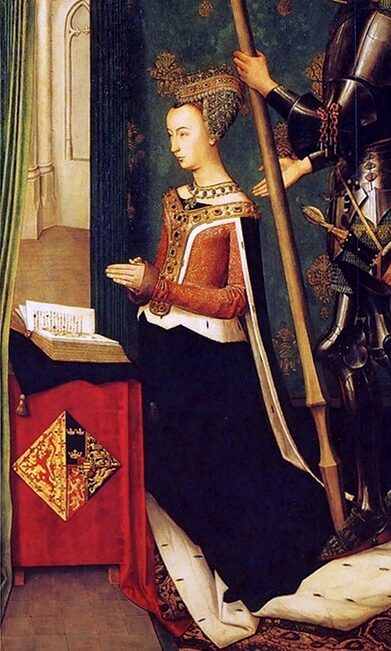
Margaret of Denmark, Queen of Scotland
Margaret of Denmark, Queen of Scotland was a queen consort of Scotland. Born June 23, 1456, in Copenhagen. Died July 14, 1486, in Stirling Castle.
Facts
17 facts · 2 confirmed by two sources · 4 cited · 11 from one source
Where this comes from
Papalocal keeps its own record. It started from these sources; what each one said is kept here as it was copied, so a change on their side never changes this page by itself. Tap one to read its version.
What Wikidata says · copied November 16, 2026 · revision 2567830546
- Described as
- queen consort of Scotland (1456–1486)
- Other names
- Margaret of Norway, Margaret of Denmark
- Born
- June 23, 1456
- Died
- July 14, 1486 · 1 reference
- Born in
- Copenhagen
- Died in
- Stirling Castle
- Buried in
- Cambuskenneth Abbey
- Citizen of
- Kingdom of Denmark
- Occupation
- aristocrat
- Spouse
- James III of Scotland (1469–1486) · 2 references
- Children
- James IV of Scotland · 1 reference; James Stewart, Duke of Ross · 2 references; John Stewart, Earl of Mar · 2 references
- Father
- Christian I of Denmark
- Mother
- Dorothea of Brandenburg
- Siblings
- Olaf of Denmark; Canute of Denmark; John, King of Denmark; Frederick I of Denmark
- Wikipedias with a page
- 34
Wikidata item Q233804 (wikidata.org/wiki/Q233804), public domain (CC0). Copied November 16, 2026.
What Wikipedia says · copied November 16, 2026 · revision 1382525393
Margaret of Denmark (Margrete in Danish; 23 June 1456 – 14 July 1486) was Queen of Scots from 1469 to 1486 by marriage to King James III. She was the daughter of Christian I, King of Denmark, Norway and Sweden, and Dorothea of Brandenburg.
- Born, in its opening lines
- June 23, 1456
- Died, in its opening lines
- July 14, 1486
From the Wikipedia article “Margaret of Denmark, Queen of Scotland” (en.wikipedia.org/wiki/Margaret_of_Denmark,_Queen_of_Scotland), by its contributors, under CC BY-SA 4.0 (creativecommons.org/licenses/by-sa/4.0/). Copied November 16, 2026; not changed.
Confirmed Two sources agree. Cited One source, and it names where it got it. One source One source, without a reference of its own. Sources disagree The sources disagree. We show the best-supported value and keep theirs below.
