
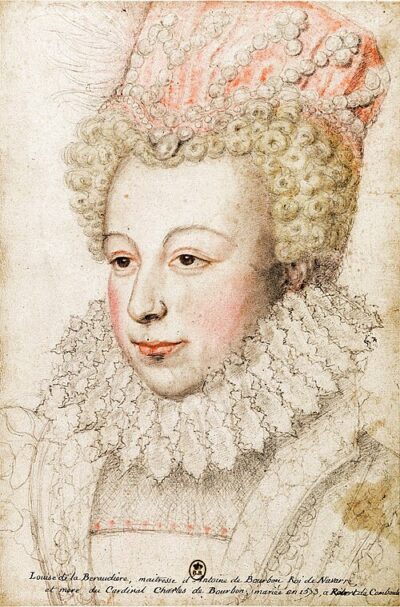
Margaret of Valois
Margaret of Valois was a Queen of France and Navarre until 1599 (1553-1615).. Born May 14, 1553, in Saint-Germain-en-Laye. Died March 27, 1615, in Paris. Positions held include royal consort and Queen Consort of France.
Facts
26 facts · 2 confirmed by two sources · 8 cited · 16 from one source
Where this comes from
Papalocal keeps its own record. It started from these sources; what each one said is kept here as it was copied, so a change on their side never changes this page by itself. Tap one to read its version.
What Wikidata says · copied November 16, 2026 · revision 2558152242
- Described as
- Queen of France and Navarre until 1599 (1553-1615).
- Other names
- Marguerite d'Angoulême, Marguerite of Valois, Marguerite of Navarre, Queen Margot, Marguerite de Valois
- Born
- May 14, 1553 · 3 references
- Died
- March 27, 1615 · 10 references
- Born in
- Saint-Germain-en-Laye
- Died in
- Paris
- Buried in
- Basilica of Saint-Denis
- Cause of death
- pneumonia
- Name at birth
- Marguerite de Valois
- Citizen of
- France · 1 reference
- Occupation
- salonnière; writer · 1 reference
- Positions held
- royal consort; Queen Consort of France
- Spouse
- Henry IV of France (1572–1599) · 5 references
- Father
- Henry II of France · 3 references
- Mother
- Catherine de' Medici · 3 references
- Siblings
- Joan of Valois; Victoria of Valois; Diane de France, Duchess of Angoulême; Elisabeth of Valois · 1 reference; Claude of Valois; Louis of Valois; Francis II of France · 1 reference; Charles IX of France · 1 reference; Henri d'Angoulême; Francis, Duke of Anjou
- Religion
- Catholicism · 1 reference
- Wikipedias with a page
- 69
Wikidata item Q220845 (wikidata.org/wiki/Q220845), public domain (CC0). Copied November 16, 2026.
What Wikipedia says · copied November 16, 2026 · revision 1378382860
Margaret of Valois (French: Marguerite de Valois; 14 May 1553 – 27 March 1615), popularly known as Queen Margot (La Reine Margot, [la ʁɛn maʁɡo]), was Queen of Navarre from 1572 to 1599 and Queen of France from 1589 to 1599 as the consort of Henry IV of France and III of Navarre.
Margaret was the daughter of King Henry II of France and Catherine de' Medici and the sister of Kings Francis II, Charles IX and Henry III. Her union with Henry of Navarre, intended to contribute to the reconciliation of Catholics and Huguenots in France, was tarnished six days after the marriage ceremony by the St. Bartholomew's Day massacre and the resumption of the French Wars of Religion. In the conflict between Henry III of France and the Malcontents, she took the side of Francis, Duke of Anjou, her younger brother, which caused Henry to have a deep aversion to her.
As Queen of Navarre, Margaret also played a pacifying role in the stormy relations between her husband and the French monarchy. Shuttling back and forth between both courts, she endeavoured to lead a happy conjugal life, but her infertility and the political tensions inherent in the civil conflict led to the end of her marriage. Mistreated by her brother Henry, who was quick to take offence, and rejected by her husband, she chose the path of opposition in 1585. She took the side of the Catholic League and was thus exiled to Auvergne, which lasted for 20 years. In 1599, she consented to a "royal divorce", the annulment of the marriage, but only after the payment of a generous compensation.
A well-known woman of letters, considered both enlightened and a generous patron, Margaret played a considerable part in the cultural life of the court, especially after her return from exile in 1605. She preached the supremacy of platonic love over physical love. During her imprisonment, she took advantage of the time to write her Memoirs, the first woman to have done so. One of the most fashionable women of her time, her dress influenced many of Europe's royal courts.
After Margaret's death, the anecdotes and slanders circulated about her created a legend which consolidated around the nickname La Reine Margot, invented by Alexandre Dumas père. These fictional elements of nymphomania and incest created a mythical image of a woman which persisted through the centuries to the modern day. In the late 20th and the early 21st centuries, revisionist historians have reviewed the extensive chronicles of her life and concluded that some elements of her scandalous reputation stemmed from anti-Valois propaganda and a factionalism that denigrated the participation of women in politics and was created by Bourbon dynasty court historians in the 17th century.
- Born, in its opening lines
- May 14, 1553
- Died, in its opening lines
- March 27, 1615
From the Wikipedia article “Margaret of Valois” (en.wikipedia.org/wiki/Margaret_of_Valois), by its contributors, under CC BY-SA 4.0 (creativecommons.org/licenses/by-sa/4.0/). Copied November 16, 2026; not changed.
Confirmed Two sources agree. Cited One source, and it names where it got it. One source One source, without a reference of its own. Sources disagree The sources disagree. We show the best-supported value and keep theirs below.
