
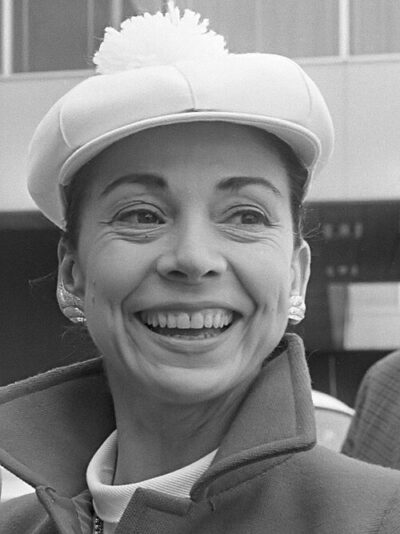
Margot Fonteyn
Margot Fonteyn was a British ballerina. Born May 18, 1919, in Reigate. Died February 21, 1991, in Panama City. Positions held include Chancellor of Durham University (1982–1991). Educated at Royal Ballet School. Awards include Dame Commander of the Order of the British Empire, Benjamin Franklin Medal and Pro Finlandia Medal of the Order of the Lion of Finland.
Facts
21 facts · 2 confirmed by two sources · 6 cited · 13 from one source
Where this comes from
Papalocal keeps its own record. It started from these sources; what each one said is kept here as it was copied, so a change on their side never changes this page by itself. Tap one to read its version.
What Wikidata says · copied November 16, 2026 · revision 2563460504
- Described as
- British ballerina
- Other names
- Peggi Hookham, Margot Fonteyn de Arias, Margot, Dame Fonteyn de Arias, Margot Fontes, Dame Margot Fonteyn, Margaret Evelyn Hookham, Margot Arias, Margot Fonteyn-Arias, Peggy Hookham, Dame Margot Fonteyn de Arias
- Born
- May 18, 1919 · 11 references
- Died
- February 21, 1991 · 10 references
- Born in
- Reigate
- Died in
- Panama City · 1 reference
- Cause of death
- ovarian cancer
- Name at birth
- Margaret Evelyn Hookham
- Citizen of
- United Kingdom of Great Britain and Ireland (–1927); United Kingdom
- Occupation
- dancer · 1 reference; choreographer; ballet dancer · 1 reference; fashion designer · 1 reference
- Positions held
- Chancellor of Durham University (1982–1991)
- Worked for
- American Airlines; The Royal Ballet
- Education
- Royal Ballet School
- Awards
- Dame Commander of the Order of the British Empire (1951) · 1 reference; Benjamin Franklin Medal (1974); Pro Finlandia Medal of the Order of the Lion of Finland (1960) · 1 reference
- Field
- ballet · 1 reference
- Spouse
- Roberto Arias
- Wikipedias with a page
- 68
Wikidata item Q231776 (wikidata.org/wiki/Q231776), public domain (CC0). Copied November 16, 2026.
What Wikipedia says · copied November 16, 2026 · revision 1380082327
Dame Margaret Evelyn de Arias DBE (née Hookham; 18 May 1919 – 21 February 1991), known by the stage name Margot Fonteyn (), was an English ballerina. She spent her entire career as a dancer with the Sadler's Wells Ballet Company, now known as the Royal Ballet, eventually being appointed prima ballerina assoluta of the company by Queen Elizabeth II.
Beginning ballet lessons at the age of four, she studied in England and China, where her father was transferred for his work. Her training in Shanghai was with Russian expatriate dancer Georgy Goncharov, contributing to her continuing interest in Russian ballet. Returning to London at the age of 14, she was invited to join the Vic-Wells Ballet School by Ninette de Valois. She succeeded Alicia Markova as prima ballerina of the company in 1935. The Vic-Wells choreographer, Sir Frederick Ashton, wrote numerous parts for Fonteyn and her partner, Robert Helpmann, with whom she danced from the 1930s to the 1940s.
In 1946, the company, now renamed the Sadler's Wells Ballet, moved into the Royal Opera House at Covent Garden where Fonteyn's most frequent partner throughout the next decade was Michael Somes. Her performance in The Sleeping Beauty became a distinguishing role for both Fonteyn and the company, but she was also well known for the ballets created by Ashton, including Symphonic Variations, Cinderella, Daphnis and Chloe, Ondine and Sylvia.
In 1949, she led the company in a tour of the United States and became an international celebrity. Before and after the Second World War, Fonteyn performed in televised broadcasts of ballet performances in Britain and in the early 1950s appeared on The Ed Sullivan Show, consequently increasing the popularity of dance in the United States.
In 1955, she married the Panamanian politician Roberto Arias and appeared in a live colour production of The Sleeping Beauty aired on NBC. Three years later, she and Somes danced for the BBC television adaptation of Tchaikovsky'sThe Nutcracker. Thanks to her international acclaim and many guest artist requests, the Royal Ballet allowed Fonteyn to become a freelance dancer in 1959.
In 1961, when Fonteyn was considering retirement, Rudolf Nureyev defected from the Kirov Ballet while dancing in Paris. Fonteyn, though reluctant to partner with him because of their 19-year age difference, danced with him in his début with the Royal Ballet in Giselle on 21 February 1962. The duo immediately became an international sensation, each dancer pushing the other to their best performances. They were most noted for their classical performances in works such as Le Corsaire Pas de Deux, Les Sylphides, La Bayadère, Swan Lake, and Raymonda, in which Nureyev sometimes adapted choreographies specifically to showcase their talents. The pair premièred Ashton's Marguerite and Armand, which had been choreographed specifically for them, and were noted for their performance in the title roles of Sir Kenneth MacMillan's Romeo and Juliet.
In 1964 Fonteyn's husband was shot during an assassination attempt and became a quadriplegic, requiring constant care for the remainder of his life. In 1972, Fonteyn went into semi-retirement, although she continued to dance periodically until the end of the decade. In 1979, she was fêted by the Royal Ballet and officially pronounced the prima ballerina assoluta of the company. She retired to Panama, where she spent her time writing books, raising cattle, and caring for her husband. She died from ovarian cancer exactly 29 years after her premiere with Nureyev in Giselle.
- Born, in its opening lines
- May 18, 1919
- Died, in its opening lines
- February 21, 1991
From the Wikipedia article “Margot Fonteyn” (en.wikipedia.org/wiki/Margot_Fonteyn), by its contributors, under CC BY-SA 4.0 (creativecommons.org/licenses/by-sa/4.0/). Copied November 16, 2026; not changed.
Confirmed Two sources agree. Cited One source, and it names where it got it. One source One source, without a reference of its own. Sources disagree The sources disagree. We show the best-supported value and keep theirs below.
