
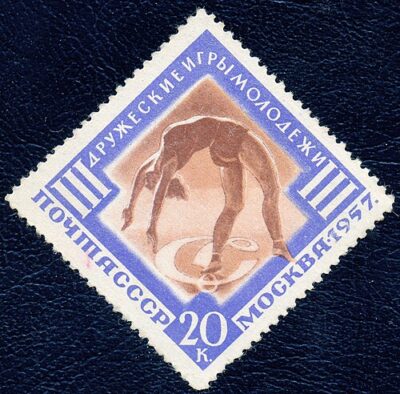
Maria Gorokhovskaya
Maria Gorokhovskaya was a Soviet-Israeli artistic gymnast. Born October 17, 1921, in Yevpatoriya. Died July 22, 2001, in Tel Aviv. Awards include Order of the Red Banner of Labour, Honoured Master of Sports of the USSR and International Gymnastics Hall of Fame.
Facts
12 facts · 2 confirmed by two sources · 2 cited · 8 from one source
Where this comes from
Papalocal keeps its own record. It started from these sources; what each one said is kept here as it was copied, so a change on their side never changes this page by itself. Tap one to read its version.
What Wikidata says · copied November 17, 2026 · revision 2530114251
- Described as
- Soviet-Israeli artistic gymnast (1921–2001)
- Other names
- Maria Kondratyevna Gorokhovskaya, Гороховская, Мария Кондратьевна, מריה גורוחובסקי
- Born
- October 17, 1921 · 1 reference
- Died
- July 22, 2001 · 1 reference
- Born in
- Yevpatoriya · 1 reference
- Died in
- Tel Aviv
- Citizen of
- Soviet Union; Israel
- Occupation
- artistic gymnast
- Sport
- artistic gymnastics
- Awards
- Order of the Red Banner of Labour; Honoured Master of Sports of the USSR; International Gymnastics Hall of Fame (2021) · 1 reference; International Jewish Sports Hall of Fame (1991) · 1 reference
- Wikipedias with a page
- 25
Wikidata item Q265749 (wikidata.org/wiki/Q265749), public domain (CC0). Copied November 17, 2026.
What Wikipedia says · copied November 17, 2026 · revision 1373555996
Maria Kondratyevna Gorokhovskaya (Russian: Мария Кондратьевна Гороховская, Ukrainian: Марія Кіндратівна Гороховська; 17 October 1921 – 22 July 2001) was a Soviet gymnast of Jewish descent. At the 1952 Summer Olympics, she was the first woman to win seven medals at one Olympics. That is the highest number of medals won by a woman in a single Olympics, which is an achievement shared by only one other female athlete, the Australian swimmer Emma McKeon, who achieved that at the 2020 Summer Olympics held in 2021.
Competing for Budivelnyk Kharkov, Gorokhovskaya won her first USSR title on the balance beam in 1948. She came to the Helsinki Olympics as the twofold national champion. Soviet gymnastics had never competed at major international tournaments before, and it was the first Olympics in which the country participated.
The Soviet gymnasts dominated the competition, with Gorokhovskaya leading them. In all four individual apparatus events – the balance beam, floor exercise, the vault and the uneven bars – Gorokhovskaya finished second. This performance earned her the gold medal in the all-around competition, finishing ahead of team-mate Nina Bocharova by eight tenths of a point.
With seven of the eight Soviet gymnasts finishing in the top ten, it was clear that the team gold medal would go to them. Gorokhovskaya won her seventh medal in the now discontinued team exercise with portable apparatus, where the Soviet team finished second behind Sweden.
Gorokhovskaya made one more international appearance as a part of the winning Soviet team at the 1954 World Championships, and retired afterwards. She then worked as a judge (international since 1964) and a lecturer.
In 1990, Gorokhovskaya, who was Jewish, emigrated to Israel, where she worked as a gymnastics coach until her death. In 1991 she was inducted into the International Jewish Sports Hall of Fame.
- Born, in its opening lines
- October 17, 1921
- Died, in its opening lines
- July 22, 2001
From the Wikipedia article “Maria Gorokhovskaya” (en.wikipedia.org/wiki/Maria_Gorokhovskaya), by its contributors, under CC BY-SA 4.0 (creativecommons.org/licenses/by-sa/4.0/). Copied November 17, 2026; not changed.
Confirmed Two sources agree. Cited One source, and it names where it got it. One source One source, without a reference of its own. Sources disagree The sources disagree. We show the best-supported value and keep theirs below.
