
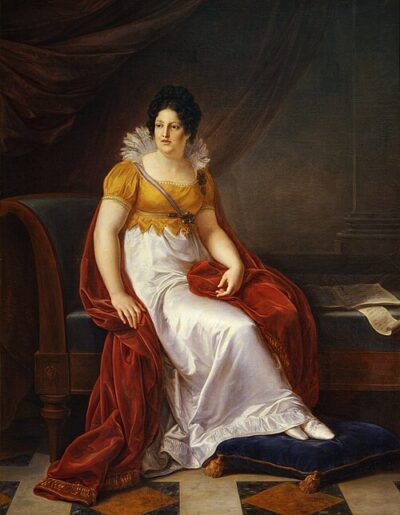
Maria Luisa I, Duchess of Lucca
Maria Luisa I, Duchess of Lucca was a Spanish Royal. Born July 6, 1782, in Real Sitio de San Ildefonso. Died March 13, 1824, in Rome. Positions held include regent and Member of the Board of Ladies of Honour and Merit (1793–). Awards include Order of the Starry Cross and Order of Queen Maria Luisa.
Facts
24 facts · 2 confirmed by two sources · 3 cited · 19 from one source
Where this comes from
Papalocal keeps its own record. It started from these sources; what each one said is kept here as it was copied, so a change on their side never changes this page by itself. Tap one to read its version.
What Wikidata says · copied November 17, 2026 · revision 2567266829
- Described as
- Spanish Royal
- Other names
- Infanta Maria Luisa of Spain, Maria Luisa of Spain
- Born
- July 6, 1782 · 3 references
- Died
- March 13, 1824 · 3 references
- Born in
- Real Sitio de San Ildefonso
- Died in
- Rome · 1 reference
- Buried in
- Pantheon of the Infantes of the Royal Monastery of San Lorenzo de El Escorial
- Cause of death
- cancer
- Citizen of
- Spain
- Occupation
- regent
- Positions held
- regent; Member of the Board of Ladies of Honour and Merit (1793–)
- Awards
- Order of the Starry Cross; Order of Queen Maria Luisa
- Spouse
- Louis of Parma, king of Etruria (1795–) · 1 reference
- Children
- Charles II, Duke of Parma; Princess Maria Luisa Carlota of Parma
- Father
- Charles IV of Spain · 1 reference
- Mother
- Maria Luisa of Parma · 1 reference
- Siblings
- Infanta María Amalia of Spain; Maria Isabella of Spain; Carlota Joaquina of Spain; Ferdinand VII of Spain; Carlos de Borbón y Borbón-Parma; Infante Francisco de Paula of Spain; Maria Christina of the Two Sicilies
- Wikipedias with a page
- 27
Wikidata item Q233587 (wikidata.org/wiki/Q233587), public domain (CC0). Copied November 17, 2026.
What Wikipedia says · copied November 17, 2026 · revision 1386050536
Maria Luisa of Spain (Spanish pronunciation: [maˈɾi.a ˈlwisa], 6 July 1782 – 13 March 1824) was a Spanish infanta, daughter of King Charles IV and Maria Luisa of Parma. In 1795, she married her first cousin Louis of Bourbon-Parma, heir apparent to the Duchy of Parma. She spent the first years of her married life at the Spanish court where their first child, Charles Louis, was born.
In 1801, the Treaty of Aranjuez made her husband King of Etruria, a kingdom created from the former Grand Duchy of Tuscany in exchange for the renunciation of the Duchy of Parma. They arrived in Florence, the capital of the new kingdom, in August 1801. During a brief visit to Spain in 1802, Maria Luisa gave birth to her second child. Her husband's reign in Etruria was marred by his ill health. He died in 1803 at the age of 30, following an epileptic crisis. Maria Luisa acted as regent for their son. During her government in Florence, she tried to gain the support of her subjects, but her administration of Etruria was cut short by Napoleon Bonaparte, who forced her to leave with her children in December 1807. As part of the Treaty of Fontainebleau, Napoleon incorporated Etruria to his domains.
After a futile interview with Napoleon in Milan, Maria Luisa looked for refuge in exile with her family in Spain. The Spanish court was deeply divided and a month after her arrival the country was thrown into unrest when a popular uprising, known as the Mutiny of Aranjuez, forced Maria Luisa's father to abdicate in favor of her brother Ferdinand VII. Napoleon invited father and son to Bayonne, France, with the excuse of acting as a mediator, but gave the kingdom to his brother Joseph. Napoleon called the remaining members of the Spanish royal family to France and at their departure on 2 May 1808, the citizens of Madrid rose up against the French occupation. In France, Maria Luisa was reunited in exile with her parents. She was the only member of the Spanish royal family to oppose Napoleon directly. After her secret plan to escape was discovered, Maria Luisa was separated from her son and placed with her daughter as prisoners in a Roman convent.
Maria Luisa, mostly known as the Queen of Etruria during her lifetime, regained her freedom in 1814 at the fall of Napoleon. In the following years, she continued to live in Rome, hoping to recover her father-in-law's former domains. To put forward her case, she wrote a book of memoirs, but was disappointed when the Congress of Vienna (1814–15) compensated her not with Parma, but with the smaller Duchy of Lucca, which had been created specifically for her family in place of the ancient Republic of Lucca. As a consolation, she was allowed to retain the honours of a queen. Initially stubbornly opposed to accepting this accord, Maria Luisa only took the government of Lucca in December 1817, after her family had been granted the right of reversion to the Duchy of Parma upon the death of the incumbent Duchess, the former Empress of the French, Marie Louise of Austria.
As the reigning duchess of Lucca, she disregarded the constitution imposed by the Congress of Vienna. While spending time in her palace in Rome, she died of cancer at the age of 41.
- Born, in its opening lines
- July 6, 1782
- Died, in its opening lines
- March 13, 1824
From the Wikipedia article “Maria Luisa, Duchess of Lucca” (en.wikipedia.org/wiki/Maria_Luisa,_Duchess_of_Lucca), by its contributors, under CC BY-SA 4.0 (creativecommons.org/licenses/by-sa/4.0/). Copied November 17, 2026; not changed.
Confirmed Two sources agree. Cited One source, and it names where it got it. One source One source, without a reference of its own. Sources disagree The sources disagree. We show the best-supported value and keep theirs below.
