
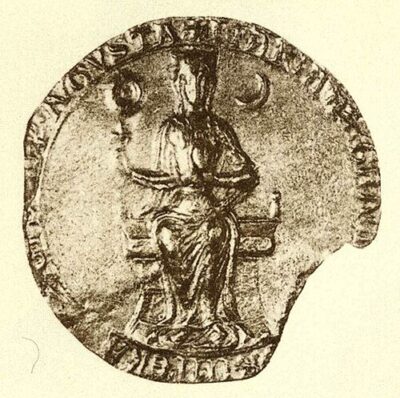
Maria of Brabant
Maria of Brabant was a Holy Roman Empress and German Queen. Born 1190, in Leuven. Died June 14, 1260, in Leuven.
Facts
17 facts · 0 confirmed by two sources · 6 cited · 10 from one source · 1 where the sources disagree
What’s different
- Born: we show 1190 (Sources disagree). Wikidata also lists 1195
Where this comes from
Papalocal keeps its own record. It started from these sources; what each one said is kept here as it was copied, so a change on their side never changes this page by itself. Tap one to read its version.
What Wikidata says · copied November 18, 2026 · revision 2564040723
- Described as
- Holy Roman Empress and German Queen
- Other names
- Maria van Brabant
- Born
- 1190 · 1 reference; 1195 · 1 reference
- Died
- June 14, 1260 · 2 references
- Born in
- Leuven
- Died in
- Leuven
- Buried in
- St. Peter's Church, Leuven · 1 reference
- Citizen of
- Germany
- Occupation
- consort
- Spouse
- Otto IV, Holy Roman Emperor (1214–1218) · 2 references; William I, Count of Holland (1220–1222) · 1 reference
- Father
- Henry the Courageous · 2 references
- Mother
- Matilda of Flanders · 2 references
- Siblings
- Margaretha of Brabant; Matilda of Brabant · 1 reference; Élisabeth de Brabant; Adelaide of Brabant; Godfrey, Lord of Gaesbeek; Henry II · 1 reference
- Wikipedias with a page
- 24
Wikidata item Q224685 (wikidata.org/wiki/Q224685), public domain (CC0). Copied November 18, 2026.
What Wikipedia says · copied November 18, 2026 · revision 1376451155
Maria of Brabant (c. 1190 – May/June 1260), a member of the House of Reginar, was Holy Roman Empress from 1214 until 1215 as the second and last wife of the Welf emperor Otto IV.
From the Wikipedia article “Maria of Brabant, Holy Roman Empress” (en.wikipedia.org/wiki/Maria_of_Brabant,_Holy_Roman_Empress), by its contributors, under CC BY-SA 4.0 (creativecommons.org/licenses/by-sa/4.0/). Copied November 18, 2026; not changed.
Confirmed Two sources agree. Cited One source, and it names where it got it. One source One source, without a reference of its own. Sources disagree The sources disagree. We show the best-supported value and keep theirs below.
