
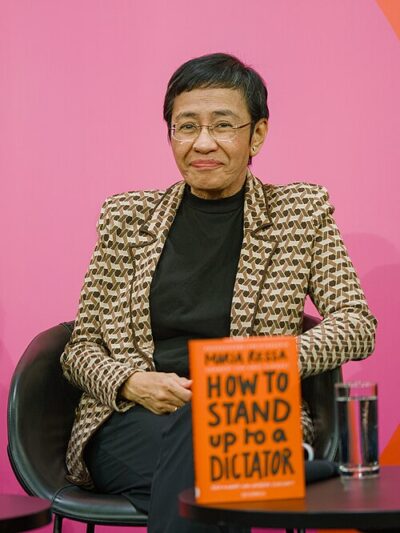
Maria Ressa
Maria Ressa is a Filipino journalist. Born October 2, 1963, in Manila. Educated at Princeton University and University of the Philippines Diliman. Awards include World Association of Newspapers' Golden Pen of Freedom Award, BBC 100 Women and Fulbright Scholarship.
Facts
25 facts · 1 confirmed by two sources · 17 cited · 7 from one source
Where this comes from
Papalocal keeps its own record. It started from these sources; what each one said is kept here as it was copied, so a change on their side never changes this page by itself. Tap one to read its version.
What Wikidata says · copied November 13, 2026 · revision 2568394351
- Described as
- Filipino journalist
- Other names
- Maria Angelita Aycardo Ressa, Maria Angelita Ressa, Maria A. Ressa
- Born
- October 2, 1963 · 1 reference
- Born in
- Manila · 2 references
- Name at birth
- María Angelita Delfín Aycardo
- Citizen of
- Philippines; United States · 1 reference
- Occupation
- journalist · 1 reference; editing staff · 1 reference; university teacher · 1 reference
- Worked for
- Rappler · 1 reference
- Education
- Princeton University; University of the Philippines Diliman; Toms River High School North · 1 reference; St. Scholastica's College
- Member of
- International Consortium of Investigative Journalists · 1 reference
- Awards
- World Association of Newspapers' Golden Pen of Freedom Award (2018) · 1 reference; BBC 100 Women (2019) · 1 reference; Fulbright Scholarship · 1 reference; Four Freedoms Award – Freedom of Speech; Nobel Peace Prize (2021) · 1 reference; UNESCO/Guillermo Cano World Press Freedom Prize (2021) · 1 reference; Kurt Tucholsky Prize (2020) · 1 reference; Asia's Most Influential Philippines (2022) · 1 reference; Free Press Unlimited Most Resilient Journalist Award (2020) · 1 reference
- Field
- journalism · 1 reference; investigative journalism · 1 reference
- Wikipedias with a page
- 77
Wikidata item Q6761526 (wikidata.org/wiki/Q6761526), public domain (CC0). Copied November 13, 2026.
What Wikipedia says · copied November 13, 2026 · revision 1384998736
Maria Angelita Ressa (Tagalog pronunciation: [ˈɾesa]; born Maria Angelita Delfin Aycardo; born October 2, 1963) is a Filipino and American journalist and Nobel Peace Prize laureate. She is the co-founder and CEO of Rappler. She previously spent nearly two decades working as a lead investigative reporter in Southeast Asia for CNN. She has been a distinguished fellow at Columbia University's new Institute of Global Politics since 2023 and a professor of professional practice in Columbia's School of International and Public Affairs since July 2024.
Ressa was born in Manila and raised in Toms River, New Jersey. She was included in Time's Person of the Year 2018 issue featuring a collection of journalists from around the world actively combatting fake news. On February 13, 2019, she was arrested by Philippine authorities for cyberlibel due to accusations that Rappler published a false news story concerning businessman Wilfredo Keng. On June 15, 2020, a court in Manila found her guilty of cyberlibel under the controversial Anti-Cybercrime law, a move condemned by human rights groups and journalists as an attack on press freedom. As a prominent critic of the then Philippine president Rodrigo Duterte, her arrest and conviction were seen by many in the opposition and the international community as a politically motivated act. Ressa is one of the 25 leading figures on the Information and Democracy Commission launched by Reporters Without Borders. She was awarded the 2021 Nobel Peace Prize jointly with Dmitry Muratov for "their efforts to safeguard freedom of expression, which is a precondition for democracy and lasting peace."
- Born, in its opening lines
- October 2, 1963
From the Wikipedia article “Maria Ressa” (en.wikipedia.org/wiki/Maria_Ressa), by its contributors, under CC BY-SA 4.0 (creativecommons.org/licenses/by-sa/4.0/). Copied November 13, 2026; not changed.
Confirmed Two sources agree. Cited One source, and it names where it got it. One source One source, without a reference of its own. Sources disagree The sources disagree. We show the best-supported value and keep theirs below.
