
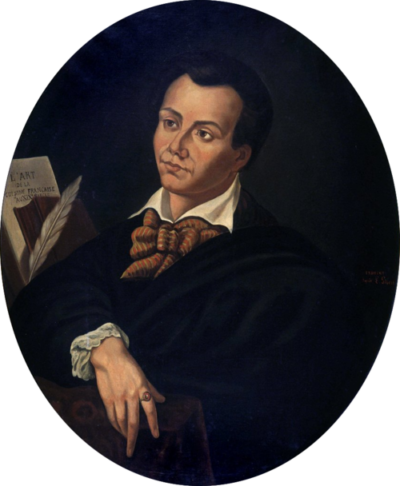
Marie-Antoine Carême was a French chef. Born June 8, 1783, in Paris. Died January 12, 1833, in rue Saint-Roch.
Facts
19 facts · 2 confirmed by two sources · 14 cited · 3 from one source
What’s different
- Born: we show June 8, 1783 (Confirmed). Wikidata also lists June 8, 1784
Where this comes from
Papalocal keeps its own record. It started from these sources; what each one said is kept here as it was copied, so a change on their side never changes this page by itself. Tap one to read its version.
What Wikidata says · copied November 16, 2026 · revision 2562170885
- Described as
- French chef
- Born
- June 8, 1784 · 1 reference; June 8, 1783 · 3 references
- Died
- January 12, 1833 · 2 references
- Born in
- Paris · 1 reference
- Died in
- rue Saint-Roch · 1 reference
- Buried in
- Montmartre Cemetery · 1 reference
- Citizen of
- France · 1 reference
- Occupation
- chef · 1 reference; culinary writer; draftsperson · 1 reference; illustrator · 1 reference; printmaker · 1 reference; pastry chef; confectioner · 1 reference; designer · 1 reference
- Field
- gastronomy · 1 reference; cooking · 1 reference; confectionery · 1 reference; visual arts · 1 reference; architecture
- Wikipedias with a page
- 42
Wikidata item Q355751 (wikidata.org/wiki/Q355751), public domain (CC0). Copied November 16, 2026.
What Wikipedia says · copied November 16, 2026 · revision 1370503794
Marie-Antoine Carême (French: [maʁi ɑ̃twan kaʁɛːm]; 8 June 1783 or 1784 – 12 January 1833), also known as Antonin Carême, was a French chef and author who specialised in grande cuisine for the elite society.
Carême was born in Paris to a poor family and, when still a child, worked in a cheap restaurant. Later he became an apprentice to a leading Parisian pâtissier and quickly became known for his patisserie skills. He was deeply interested in architecture and was famous for his large pièces montées – table decorations sculpted in sugar, depicting classical buildings.
Working with leading chefs of the day, Carême extended his knowledge to cover all aspects of cooking, and became head chef to prominent people including Charles Maurice de Talleyrand-Périgord, Tsar Alexander I of Russia and the Prince Regent in Britain. He codified and to some extent simplified classical French cookery, insisted on the finest and most expensive ingredients, and was regarded as the foremost chef of his day.
Carême wrote a series of books, lavishly illustrated, intended to pass his skills on to other chefs providing grande cuisine for the elite of French, and other, society. His influence continued after his death; his approach was continued by Jules Gouffé, Urbain Dubois and Émile Bernard, reinvigorated by Auguste Escoffier and continued until it was overtaken by nouvelle cuisine in the second half of the 20th century.
- Born, in its opening lines
- June 8, 1783
- Died, in its opening lines
- January 12, 1833
From the Wikipedia article “Marie-Antoine Carême” (en.wikipedia.org/wiki/Marie-Antoine_Carême), by its contributors, under CC BY-SA 4.0 (creativecommons.org/licenses/by-sa/4.0/). Copied November 16, 2026; not changed.
Confirmed Two sources agree. Cited One source, and it names where it got it. One source One source, without a reference of its own. Sources disagree The sources disagree. We show the best-supported value and keep theirs below.
