
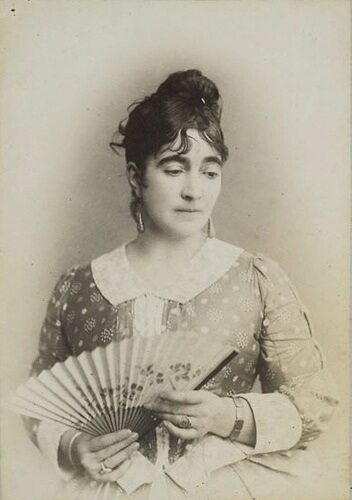
Marie Bracquemond
Marie Bracquemond was a French painter. Born December 1, 1840, in Landunvez. Died January 17, 1916, in Sèvres. Known for The Lady in White and Three Women with Parasols.
Facts
19 facts · 2 confirmed by two sources · 7 cited · 10 from one source
Where this comes from
Papalocal keeps its own record. It started from these sources; what each one said is kept here as it was copied, so a change on their side never changes this page by itself. Tap one to read its version.
What Wikidata says · copied November 16, 2026 · revision 2568984411
- Described as
- French painter (1840–1916)
- Other names
- Marie Quivoron-Pasquiou, Mme Bracquemond
- Born
- December 1, 1840 · 3 references
- Died
- January 17, 1916 · 2 references
- Born in
- Landunvez
- Died in
- Sèvres · 1 reference
- Buried in
- Cimetière des Bruyères
- Name at birth
- Marie Anne Caroline Quivoron · 1 reference
- Citizen of
- France · 1 reference
- Occupation
- painter · 1 reference; porcelain painter · 1 reference; printmaker · 1 reference; ceramicist
- Genre
- portrait
- Known for
- The Lady in White; Three Women with Parasols
- Field
- painting · 1 reference; printmaking; ceramic art
- Spouse
- Félix Bracquemond (1869–)
- Children
- Pierre Bracquemond · 1 reference
- Wikipedias with a page
- 29
Wikidata item Q273552 (wikidata.org/wiki/Q273552), public domain (CC0). Copied November 16, 2026.
What Wikipedia says · copied November 16, 2026 · revision 1383147512
Marie Anne Caroline Bracquemond (French pronunciation: [maʁi bʁakmɔ̃]; née Quivoron; 1 December 1840 – 17 January 1916) was a French Impressionist artist. She was one of four notable women in the Impressionist movement, along with Mary Cassatt, Berthe Morisot, and Eva Gonzalès. Bracquemond studied drawing as a child and began showing her work at the Paris Salon when she was still an adolescent. She never underwent formal art training, but she received limited instruction from Jean-Auguste-Dominique Ingres and advice from Paul Gauguin which contributed to her stylistic approach.
She married noted printmaker Félix Bracquemond, who helped popularize Japanese art in France. Together, they produced ceramic art for Haviland & Co., a manufacturer of Limoges porcelain. Marie's frequent omission from books on artists is sometimes attributed to the efforts of her husband. Although Félix participated with the Impressionist exhibitions, he notably disapproved of the movement at which his wife excelled. Indeed, Pierre Bracquemond, their son, stated that his father was jealous of Marie's work, belittled her ambition, and refused to show her paintings to visitors.
Marie participated in three out of the eight major Impressionist exhibitions, submitting her work to the fourth (1879), fifth (1880), and eighth (1889) group showings. During her lifetime as an artist, Bracquemond produced at least 157 original works, of which only 31 have been located and catalogued in existing collections today, with the rest having disappeared into various private collections without record. Her only two solo exhibitions were held after her death. Some of her most famous works include The Lady in White (1880), On the Terrace at Sèvres (1880), Afternoon Tea (1880), and Under the Lamp (1887).
- Born, in its opening lines
- December 1, 1840
- Died, in its opening lines
- January 17, 1916
From the Wikipedia article “Marie Bracquemond” (en.wikipedia.org/wiki/Marie_Bracquemond), by its contributors, under CC BY-SA 4.0 (creativecommons.org/licenses/by-sa/4.0/). Copied November 16, 2026; not changed.
Confirmed Two sources agree. Cited One source, and it names where it got it. One source One source, without a reference of its own. Sources disagree The sources disagree. We show the best-supported value and keep theirs below.
