
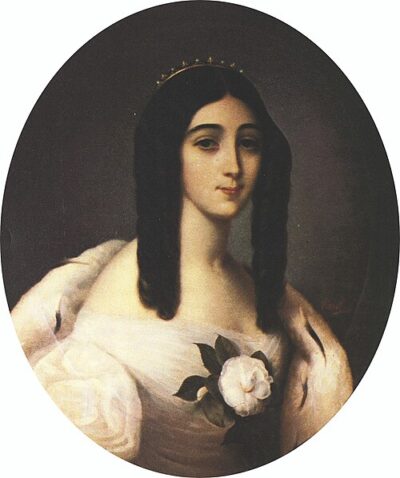
Marie Duplessis
Marie Duplessis was the 19th-century French courtesan. Born January 15, 1824, in Nonant-le-Pin. Died February 3, 1847, in Boulevard de la Madeleine.
Facts
10 facts · 2 confirmed by two sources · 5 cited · 3 from one source
Where this comes from
Papalocal keeps its own record. It started from these sources; what each one said is kept here as it was copied, so a change on their side never changes this page by itself. Tap one to read its version.
What Wikidata says · copied November 18, 2026 · revision 2501962181
- Described as
- 19th-century French courtesan
- Other names
- Alphonsine Plessis
- Born
- January 15, 1824 · 4 references
- Died
- February 3, 1847 · 4 references
- Born in
- Nonant-le-Pin · 1 reference
- Died in
- Boulevard de la Madeleine · 1 reference
- Buried in
- Montmartre Cemetery · 1 reference
- Cause of death
- tuberculosis · 1 reference
- Name at birth
- Alphonsine Plessis · 1 reference
- Citizen of
- France
- Occupation
- demi-mondaine
- Spouse
- Édouard de Perregaux
- Wikipedias with a page
- 22
Wikidata item Q261139 (wikidata.org/wiki/Q261139), public domain (CC0). Copied November 18, 2026.
What Wikipedia says · copied November 18, 2026 · revision 1348497092
Marie Duplessis (born Alphonsine Rose Plessis; 15 January 1824 – 3 February 1847) was a French courtesan and mistress to a number of prominent and wealthy men. She was the inspiration for Marguerite Gautier, the main character of the 1848 novel La Dame aux Camélias by Alexandre Dumas fils, one of Duplessis's lovers. Much of what is known about her has been derived from the literary persona and contemporary legends.
- Born, in its opening lines
- January 15, 1824
- Died, in its opening lines
- February 3, 1847
From the Wikipedia article “Marie Duplessis” (en.wikipedia.org/wiki/Marie_Duplessis), by its contributors, under CC BY-SA 4.0 (creativecommons.org/licenses/by-sa/4.0/). Copied November 18, 2026; not changed.
Confirmed Two sources agree. Cited One source, and it names where it got it. One source One source, without a reference of its own. Sources disagree The sources disagree. We show the best-supported value and keep theirs below.
