
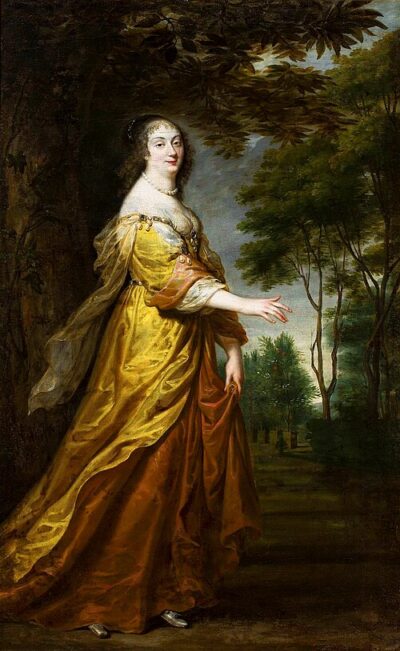
Marie Louise Gonzaga
Marie Louise Gonzaga was a Queen of Poland. Born August 18, 1611, in Paris. Died May 10, 1667, in Warsaw. Positions held include Queen Consort of Poland (1646–1648). Awards include Golden Rose.
Facts
21 facts · 2 confirmed by two sources · 2 cited · 16 from one source · 1 where the sources disagree
What’s different
- Born in: we show Paris (Sources disagree). Wikidata also lists Nevers
Where this comes from
Papalocal keeps its own record. It started from these sources; what each one said is kept here as it was copied, so a change on their side never changes this page by itself. Tap one to read its version.
What Wikidata says · copied November 16, 2026 · revision 2557183581
- Described as
- Queen of Poland (1611-1667)
- Other names
- Luise Marie de Gonzaga
- Born
- August 18, 1611 · 3 references
- Died
- May 10, 1667 · 3 references
- Born in
- Paris · 1 reference; Nevers · 1 reference
- Died in
- Warsaw · 2 references
- Buried in
- Wawel Cathedral
- Cause of death
- catarrh
- Citizen of
- Kingdom of France; Polish–Lithuanian Commonwealth
- Occupation
- politician
- Positions held
- Queen Consort of Poland (1646–1648)
- Awards
- Golden Rose · 1 reference
- Spouse
- Władysław IV Vasa (1646–) · 1 reference; John II Casimir Vasa (1649–) · 1 reference
- Children
- Maria Anna Vasa; John Sigismund, Crown Prince of Poland · 1 reference
- Father
- Charles Gonzaga, Duke of Mantua and Montferrat · 1 reference
- Mother
- Catherine of Guise
- Siblings
- Anne Gonzaga; Francis Gonzaga, Duke of Rethel; Charles Gonzaga; Ferdinand Gonzaga
- Wikipedias with a page
- 30
Wikidata item Q232793 (wikidata.org/wiki/Q232793), public domain (CC0). Copied November 16, 2026.
What Wikipedia says · copied November 16, 2026 · revision 1379423222
Marie Louise Gonzaga (Italian: Maria Luisa, Polish: Ludwika Maria, Lithuanian: Liudvika Marija; 18 August 1611 – 10 May 1667) was Queen of Poland and Grand Duchess of Lithuania by marriage to two kings of Poland and grand dukes of Lithuania, brothers Władysław IV and John II Casimir. Together with Bona Sforza (1494–1557), she is regarded as one of the most influential and powerful queen consorts of the Kingdom of Poland and the Polish–Lithuanian Commonwealth.
Born in Nevers to Charles I, Duke of Mantua and Catherine of Guise, Marie was brought up at the French court as the future bride of Duke Gaston of Orléans. In 1645, she married Władysław IV of Poland with whom she did not have a harmonious relationship. After his death in 1648, the widowed queen married his half-brother and successor, John II Casimir. Marie Louise exercised considerable influence over her second husband and dictated the political course in the country. An ambitious and energetic woman, she was a strong supporter of an absolute monarchy for which she was reviled by certain spheres of the Polish szlachta and Lithuanian nobility. She, nevertheless, remained active in the Commonwealth's politics and co-sponsored the foundation of the first Polish newspaper, Merkuriusz Polski Ordynaryjny (Polish Mercury Ordinary), in 1661 as well as other public institutions.
While her role is regarded as crucial in repulsing the foreign forces out of Poland-Lithuania during the Swedish Deluge (1655–1660), she became increasingly unpopular for her absolutist policies and her intention of nominating her niece's husband, Henri Jules, the future Prince of Condé, the heir apparent to the Polish-Lithuanian throne. That resulted in a military conflict with the internal opposition, which ended with the defeat of the royal army in 1666, during Lubomirski's rebellion. After Marie Louise's death, John Casimir hesitatingly renounced the crown, and the Commonwealth government officially curtailed the prerogatives of the royal consort.
- Born, in its opening lines
- August 18, 1611
- Died, in its opening lines
- May 10, 1667
From the Wikipedia article “Marie Louise Gonzaga” (en.wikipedia.org/wiki/Marie_Louise_Gonzaga), by its contributors, under CC BY-SA 4.0 (creativecommons.org/licenses/by-sa/4.0/). Copied November 16, 2026; not changed.
Confirmed Two sources agree. Cited One source, and it names where it got it. One source One source, without a reference of its own. Sources disagree The sources disagree. We show the best-supported value and keep theirs below.
