
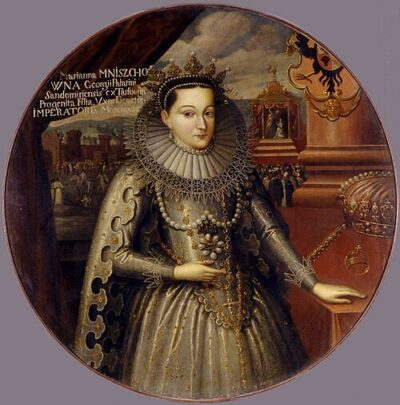
Marina Mniszech was a (1588-1614) Tsaritsa of Russia, 1606. Born 1588, in Murovane. Died December 24, 1614, in Kolomna Kremlin. Positions held include regent.
Facts
16 facts · 2 confirmed by two sources · 1 cited · 13 from one source
Where this comes from
Papalocal keeps its own record. It started from these sources; what each one said is kept here as it was copied, so a change on their side never changes this page by itself. Tap one to read its version.
What Wikidata says · copied November 16, 2026 · revision 2565573646
- Described as
- (1588-1614) Tsaritsa of Russia, 1606
- Born
- 1588 · 3 references
- Died
- December 24, 1614
- Born in
- Murovane
- Died in
- Kolomna Kremlin
- Citizen of
- Polish–Lithuanian Commonwealth
- Occupation
- regent
- Positions held
- regent
- Spouse
- False Dmitriy I · 1 reference; False Dmitry II · 1 reference
- Children
- Tsarevich Ivan Dmitriyevich
- Father
- Jerzy Mniszech
- Mother
- Jadviga Tarlo-Mniszech
- Siblings
- Franciszek Bernard Mniszech; Stanislas Boniface Mniszech; Urszula Mniszchówna
- Religion
- Catholicism
- Wikipedias with a page
- 30
Wikidata item Q1140161 (wikidata.org/wiki/Q1140161), public domain (CC0). Copied November 16, 2026.
What Wikipedia says · copied November 16, 2026 · revision 1379803392
Marina Mniszech or Mnishek (Polish: Maryna Mniszech, IPA: [maˈrɨna ˈmɲiʂɛk]; Russian: Марина Мнишек, IPA: [mɐˈrʲinə ˈmnʲiʂɨk]; c. 1588 – 24 December 1614) was a Polish noblewoman who was the tsaritsa of all Russia in May 1606 during the Time of Troubles as the wife of False Dmitry I. Following the death of her husband, she later married another imposter to the throne, False Dmitry II. A devout Catholic, she hoped to convert Russia's population to Catholicism.
- Born, in its opening lines
- c. 1588
- Died, in its opening lines
- December 24, 1614
From the Wikipedia article “Marina Mniszech” (en.wikipedia.org/wiki/Marina_Mniszech), by its contributors, under CC BY-SA 4.0 (creativecommons.org/licenses/by-sa/4.0/). Copied November 16, 2026; not changed.
Confirmed Two sources agree. Cited One source, and it names where it got it. One source One source, without a reference of its own. Sources disagree The sources disagree. We show the best-supported value and keep theirs below.
