
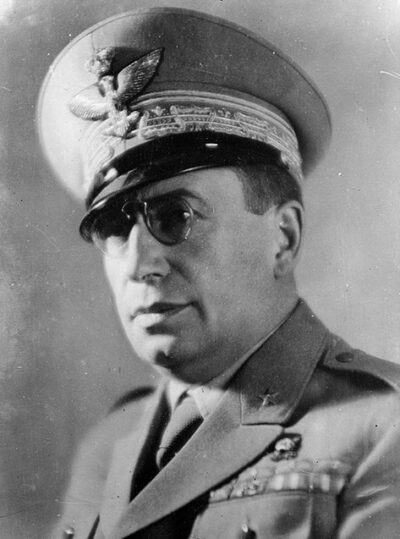
Mario Roatta
Mario Roatta was an Italian general. Born February 2, 1887, in Modena. Died January 7, 1968, in Rome. Awards include Medal of Military Valour.
Facts
9 facts · 2 confirmed by two sources · 0 cited · 7 from one source
Where this comes from
Papalocal keeps its own record. It started from these sources; what each one said is kept here as it was copied, so a change on their side never changes this page by itself. Tap one to read its version.
What Wikidata says · copied November 17, 2026 · revision 2545435530
- Described as
- Italian general (1887-1968)
- Born
- February 2, 1887 · 3 references
- Died
- January 7, 1968 · 3 references
- Born in
- Modena
- Died in
- Rome
- Citizen of
- Italy (1946–); Kingdom of Italy (–1946)
- Occupation
- military officer
- Awards
- Medal of Military Valour · 1 reference
- Military rank
- general
- Wikipedias with a page
- 26
Wikidata item Q165220 (wikidata.org/wiki/Q165220), public domain (CC0). Copied November 17, 2026.
What Wikipedia says · copied November 17, 2026 · revision 1372635883
Mario Roatta (2 February 1887 – 7 January 1968) was an Italian general. After serving in World War I he rose to command the Corpo Truppe Volontarie which assisted Francisco Franco's nationalist forces during the Spanish Civil War. He was the deputy chief of staff of the Italian Army from October 1939 to March 1941 and from March 1941 to January 1942 its chief of staff and helped in preparing for the invasion of Yugoslavia. Roatta would gain the nickname "Black Beast of Yugoslavia” due to his brutal methods of repression.
He is best known for his role as the commander of the Italian Second Army in its repression against civilians, in the Slovene- and Croatian-inhabited areas of Italian-occupied and annexed Yugoslavia during World War II.
He constructed a policy in which he attempted to eliminate the Yugoslav Partisans, helped manage relations with the authorities of the puppet Independent State of Croatia, and "greatly advanced and systematized" collaboration with the Chetniks. As a "manifesto for repression in the Yugoslav territories", Roatta issued Circular 3C which urged "ethnic clearance" be carried out and stressed the need for "complete cleansing" of Slovene-inhabited areas. In line with Circular 3C's objectives Roatta ordered summary executions, hostage taking, reprisals, internments, burning of houses and whole villages, and the deportation of 25,000 people, who were placed in Italian concentration camps at Rab, Gonars, Monigo (Treviso), Renicci d'Anghiari, Chiesanuova and elsewhere. The survivors received no compensation from the Italian state after the war. The deportees had formed about 7.5 percent of the total population of the Italian-annexed Province of Ljubljana.
- Born, in its opening lines
- February 2, 1887
- Died, in its opening lines
- January 7, 1968
From the Wikipedia article “Mario Roatta” (en.wikipedia.org/wiki/Mario_Roatta), by its contributors, under CC BY-SA 4.0 (creativecommons.org/licenses/by-sa/4.0/). Copied November 17, 2026; not changed.
Confirmed Two sources agree. Cited One source, and it names where it got it. One source One source, without a reference of its own. Sources disagree The sources disagree. We show the best-supported value and keep theirs below.
