
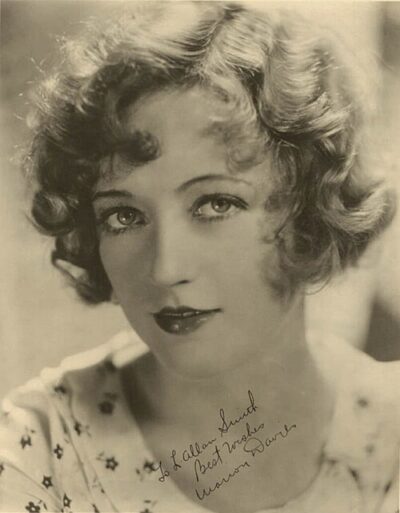
Marion Davies
Marion Davies was an American actress. Born January 3, 1897, in Brooklyn. Died September 22, 1961, in Hollywood. Awards include star on Hollywood Walk of Fame.
Facts
16 facts · 2 confirmed by two sources · 2 cited · 12 from one source
Where this comes from
Papalocal keeps its own record. It started from these sources; what each one said is kept here as it was copied, so a change on their side never changes this page by itself. Tap one to read its version.
What Wikidata says · copied November 15, 2026 · revision 2567218364
- Described as
- American actress (1897–1961)
- Born
- January 3, 1897 · 6 references
- Died
- September 22, 1961 · 6 references
- Born in
- Brooklyn
- Died in
- Hollywood
- Buried in
- Hollywood Forever Cemetery
- Cause of death
- stomach cancer · 1 reference
- Citizen of
- United States
- Occupation
- actor · 1 reference; film producer; screenwriter; model; film actor; Ziegfeld girl
- Awards
- star on Hollywood Walk of Fame · 1 reference
- Siblings
- Rosemary Davies; Reine Davies
- Wikipedias with a page
- 36
Wikidata item Q242416 (wikidata.org/wiki/Q242416), public domain (CC0). Copied November 15, 2026.
What Wikipedia says · copied November 15, 2026 · revision 1385098106
Marion Davies (born Marion Cecilia Douras; January 3, 1897 – September 22, 1961) was an American actress, producer, screenwriter, and philanthropist. Educated in a religious convent, Davies left the school to pursue a career as a chorus girl. As a teenager, she appeared in several Broadway musicals and one film, Runaway Romany (1917). She soon became a featured performer in the Ziegfeld Follies. While performing in the 1916 Follies, the nineteen-year-old Marion met the fifty-three-year-old newspaper tycoon William Randolph Hearst and became his mistress. Hearst took over management of Davies's career and promoted her as a film actress.
Hearst financed Davies’s pictures and promoted her career extensively in his newspapers and Hearst newsreels. He founded Cosmopolitan Pictures to produce her films. By 1924, Davies ranked as the top female box office star in Hollywood because of the popularity of When Knighthood Was in Flower and Little Old New York, two of the biggest box-office hits of their respective years. During the zenith of the Jazz Age, Davies became renowned as the hostess of lavish soirees for Hollywood actors and political elites. In 1924, her name became linked with scandal when film producer Thomas Ince died at a party aboard Hearst's yacht.
Following the decline of her film career during the Great Depression, Davies struggled with alcoholism. She retired from the screen in 1937 to devote herself to an ailing Hearst and charitable work. In Hearst's declining years, Davies remained his steadfast companion until his death in 1951. Eleven weeks after Hearst's death, she married sea captain Horace Brown. Their marriage lasted until Davies's death at 64 from malignant osteomyelitis (bone cancer) of the jaw in 1961.
By the time of her death, her popular association with the character of Susan Alexander Kane in the film Citizen Kane (1941) overshadowed Davies's legacy as a talented actress. Many viewers assumed Davies inspired the title character's second wife—an attractive but untalented singer whom he tries to promote. However, many commentators, including writer–director Orson Welles, defended Davies's record as a gifted actress and comedienne to whom Hearst's patronage did more harm than good. In his final years, Welles attempted to correct the widespread misconceptions the film had created about Davies's popularity and talents as an actress.
- Born, in its opening lines
- January 3, 1897
- Died, in its opening lines
- September 22, 1961
From the Wikipedia article “Marion Davies” (en.wikipedia.org/wiki/Marion_Davies), by its contributors, under CC BY-SA 4.0 (creativecommons.org/licenses/by-sa/4.0/). Copied November 15, 2026; not changed.
Confirmed Two sources agree. Cited One source, and it names where it got it. One source One source, without a reference of its own. Sources disagree The sources disagree. We show the best-supported value and keep theirs below.
