
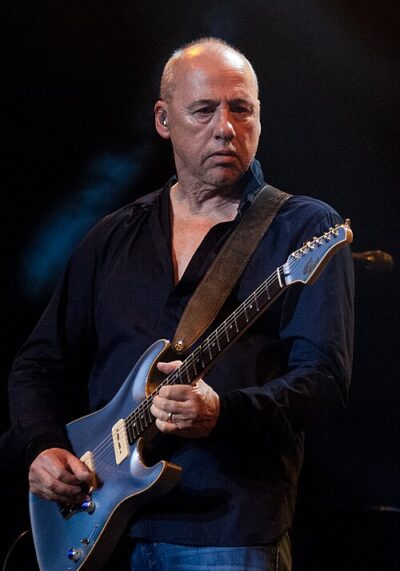
Mark Knopfler
Mark Knopfler is a British musician. Born August 12, 1949, in Glasgow. Known for Calling Elvis and Tunnel of Love. Educated at University of Leeds and Gosforth Academy. Awards include Officer of the Order of the British Empire, Steiger Award and Premios Ondas.
Facts
45 facts · 1 confirmed by two sources · 9 cited · 35 from one source
Where this comes from
Papalocal keeps its own record. It started from these sources; what each one said is kept here as it was copied, so a change on their side never changes this page by itself. Tap one to read its version.
What Wikidata says · copied November 16, 2026 · revision 2569263197
- Described as
- British musician (born 1949)
- Other names
- Mark Freuder Knopfler
- Born
- August 12, 1949 · 3 references
- Born in
- Glasgow · 1 reference
- Name at birth
- Mark Freuder Knopfler · 1 reference
- Citizen of
- United Kingdom
- Occupation
- singer-songwriter; guitarist · 1 reference; record producer; film score composer; multi-instrumentalist; musician · 2 references; rock musician · 1 reference; singer · 1 reference
- Education
- University of Leeds (1970–1973); Gosforth Academy; Harlow College (1967–1968)
- Member of
- Dire Straits
- Genre
- rock music; blues rock; Celtic rock; country rock; country music; blues · 1 reference
- Instrument
- Fender Stratocaster; Fender Telecaster; Gibson Les Paul; voice · 1 reference; guitar · 1 reference
- Record label
- Warner Bros. Records; Reprise Records; Mercury Records; Vertigo Records
- Known for
- Calling Elvis; Tunnel of Love
- Awards
- Officer of the Order of the British Empire; Steiger Award (2011); Premios Ondas (1995); Grammy Award for Best Country Instrumental Performance (2 times) (1985, 1990); Grammy Award for Best Immersive Audio Album (2005); Grammy Award for Best Country Collaboration with Vocals (1990)
- Spouse
- Kitty Aldridge (1997–) · 1 reference
- Children
- Katya Ruby Rose Knopfler
- Siblings
- David Knopfler
- Lived in
- Glasgow; Newcastle upon Tyne
- Website
- https://www.markknopfler.com/
- Wikipedias with a page
- 60
Wikidata item Q185343 (wikidata.org/wiki/Q185343), public domain (CC0). Copied November 16, 2026.
What Wikipedia says · copied November 16, 2026 · revision 1384929788
Mark Freuder Knopfler (born 12 August 1949) is a British musician. He was the lead guitarist, singer and songwriter of the rock band Dire Straits from 1977 to 1995, and is one of the two members who stayed throughout the band's existence, along with the bassist John Illsley. After Dire Straits dissolved, he pursued a solo career and is now an independent artist.
Knopfler was born in Glasgow, and was raised in Newcastle. After graduating from the University of Leeds and working for three years as a college lecturer, Knopfler co-founded Dire Straits with his younger brother, David Knopfler. The band recorded six albums, including Brothers in Arms (1985), one of the best-selling albums in history. After Dire Straits disbanded in 1995, Knopfler began a solo career, and has produced ten solo albums to date. He has composed and produced film scores for nine films, including Local Hero (1983), Cal (1984), The Princess Bride (1987), Wag the Dog (1997) and Altamira (2016). He has produced albums for Tina Turner, Bob Dylan, and Randy Newman.
Described by Classic Rock as a virtuoso, Knopfler is a fingerstyle guitarist and was ranked 27th on Rolling Stone's list of the "100 Greatest Guitarists of All Time". With Dire Straits, Knopfler sold between 100 million and 120 million records. A four-time Grammy Award winner, Knopfler is the recipient of the Edison Award, the Steiger Award and the Ivor Novello Award, as well as holding three honorary doctorate degrees in music from universities in the United Kingdom. Knopfler was inducted into the Rock and Roll Hall of Fame as a member of Dire Straits in 2018.
- Born, in its opening lines
- August 12, 1949
From the Wikipedia article “Mark Knopfler” (en.wikipedia.org/wiki/Mark_Knopfler), by its contributors, under CC BY-SA 4.0 (creativecommons.org/licenses/by-sa/4.0/). Copied November 16, 2026; not changed.
Confirmed Two sources agree. Cited One source, and it names where it got it. One source One source, without a reference of its own. Sources disagree The sources disagree. We show the best-supported value and keep theirs below.
