
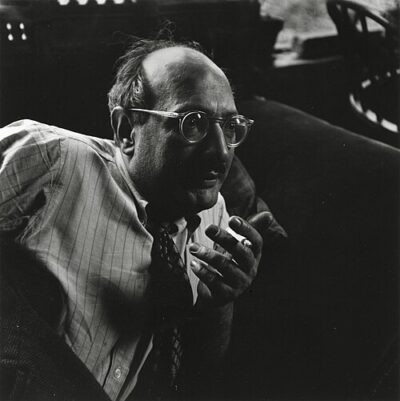
Mark Rothko
Mark Rothko was an American painter of Latvian-Jewish descent. Born September 25, 1903, in Daugavpils. Died February 25, 1970, in Manhattan. Known for Orange, Red, Yellow, Orange and Yellow and No. 10. Educated at Yale University and Art Students League of New York.
Facts
34 facts · 2 confirmed by two sources · 11 cited · 21 from one source
Where this comes from
Papalocal keeps its own record. It started from these sources; what each one said is kept here as it was copied, so a change on their side never changes this page by itself. Tap one to read its version.
What Wikidata says · copied November 13, 2026 · revision 2565545207
- Described as
- American painter of Latvian-Jewish descent (1903–1970)
- Other names
- Marcus Rothkowitz
- Born
- September 25, 1903 · 13 references
- Died
- February 25, 1970 · 10 references
- Born in
- Daugavpils · 2 references
- Died in
- Manhattan · 2 references
- Buried in
- East Marion Cemetery · 1 reference
- Name at birth
- Маркус Янкелевич Роткович
- Citizen of
- United States (1938–) · 1 reference; Russian Empire; Latvia · 1 reference
- Occupation
- painter · 2 references; university teacher; draftsperson · 2 references; artist · 1 reference
- Worked for
- Brooklyn College
- Education
- Yale University (–1921) · 1 reference; Art Students League of New York; Lincoln High School (–1921) · 1 reference
- Member of
- American Academy of Arts and Letters; American Academy of Arts and Sciences
- Genre
- abstract art · 1 reference
- Known for
- Orange, Red, Yellow; Orange and Yellow; No. 10; Rothko Chapel; No. 1; No. 2; No. 3; No. 3; No. 4; No. 5
- Field
- painting · 2 references
- Spouse
- Mary Ellen Beistle
- Children
- Kate Rothko; Christopher Rothko · 1 reference
- Wikipedias with a page
- 71
Wikidata item Q160149 (wikidata.org/wiki/Q160149), public domain (CC0). Copied November 13, 2026.
What Wikipedia says · copied November 13, 2026 · revision 1384342124
Mark Rothko ( ROTH-koh; Markus Yakovlevich Rothkowitz until 1940; September 25, 1903 – February 25, 1970) was a Latvian-born American abstract painter. He is best known for his color field paintings that depicted irregular and painterly rectangular regions of color, which he produced from 1949 to 1970. Although Rothko did not personally subscribe to any one school, he is associated with the American abstract expressionism movement of modern art.
Born to a Jewish family in Daugavpils, Latvia, then part of the Russian Empire, Rothko emigrated with his parents and siblings to the United States, arriving at Ellis Island in late 1913 and originally settling in Portland, Oregon. He moved to New York City in 1923 where his youthful period of artistic production dealt primarily with urban scenery. In response to World War II, Rothko's art entered a transitional phase during the 1940s, where he experimented with mythological themes and Surrealism to express tragedy. Toward the end of the decade, Rothko painted canvases with regions of pure color which he further abstracted into rectangular color forms, the idiom he would use for the rest of his life.
In his later career, Rothko executed several canvases for three different mural projects. The Seagram murals were to have decorated the Four Seasons Restaurant in the Seagram Building, but Rothko eventually grew disgusted with the idea that his paintings would be decorative objects for wealthy diners and refunded the lucrative commission, donating the paintings to museums, including the Tate Gallery. The Harvard Mural series was donated to a dining room in Harvard's Holyoke Center; their colors faded badly over time due to Rothko's use of the pigment lithol red together with regular sunlight exposure. The Harvard series has since been restored using a special lighting technique. Rothko contributed 14 canvases to a permanent installation at the Rothko Chapel, a non-denominational chapel in Houston, Texas.
Although Rothko lived modestly for much of his life, the resale value of his paintings grew tremendously in the decades following his suicide in 1970. His painting No. 6 (Violet, Green and Red) sold in 2014 for $186 million.
- Born, in its opening lines
- September 25, 1903
- Died, in its opening lines
- February 25, 1970
From the Wikipedia article “Mark Rothko” (en.wikipedia.org/wiki/Mark_Rothko), by its contributors, under CC BY-SA 4.0 (creativecommons.org/licenses/by-sa/4.0/). Copied November 13, 2026; not changed.
Confirmed Two sources agree. Cited One source, and it names where it got it. One source One source, without a reference of its own. Sources disagree The sources disagree. We show the best-supported value and keep theirs below.
