
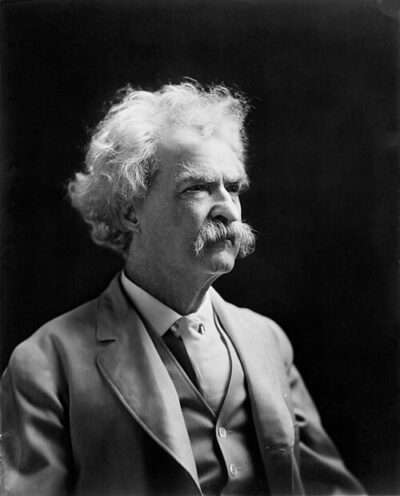
Mark Twain
Mark Twain was an American author and humorist. Born November 30, 1835, in Florida. Died April 21, 1910, in Redding. Known for Adventures of Huckleberry Finn and The Adventures of Tom Sawyer. Educated at Cascadilla School. Awards include honorary doctor of Yale University, member of the Nevada Newspaper Hall of Fame and member of the Nevada Writers Hall of Fame.
Facts
37 facts · 2 confirmed by two sources · 10 cited · 25 from one source
Where this comes from
Papalocal keeps its own record. It started from these sources; what each one said is kept here as it was copied, so a change on their side never changes this page by itself. Tap one to read its version.
What Wikidata says · copied November 13, 2026 · revision 2566387926
- Described as
- American author and humorist (1835–1910)
- Other names
- Thomas Jefferson Snodgrass, Quintus Curtius Snodgrass, Louis de Conte, Samuel L. Clemens, Samuel Clemens, Samuel Langhorne Clemens
- Born
- November 30, 1835 · 23 references
- Died
- April 21, 1910 · 23 references
- Born in
- Florida · 1 reference
- Died in
- Redding · 1 reference
- Buried in
- Woodlawn Cemetery
- Cause of death
- myocardial infarction · 1 reference
- Name at birth
- Samuel Langhorne Clemens
- Citizen of
- United States · 1 reference
- Occupation
- journalist · 2 references; novelist; autobiographer; teacher · 1 reference; humorist; children's writer; travel writer; aphorist
- Education
- Cascadilla School
- Member of
- American Academy of Arts and Letters
- Genre
- historical fiction · 1 reference
- Known for
- Adventures of Huckleberry Finn; The Adventures of Tom Sawyer
- Awards
- honorary doctor of Yale University; member of the Nevada Newspaper Hall of Fame · 1 reference; member of the Nevada Writers Hall of Fame (1998) · 1 reference
- Field
- literature; humor
- Spouse
- Olivia Langdon Clemens (1870–1904)
- Children
- Susy Clemens; Clara Clemens; Jean Clemens
- Father
- John Marshall Clemens · 1 reference
- Mother
- Jane Lampton Clemens · 1 reference
- Siblings
- Orion Clemens; Pamela Ann Clemens
- Religion
- skepticism
- Lived in
- Mark Twain House (1874–1891); Mark Twain Birthplace State Historic Site (1835–) · 1 reference
- Wikipedias with a page
- 253
Wikidata item Q7245 (wikidata.org/wiki/Q7245), public domain (CC0). Copied November 13, 2026.
What Wikipedia says · copied November 13, 2026 · revision 1384384786
Samuel Langhorne Clemens (November 30, 1835 – April 21, 1910), known by the pen name Mark Twain, was an American writer, humorist, and essayist. He has been praised as the "greatest humorist the United States has produced", with William Faulkner calling him "the father of American literature". Twain's novels include The Adventures of Tom Sawyer (1876) and its sequel, Adventures of Huckleberry Finn (1884), with the latter often called the "Great American Novel". He also wrote A Connecticut Yankee in King Arthur's Court (1889) and Pudd'nhead Wilson (1894) and cowrote The Gilded Age: A Tale of Today (1873) with Charles Dudley Warner.
Twain was raised in Hannibal, Missouri, which later provided the setting for both Tom Sawyer and Huckleberry Finn. He served an apprenticeship with a printer early in his career, and then worked as a typesetter, contributing articles to his older brother Orion Clemens's newspaper. Twain then became a riverboat pilot on the Mississippi River, which provided him the material for Life on the Mississippi (1883). Soon after, Twain headed west to join Orion in Nevada. He referred humorously to his lack of success at mining, turning to journalism for the Virginia City Territorial Enterprise.
Twain first achieved success as a writer with the humorous story "The Celebrated Jumping Frog of Calaveras County," which was published in 1865; it was based on a story that he heard at the Angels Hotel in Angels Camp, California, where Twain had spent some time while he was working as a miner. The short story brought Twain international attention. He wrote both fiction and non-fiction. As his fame grew, Twain became a much sought-after speaker. His wit and satire, both in prose and in speech, earned praise from critics and peers, and Twain was a friend to presidents, artists, industrialists, and European royalty.
Although Twain initially spoke out in favor of American interests in the Hawaiian Islands, he later reversed his position, going on to become vice president of the American Anti-Imperialist League from 1901 until his death in 1910, coming out strongly against the Philippine–American War and American colonialism. Twain published a satirical pamphlet, "King Leopold's Soliloquy", in 1905 about Belgian atrocities in the Congo Free State.
Twain earned a great deal of money from his writing and lectures, but invested in ventures that lost most of it, such as the Paige Compositor, a mechanical typesetter that failed because of its complexity and imprecision. He filed for bankruptcy after these financial setbacks, but in time overcame his financial troubles with the help of Standard Oil executive Henry Huttleston Rogers, who helped Twain manage his finances and copyrights. Twain eventually paid all his creditors in full, even though his declaration of bankruptcy meant he was not required to do so. One hundred years after his death, the first volume of his autobiography was published.
Twain was born shortly after an appearance of Halley's Comet and predicted that his death would accompany it as well, writing in 1909: "I came in with Halley's Comet in 1835; it's coming again next year, and I expect to go out with it. It would be a great disappointment in my life if I don't. The Almighty has said, no doubt: 'Now here are these two unaccountable freaks; they came in together, they must go out together.'" He died of a heart attack the day after the comet was at its closest to the Sun.
- Born, in its opening lines
- November 30, 1835
- Died, in its opening lines
- April 21, 1910
From the Wikipedia article “Mark Twain” (en.wikipedia.org/wiki/Mark_Twain), by its contributors, under CC BY-SA 4.0 (creativecommons.org/licenses/by-sa/4.0/). Copied November 13, 2026; not changed.
Confirmed Two sources agree. Cited One source, and it names where it got it. One source One source, without a reference of its own. Sources disagree The sources disagree. We show the best-supported value and keep theirs below.
