
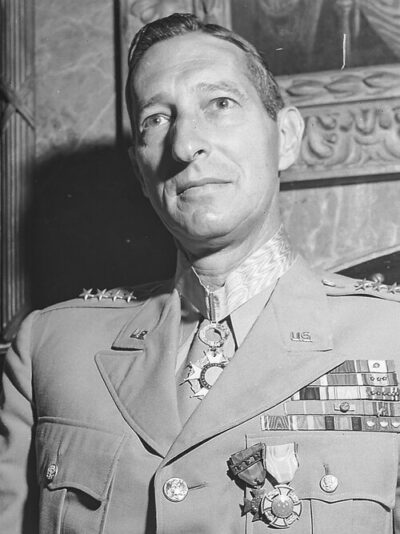
Mark W. Clark
Mark W. Clark was an United States Army general. Born May 1, 1896, in Sackets Harbor. Died April 17, 1984, in Charleston. Educated at United States Army Command and General Staff College and United States Military Academy. Awards include Bronze Star Medal, Knight Commander of the Order of the British Empire and Grand Cross of the Order of Wissam Alaouite.
Facts
31 facts · 2 confirmed by two sources · 7 cited · 22 from one source
Where this comes from
Papalocal keeps its own record. It started from these sources; what each one said is kept here as it was copied, so a change on their side never changes this page by itself. Tap one to read its version.
What Wikidata says · copied November 15, 2026 · revision 2569124524
- Described as
- United States Army general (1896–1984)
- Other names
- Mark Wayne Clark
- Born
- May 1, 1896 · 9 references
- Died
- April 17, 1984 · 9 references
- Born in
- Sackets Harbor · 1 reference
- Died in
- Charleston · 3 references
- Buried in
- The Citadel · 1 reference
- Citizen of
- United States
- Occupation
- military officer
- Education
- United States Army Command and General Staff College; United States Military Academy · 1 reference; United States Army War College; Racine College
- Awards
- Bronze Star Medal; Knight Commander of the Order of the British Empire; Grand Cross of the Order of Wissam Alaouite; Legionnaire of Legion of Merit; Grand cross of the Order of the White Lion; Order of Suvorov, 1st class; Grand Officer of the Order of the Southern Cross; Knight Grand Cross of the Order of Saints Maurice and Lazarus; Grand Cross of the Legion of Honour; honorary doctor of the University of Vienna · 1 reference; Distinguished Service Cross · 1 reference; Distinguished Service Medal · 1 reference; Navy Distinguished Service Medal · 1 reference; Legion of Merit · 1 reference; Military Order of Italy · 1 reference
- Spouse
- Maurine Doran · 1 reference
- Children
- William Doran Clark · 1 reference
- Military branch
- United States Army
- Military rank
- general; general · 1 reference
- Wikipedias with a page
- 39
Wikidata item Q34339 (wikidata.org/wiki/Q34339), public domain (CC0). Copied November 15, 2026.
What Wikipedia says · copied November 15, 2026 · revision 1384332650
Mark Wayne Clark (1 May 1896 – 17 April 1984) was a United States Army officer who fought in World War I, World War II, and the Korean War. He was the youngest four-star general in the U.S. Army during World War II.
During World War I, he was a company commander and served in France in 1918, as a 22-year-old captain, where he was seriously wounded by shrapnel. After the war, the future US Army Chief of Staff, General George C. Marshall, noticed Clark's abilities. During World War II, he commanded the United States Fifth Army, and later the 15th Army Group, in the Italian campaign. He is known for leading the Fifth Army when it captured Rome in June 1944, around the same time as the Normandy landings. He was also the head of planning for Operation Torch, the largest seaborne invasion at the time.
On 10 March 1945, at the age of 48, Clark became one of the youngest American officers promoted to the rank of four-star general. Dwight D. Eisenhower, a close friend, considered Clark to be a brilliant staff officer and trainer of men.
Throughout his thirty-six years of military service, Clark was awarded many medals, the Distinguished Service Cross (DSC), the US Army's second-highest decoration, being the most notable.
A legacy of the "Clark Task Force," which he led from 1953 to 1955 to review and to make recommendations on all federal intelligence activities, is the term "intelligence community."
- Born, in its opening lines
- May 1, 1896
- Died, in its opening lines
- April 17, 1984
From the Wikipedia article “Mark W. Clark” (en.wikipedia.org/wiki/Mark_W._Clark), by its contributors, under CC BY-SA 4.0 (creativecommons.org/licenses/by-sa/4.0/). Copied November 15, 2026; not changed.
Confirmed Two sources agree. Cited One source, and it names where it got it. One source One source, without a reference of its own. Sources disagree The sources disagree. We show the best-supported value and keep theirs below.
