
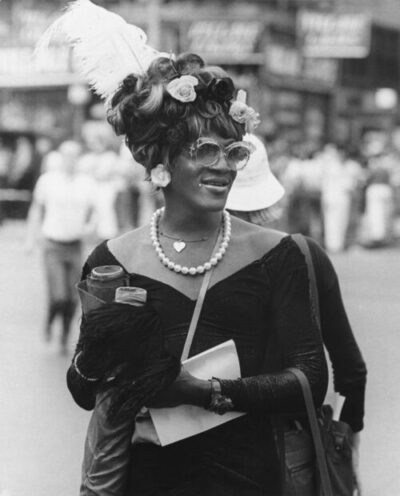
Marsha P. Johnson
Marsha P. Johnson was a Black American queer liberation activist. Born August 24, 1945, in New York City. Died July 6, 1992, in New York City. Educated at Thomas A. Edison Career and Technical Academy. Awards include VH1 Trailblazer Honors.
Facts
16 facts · 1 confirmed by two sources · 5 cited · 9 from one source · 1 where the sources disagree
What’s different
- Died: we show July 6, 1992 (Sources disagree). Wikipedia says July 3, 1992
Where this comes from
Papalocal keeps its own record. It started from these sources; what each one said is kept here as it was copied, so a change on their side never changes this page by itself. Tap one to read its version.
What Wikidata says · copied November 13, 2026 · revision 2566959967
- Described as
- Black American queer liberation activist (1945–1992)
- Other names
- Marsha Johnson
- Born
- August 24, 1945 · 2 references
- Died
- July 6, 1992 · 2 references
- Born in
- New York City · 1 reference
- Died in
- New York City · 1 reference
- Citizen of
- United States
- Occupation
- artist · 2 references; LGBTQ rights activist; HIV/AIDS activist; trans activist; drag queen · 2 references; activist · 1 reference
- Education
- Thomas A. Edison Career and Technical Academy
- Member of
- Gay Liberation Front · 1 reference; Street Transvestite Action Revolutionaries; ACT UP
- Awards
- VH1 Trailblazer Honors (2016)
- Wikipedias with a page
- 44
Wikidata item Q6773400 (wikidata.org/wiki/Q6773400), public domain (CC0). Copied November 13, 2026.
What Wikipedia says · copied November 13, 2026 · revision 1384939204
Marsha P. Johnson (August 24, 1945 – July 3, 1992) was an American LGBTQ activist, sex worker and performer. Sometimes known as the "Saint of Christopher Street", she is considered an important figure in the LGBTQ and transgender rights movements due to her involvement in the Stonewall riots, her work with Street Transvestite Action Revolutionaries (STAR), and her advocacy for people with AIDS.
Born in Elizabeth, New Jersey, Johnson wore women's clothing for the first time when she was five years old. After graduating from high school, she moved to Manhattan, where she regularly spent time on 42nd Street in Times Square, working at the local Childs Restaurants and supplementing her income through begging and sex work. Often going out in partial drag, she became well known for her vibrant accessories. She participated in the Stonewall riots in 1969, though her exact role is debated, and afterward, she was active in the Gay Activists Alliance (GAA) and Gay Liberation Front (GLF). In 1970, she participated in the Weinstein Hall occupation and helped found STAR, which provided food and shelter for transgender youth through STAR House, a four-bedroom rental home in the East Village.
After STAR's dissolution in 1973, Johnson began performing with various theatrical troupes around Manhattan, including the Angels of Light and the Hot Peaches. After the beginning of the AIDS pandemic in New York in 1980, she cared for her friends who were dying of AIDS and engaged in AIDS-related activism. She disappeared under mysterious circumstances in 1992, with her body being found floating in the Hudson River on July 6. While police initially ruled her death a suicide, many speculate that she was either murdered, chased into the water, or fell in accidentally. She was 46.
After her death, Johnson became the subject of many tributes and memorials throughout the United States. She is the subject of several films, including the documentaries Pay It No Mind and The Death and Life of Marsha P. Johnson, as well as the short film Happy Birthday, Marsha! Because of her struggles with mental health, as well as her regular interaction with the medical and penal systems, some researchers analyze her life and contributions to the LGBTQ movement through the perspective of mad and disability studies.
- Born, in its opening lines
- August 24, 1945
- Died, in its opening lines
- July 3, 1992
From the Wikipedia article “Marsha P. Johnson” (en.wikipedia.org/wiki/Marsha_P._Johnson), by its contributors, under CC BY-SA 4.0 (creativecommons.org/licenses/by-sa/4.0/). Copied November 13, 2026; not changed.
Confirmed Two sources agree. Cited One source, and it names where it got it. One source One source, without a reference of its own. Sources disagree The sources disagree. We show the best-supported value and keep theirs below.
