
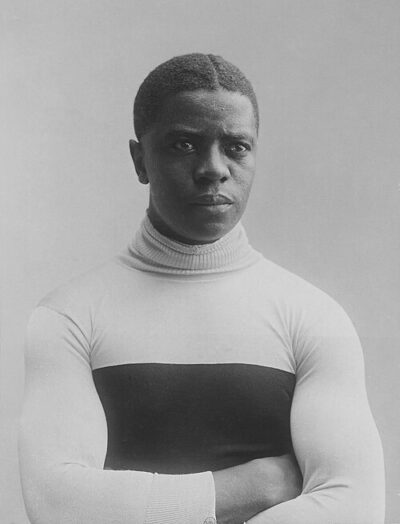
Marshall Taylor
Marshall Taylor was an American racing cyclist. Born November 26, 1878, in Indianapolis. Died June 21, 1932, in Chicago. Awards include United States Bicycling Hall of Fame and UCI Hall of Fame.
Facts
12 facts · 2 confirmed by two sources · 5 cited · 5 from one source
Where this comes from
Papalocal keeps its own record. It started from these sources; what each one said is kept here as it was copied, so a change on their side never changes this page by itself. Tap one to read its version.
What Wikidata says · copied November 18, 2026 · revision 2571572990
- Described as
- American racing cyclist (1878-1932)
- Other names
- Marshall Walter Taylor, Major Taylor
- Born
- November 26, 1878 · 2 references
- Died
- June 21, 1932 · 1 reference
- Born in
- Indianapolis
- Died in
- Chicago · 1 reference
- Buried in
- Mount Glenwood Memory Gardens (South) · 1 reference
- Citizen of
- United States
- Occupation
- sport cyclist; writer · 1 reference
- Sport
- track cycling
- Awards
- United States Bicycling Hall of Fame (1989) · 1 reference; UCI Hall of Fame (2000) · 1 reference
- Website
- http://majortaylor.biz/
- Wikipedias with a page
- 17
Wikidata item Q1379832 (wikidata.org/wiki/Q1379832), public domain (CC0). Copied November 18, 2026.
What Wikipedia says · copied November 18, 2026 · revision 1380379121
Marshall Walter "Major" Taylor (November 26, 1878 – June 21, 1932) was an American professional cyclist. He has been called "the first Black American global sports superstar."
He was born and raised in Indianapolis, where he worked in bicycle shops and began racing multiple distances in the track and road disciplines of cycling. As a teenager, he moved to Worcester, Massachusetts, with his employer/coach/mentor and continued his successful amateur career, which included breaking track records.
Taylor turned professional in 1896, at the age of 18, living in cities on the East Coast and participating in multiple track events including six-day races. He moved his focus to the sprint event in 1897, competing in a national racing circuit, winning many races and gaining popularity with the public. In 1898 and 1899, he set numerous world records in race distances ranging from the quarter-mile (0.4 km) to the two-mile (3.2 km).
Taylor won the 1-mile sprint event at the 1899 world track championships to become the first Black American to achieve the level of world champion and the second Black athlete to win a world championship in any sport (following Canadian boxer George Dixon, 1890). Taylor was also a national sprint champion in 1899 and 1900. He raced in the U.S., Europe and Australia from 1901 to 1904, beating the world's best riders. After a 2+1⁄2-year hiatus, he made a comeback in 1907–1909, before retiring at age 32 to his home in Worcester in 1910.
Towards the end of his life Taylor faced severe financial difficulties. He spent the final two years of his life in Chicago, Illinois, where he died of a heart attack in 1932.
Throughout his career he challenged the racial prejudice he encountered on and off the track and became a pioneering role model for other athletes facing racial discrimination. Several cycling clubs, trails, and events in the U.S. have been named in his honor, as well as the Major Taylor Velodrome in Indianapolis and Major Taylor Boulevard in Worcester. Other tributes include memorials and historic markers in Worcester, Indianapolis, and at his gravesite in Chicago. He has also been memorialized in film, music and fashion.
- Born, in its opening lines
- November 26, 1878
- Died, in its opening lines
- June 21, 1932
From the Wikipedia article “Major Taylor” (en.wikipedia.org/wiki/Major_Taylor), by its contributors, under CC BY-SA 4.0 (creativecommons.org/licenses/by-sa/4.0/). Copied November 18, 2026; not changed.
Confirmed Two sources agree. Cited One source, and it names where it got it. One source One source, without a reference of its own. Sources disagree The sources disagree. We show the best-supported value and keep theirs below.
