
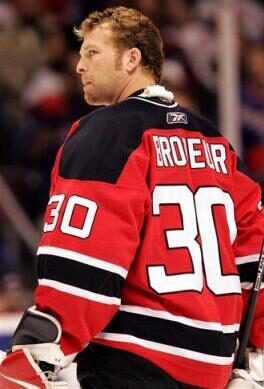
Martin Brodeur
Martin Brodeur is a Canadian-American ice hockey player. Born May 6, 1972, in Montreal. Teams include New Jersey Devils. Awards include Stanley Cup, Calder Memorial Trophy and Vezina Trophy (4 times).
Facts
17 facts · 1 confirmed by two sources · 7 cited · 9 from one source
Where this comes from
Papalocal keeps its own record. It started from these sources; what each one said is kept here as it was copied, so a change on their side never changes this page by itself. Tap one to read its version.
What Wikidata says · copied November 15, 2026 · revision 2569391777
- Described as
- Canadian-American ice hockey player
- Other names
- Martin Pierre Brodeur
- Born
- May 6, 1972 · 2 references
- Born in
- Montreal
- Citizen of
- United States; Canada
- Occupation
- ice hockey player · 1 reference; ice hockey coach
- Teams
- New Jersey Devils
- Sport
- ice hockey · 1 reference
- Awards
- Stanley Cup; Calder Memorial Trophy (1994) · 2 references; Vezina Trophy (4 times) (2003, 2004, 2007, 2008) · 2 references; William M. Jennings Trophy (5 times) (1997, 1998, 2003, 2004, 2010) · 2 references; Quebec Sports Hall of Fame
- Children
- Jeremy Brodeur
- Father
- Denis Brodeur
- Siblings
- Claude Brodeur · 1 reference
- Height
- 1.88 m (6 ft 2 in) · 1 reference
- Wikipedias with a page
- 30
Wikidata item Q357465 (wikidata.org/wiki/Q357465), public domain (CC0). Copied November 15, 2026.
What Wikipedia says · copied November 15, 2026 · revision 1384885276
Martin Pierre Brodeur (French pronunciation: [maʁtɛ̃ bʁɔdœʁ]; born May 6, 1972) is a Canadian-American professional ice hockey executive and former player. He played 22 seasons as a goaltender in the National Hockey League (NHL), 21 of them for the New Jersey Devils, with whom he won three Stanley Cup championships and five Eastern Conference championships in 17 postseason campaigns. He also won two Olympic gold medals with Canada, his first as the starting goaltender for the team in 2002, and his second as the backup goaltender in 2010, as well as several other medals with Canada in other international competitions. Brodeur is widely regarded as one of the greatest goaltenders of all time. In 2017, he was named by the league as one of the "100 Greatest NHL Players", and the following year, he was elected to the Hockey Hall of Fame.
Brodeur holds numerous NHL and franchise records among goaltenders; he ranks as the league's all-time regular season leader in wins (691), losses (397), shutouts (125), and games played (1,266). He won at least 30 games in twelve straight seasons between 1995–96 and 2007–08 and is the only goaltender in NHL history with eight 40-win seasons. He is a four-time Vezina Trophy winner, a five-time William M. Jennings Trophy winner, a ten-time NHL All-Star, and a Calder Memorial Trophy winner. He is one of 18 NHL goaltenders to score a goal in the regular season and the second to do so in the playoffs; his three goals are the most of any NHL goaltender. He only had three seasons where he posted more losses than wins.
Brodeur used a hybrid style of goaltending by standing up more than typical butterfly style goaltenders, though he adapted to more modern techniques at the latter stage of his career. He was known for his puck handling, his positional play, and his reflexes, especially with his glove hand. Brodeur's prowess at puck handling was so well known that it led in part to the NHL changing its rules to restrict where goaltenders were allowed to handle the puck outside of the goal crease, adding what is known as "the Brodeur rule" after the 2004–05 NHL lockout. He announced his retirement in the middle of the 2014–15 season after a brief stint with the St. Louis Blues, having played in just seven games with the team. He is the current executive vice president of business development for the Devils.
- Born, in its opening lines
- May 6, 1972
From the Wikipedia article “Martin Brodeur” (en.wikipedia.org/wiki/Martin_Brodeur), by its contributors, under CC BY-SA 4.0 (creativecommons.org/licenses/by-sa/4.0/). Copied November 15, 2026; not changed.
Confirmed Two sources agree. Cited One source, and it names where it got it. One source One source, without a reference of its own. Sources disagree The sources disagree. We show the best-supported value and keep theirs below.
