
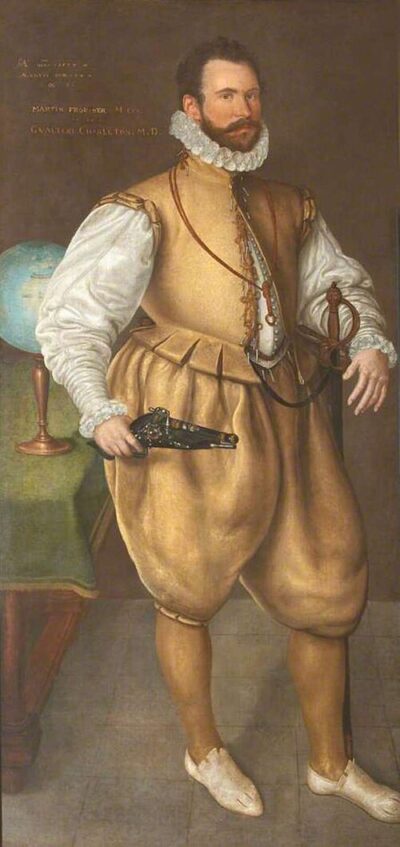
Martin Frobisher was an English seaman and privateer. Born 1535, in Altofts. Died November 15, 1594, in Plymouth. Awards include Person of National Historic Significance.
Facts
9 facts · 0 confirmed by two sources · 4 cited · 5 from one source
Where this comes from
Papalocal keeps its own record. It started from these sources; what each one said is kept here as it was copied, so a change on their side never changes this page by itself. Tap one to read its version.
What Wikidata says · copied November 16, 2026 · revision 2569108038
- Described as
- English seaman and privateer (1535–1594)
- Other names
- Sir Martin Frobisher, Frobisher, Martin
- Born
- 1535 · 11 references
- Died
- November 15, 1594 · 2 references
- Born in
- Altofts
- Died in
- Plymouth · 1 reference
- Buried in
- St Giles-without-Cripplegate
- Citizen of
- Kingdom of England
- Occupation
- explorer
- Awards
- Person of National Historic Significance · 1 reference
- Military rank
- admiral
- Wikipedias with a page
- 42
Wikidata item Q80288 (wikidata.org/wiki/Q80288), public domain (CC0). Copied November 16, 2026.
What Wikipedia says · copied November 16, 2026 · revision 1383920768
Sir Martin Frobisher (; c. 1535/1539 – 22 November 1594) was an English sea captain and privateer who made three voyages to the New World looking for the North-west Passage. He probably sighted Resolution Island near Labrador in eastern Canada, before entering Frobisher Bay and landing on present-day Baffin Island.
On his second voyage, Frobisher found what he thought was gold ore and carried 200 short tons (180 t) of it home on three ships. He initially determined a profit of £5.20 per ton (equivalent to £1,800 per ton in 2025). Encouraged, Frobisher returned to Canada with an even larger fleet and dug several mines around Frobisher Bay. He eventually carried 1,350 tons of the ore back to England, where, after years of smelting, it was realised that the ore was a worthless rock containing the mineral hornblende.
As an English privateer, he plundered riches from French ships. He was later knighted for his service in repelling the Spanish Armada in 1588. Named in his honour, Frobisher Bay lies close to Iqaluit, the capital of Nunavut.
From the Wikipedia article “Martin Frobisher” (en.wikipedia.org/wiki/Martin_Frobisher), by its contributors, under CC BY-SA 4.0 (creativecommons.org/licenses/by-sa/4.0/). Copied November 16, 2026; not changed.
Confirmed Two sources agree. Cited One source, and it names where it got it. One source One source, without a reference of its own. Sources disagree The sources disagree. We show the best-supported value and keep theirs below.
