
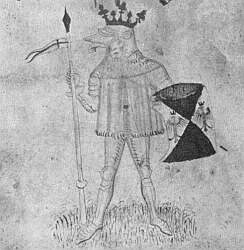
Martin I of Sicily
Martin I of Sicily was a King of Sicily and Infante and Crown prince of Aragon. Born July 25, 1374, in Kingdom of Valencia. Died July 25, 1409, in Cagliari. Positions held include King Consort of Sicily (1392–1401) and King of Sicily (1401–1409).
Facts
20 facts · 0 confirmed by two sources · 1 cited · 18 from one source · 1 where the sources disagree
What’s different
- Born: we show July 25, 1374 (Sources disagree). Wikidata also lists 1375 and 1376
Where this comes from
Papalocal keeps its own record. It started from these sources; what each one said is kept here as it was copied, so a change on their side never changes this page by itself. Tap one to read its version.
What Wikidata says · copied November 16, 2026 · revision 2516581560
- Described as
- King of Sicily and Infante and Crown prince of Aragon
- Other names
- Martin of Aragon, Martin the Younger, Martin Robert
- Born
- July 25, 1374; 1375; 1376
- Died
- July 25, 1409
- Born in
- Kingdom of Valencia
- Died in
- Cagliari
- Buried in
- Cagliari Cathedral
- Cause of death
- malaria
- Name at birth
- Martí Robert
- Occupation
- ruler; monarch
- Positions held
- King Consort of Sicily (1392–1401); King of Sicily (1401–1409)
- Spouse
- Blanche I of Navarre (1403–) · 1 reference; Maria, Queen of Sicily (1390–) · 1 reference
- Children
- Yolande of Aragon, Countess of Niebla; Peter of Aragon, Heir of Sicily · 1 reference; Martin of Aragon, Heir of Sicily; Frederick of Aragon, Count of Luna
- Father
- Martin of Aragon
- Mother
- Maria de Luna
- Religion
- Christianity
- Wikipedias with a page
- 31
Wikidata item Q468616 (wikidata.org/wiki/Q468616), public domain (CC0). Copied November 16, 2026.
What Wikipedia says · copied November 16, 2026 · revision 1358814528
Martin I of Sicily (c. 1374/1376 – 25 July 1409), called the Younger, was King of Sicily from his marriage to Queen Maria in 1390 until his death in 1409.
Martin's father was the future King Martin I of Aragon, and his grandparents were King Peter IV of Aragon and Eleanor of Sicily. In February 1390 he married Maria of Sicily, born in 1362/1363. In 1392 he returned with Maria to Sicily with a military force and defeated a group of opposing barons. In 1398 the couple had their only son Peter, crown prince of Sicily, who died in 1400. He ruled Sicily jointly with Maria until her death at Lentini on 25 May 1401. At that time, he repudiated the Treaty of Villeneuve (1372) and ruled Sicily alone. After his death in 1409 in Cagliari, Sardinia, his father, by then king of Aragon, ruled Sicily as Martin II.
After Maria's death Martin I the Younger married at Catania on 21 May 1402 by proxy and on 26 December 1402 in person Blanche of Navarre, who was heiress of the Evreux family and the future queen of Navarre, by whom he had an only son Martin in 1403, who died in Valencia in 1407. No offspring of his two marriages survived childhood; the only issue he left was a bastard son by Sicilian-born Tarsia Rizzari, Fadrique of Aragon, Count of Luna and Ejerica and Lord of Segorbe, born in 1400/1403, whom Martin II tried to make his successor in the Aragonese Empire. But the effort failed, and Fadrique was denied the succession by the Pact of Caspe. Fadrique married Yolande Louise (Violante Luisa) de Mur and died at Urena in 1438 without issue.
He also left a bastard daughter by Sicilian-born Agathe de Pesce, named Violante of Aragon, who died c. 1428. She was married twice: first in 1405 as the second wife (some say she was his mistress) to Enrique Pérez de Guzmán, 2nd Count de Niebla (1371–1436); and second, she married Enrique's cousin Martín de Guzmán.
Martin the Younger led the troops in the conquest of Sardinia in 1409, decisively defeating the ruler of Arborea at the Battle of Sanluri just before his own death.
From the Wikipedia article “Martin I of Sicily” (en.wikipedia.org/wiki/Martin_I_of_Sicily), by its contributors, under CC BY-SA 4.0 (creativecommons.org/licenses/by-sa/4.0/). Copied November 16, 2026; not changed.
Confirmed Two sources agree. Cited One source, and it names where it got it. One source One source, without a reference of its own. Sources disagree The sources disagree. We show the best-supported value and keep theirs below.
