
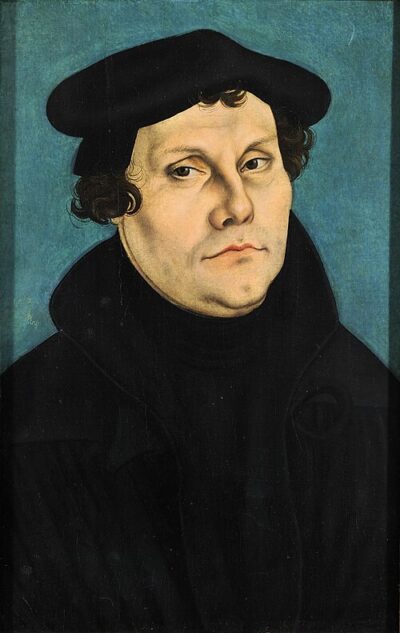
Martin Luther
Martin Luther was a German priest and theologian. Born November 10, 1483, in Eisleben. Died February 18, 1546, in Eisleben. Positions held include university teacher (1508–). Known for Ninety-five Theses and Luther Bible. Educated at University of Erfurt (1392-1816).
Facts
43 facts · 2 confirmed by two sources · 22 cited · 19 from one source
Where this comes from
Papalocal keeps its own record. It started from these sources; what each one said is kept here as it was copied, so a change on their side never changes this page by itself. Tap one to read its version.
What Wikidata says · copied November 16, 2026 · revision 2568738065
- Described as
- German priest and theologian (1483–1546)
- Other names
- Junker Jörg, Martinus Luther, Martin Luder
- Born
- November 10, 1483 · 5 references
- Died
- February 18, 1546 · 4 references
- Born in
- Eisleben · 1 reference
- Died in
- Eisleben · 2 references
- Buried in
- Castle Church
- Name at birth
- Martin Luder · 2 references
- Citizen of
- Holy Roman Empire · 1 reference; Electorate of Saxony · 1 reference
- Occupation
- translator · 2 references; theologian · 4 references; lawyer; Bible translator; hymnwriter · 1 reference; Protestant reformer · 1 reference; philosopher · 1 reference; pastor · 1 reference
- Positions held
- university teacher (1508–)
- Worked for
- University of Wittenberg · 1 reference
- Education
- University of Erfurt (1392-1816) (1501–1505)
- Known for
- Ninety-five Theses; Luther Bible
- Field
- theology · 1 reference; philosophy · 1 reference; Protestant Reformation · 1 reference; literature · 1 reference; translation · 1 reference
- Spouse
- Katharina von Bora (1525–1546) · 1 reference
- Children
- Elisabeth Luther · 1 reference; Paul Luther · 1 reference; Magdalena Luther · 1 reference; Margaretha Luther · 2 references; Martin Luther, Jr. · 1 reference; Johannes Luther · 1 reference
- Father
- Hans Luther
- Mother
- Margarethe Luther
- Siblings
- Jacob Luther
- Religion
- Catholicism (2 times) (1519–1521); Lutheranism (1519–)
- Lived in
- Eisleben (–1484); Mansfeld (1484–1497); Magdeburg (1497–1498); Eisenach (1498–1501); Erfurt (1501–1508)
- Wikipedias with a page
- 260
Wikidata item Q9554 (wikidata.org/wiki/Q9554), public domain (CC0). Copied November 16, 2026.
What Wikipedia says · copied November 16, 2026 · revision 1385564965
Martin Luther ( LOO-thər; German: [ˈmaʁtiːn ˈlʊtɐ] ; 10 November 1483 – 18 February 1546) was a German priest, theologian, author, hymnwriter, professor, and former Augustinian friar. Luther was the seminal figure of the Protestant Reformation, and his theological beliefs form the basis of Lutheranism. He is considered one of the most influential figures in Western and Christian history.
Born in Eisleben, Luther was ordained to the priesthood in 1507. He came to reject various teachings and practices of the Roman Catholic Church, in particular the view on indulgences and papal authority. Luther initiated an international debate on these in works like his Ninety-five Theses, which he authored in 1517. In 1520 Pope Leo X demanded that Luther renounce all of his writings, and when Luther refused to do so, excommunicated him in January 1521. Later that year the Holy Roman Emperor, Charles V, condemned Luther as an outlaw at the Diet of Worms. At the time of Luther's death in 1546, his excommunication was still in effect.
Luther taught that justification is not earned by any human acts or intents or merit. He preached it instead is received only as the free gift of God's grace through the believer's faith in Jesus. Luther held that good works were a necessary fruit of living faith, part of the process of sanctification. Luther's theology challenged the authority and office of the pope and bishops by teaching that the Bible is the only source of divinely revealed knowledge on the Gospel. Those who identify with these, as well as Luther's wider teachings, are called Lutherans, although Luther insisted on Christian or Evangelical (German: evangelisch), as the only acceptable names for persons who professed Christ. Luther's translation of the Bible into German (1534) made the Bible vastly more accessible to the laity, which had a tremendous impact on both the Church and German culture. It fostered the development of a standard version of the German language, added several principles to the art of translation, and influenced the writing of an English translation, the Tyndale Bible. His hymns influenced the development of singing in Protestant churches. His marriage to Katharina von Bora, a former nun, set a model for the practice of clerical marriage, allowing Protestant clergy to marry.
Luther expressed staunchly antisemitic views, calling for the expulsion of Jews and the burning of synagogues.
In 1523, Luther wrote that Jesus Christ was born a Jew which discouraged mistreatment of the Jews and advocated their conversion by proving that the Old Testament could be shown to speak of Jesus Christ. However, as the Reformation grew, Luther began to lose hope in large-scale Jewish conversion to Christianity, and in the years his health deteriorated he grew more acerbic toward the Jews, writing against them with the kind of venom he had already unleashed on the Anabaptists, Zwingli, and the pope. These works also targeted Roman Catholics, Anabaptists, and nontrinitarian Christians. While Luther did not advocate the murder of Jews, some historians contend that his rhetoric encouraged antisemitism in Germany and the emergence, centuries later, of the Nazi Party.
- Born, in its opening lines
- November 10, 1483
- Died, in its opening lines
- February 18, 1546
From the Wikipedia article “Martin Luther” (en.wikipedia.org/wiki/Martin_Luther), by its contributors, under CC BY-SA 4.0 (creativecommons.org/licenses/by-sa/4.0/). Copied November 16, 2026; not changed.
Confirmed Two sources agree. Cited One source, and it names where it got it. One source One source, without a reference of its own. Sources disagree The sources disagree. We show the best-supported value and keep theirs below.
