
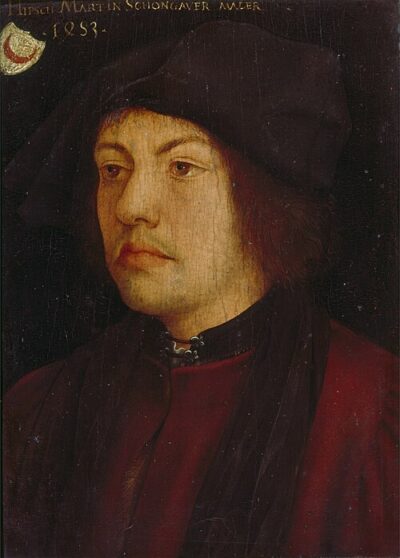
Martin Schongauer was a German artist (c. 1450–1491). Born 1440, in Colmar. Died February 2, 1491, in Breisach. Known for Madonna of the Rose Bower. Educated at Leipzig University.
Facts
12 facts · 0 confirmed by two sources · 9 cited · 3 from one source
Where this comes from
Papalocal keeps its own record. It started from these sources; what each one said is kept here as it was copied, so a change on their side never changes this page by itself. Tap one to read its version.
What Wikidata says · copied November 16, 2026 · revision 2566034062
- Described as
- German artist (c. 1450–1491)
- Other names
- Martin Schone, Martin Schön, Marutin Shōngauā, Martin Hipsch, Martin Hübsch, Buon Martino, Martin Schoen, Schön, M. Schoen, M[artin] Schoen, Martin Schoon, Bon Martini todisco coetaneo di Alberto
- Born
- 1440 · 1 reference
- Died
- February 2, 1491 · 2 references
- Born in
- Colmar · 2 references
- Died in
- Breisach · 2 references
- Occupation
- painter · 3 references; engraver; graphic artist · 1 reference; copper engraver · 3 references; draftsperson · 2 references; artist · 2 references
- Education
- Leipzig University
- Known for
- Madonna of the Rose Bower
- Wikipedias with a page
- 35
Wikidata item Q155575 (wikidata.org/wiki/Q155575), public domain (CC0). Copied November 16, 2026.
What Wikipedia says · copied November 16, 2026 · revision 1335542299
Martin Schongauer (c. 1450–1453, Colmar – 2 February 1491, Breisach), also known as Martin Schön ("Martin beautiful") or Hübsch Martin ("pretty Martin") by his contemporaries, was an Alsatian engraver and painter. He was the most important printmaker north of the Alps before Albrecht Dürer, a younger artist who collected his work. Schongauer is the first German painter to be a significant engraver, although he seems to have had the family background and training in goldsmithing which was usual for early engravers.
The bulk of Schongauer's surviving production is 116 engravings, all with his monogram but none dated, which were well known not only in Germany, but also in Italy and even made their way to England and Spain. Vasari says that Michelangelo copied one of his engravings, in the Trial of Saint Anthony. His style shows no trace of Italian influence, but a very clear and organised Gothic, which draws from both German and Early Netherlandish painting.
Recent scholarship, building on the work of Max Lehrs, attributes 116 engravings to him, with many also being copied by other artists (including his monogram), as was common in the period. His prolific contemporary Israhel van Meckenem did close copies of 58 engravings, exactly half of Schongauer's surviving output, and took motifs or figures from more, as well as apparently engraving some drawings that are now lost.
There are some fine drawings, including ones dated and signed with his monogram, and a surviving few paintings in oil and fresco.
From the Wikipedia article “Martin Schongauer” (en.wikipedia.org/wiki/Martin_Schongauer), by its contributors, under CC BY-SA 4.0 (creativecommons.org/licenses/by-sa/4.0/). Copied November 16, 2026; not changed.
Confirmed Two sources agree. Cited One source, and it names where it got it. One source One source, without a reference of its own. Sources disagree The sources disagree. We show the best-supported value and keep theirs below.
