
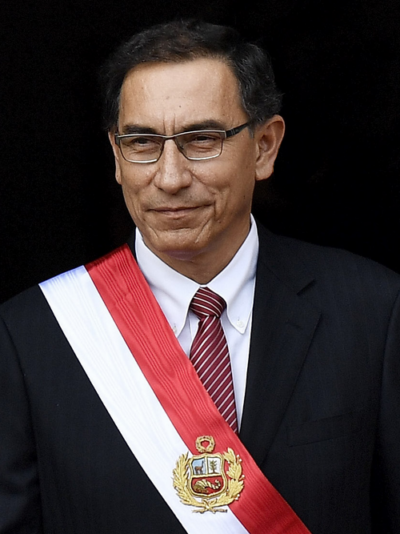
Martín Vizcarra
Martín Vizcarra is a President of Peru from 2018 to 2020. Born March 22, 1963, in Lima. Positions held include Vice President of Peru (2016–2018), Minister of Transportation and Communications (2016–2017) and regional governor of Moquegua Region (2011–2014). Educated at National University of Engineering and ESAN University. Awards include Grand Cross with Collar of the Order of the Sun of Peru, Collar of the Order of Isabella the Catholic and Golden Key of Madrid.
Facts
23 facts · 1 confirmed by two sources · 11 cited · 11 from one source
Where this comes from
Papalocal keeps its own record. It started from these sources; what each one said is kept here as it was copied, so a change on their side never changes this page by itself. Tap one to read its version.
What Wikidata says · copied November 16, 2026 · revision 2562941814
- Described as
- President of Peru from 2018 to 2020
- Other names
- Martín, Vizcarra Cornejo, Martín Vizcarra Cornejo, Martín Alberto Vizcarra Cornejo, Martin Vizcarra
- Born
- March 22, 1963 · 4 references
- Born in
- Lima · 1 reference
- Name at birth
- Martín Alberto Vizcarra Cornejo · 1 reference
- Citizen of
- Peru
- Occupation
- civil engineer; politician · 2 references; engineer · 1 reference
- Positions held
- Vice President of Peru (2016–2018); Minister of Transportation and Communications (2016–2017); regional governor of Moquegua Region (2011–2014); President of Peru (2018–2020); Ambassador of Peru to Canada (2017–2018)
- Worked for
- C y M Vizcarra S.A.C. (1992–2010)
- Education
- National University of Engineering (1979–1984) · 1 reference; ESAN University
- Awards
- Grand Cross with Collar of the Order of the Sun of Peru (2018) · 1 reference; Collar of the Order of Isabella the Catholic (2019) · 2 references; Golden Key of Madrid (2019) · 1 reference; Grand Collar of the Order of Prince Henry (2019) · 1 reference; Palmas Magisteriales (2014) · 1 reference
- Spouse
- Maribel Díaz Cabello · 1 reference
- Father
- César Vizcarra
- Siblings
- Mario Vizcarra
- Wikipedias with a page
- 51
Wikidata item Q24030720 (wikidata.org/wiki/Q24030720), public domain (CC0). Copied November 16, 2026.
What Wikipedia says · copied November 16, 2026 · revision 1380562099
Martín Alberto Vizcarra Cornejo (Latin American Spanish: [maɾˈtin alˈβeɾto βisˈkara koɾˈnexo] ; born 22 March 1963) is a Peruvian engineer and politician who served as President of Peru from 2018 to 2020. Vizcarra previously served as Governor of the Department of Moquegua (2011–2014), First Vice President of Peru (2016–2018), Minister of Transport and Communications of Peru (2016–2017), and Ambassador of Peru to Canada (2017–2018), with the latter three during the presidency of Pedro Pablo Kuczynski.
In the 2016 general election, Vizcarra ran with the Peruvians for Change presidential ticket as Pedro Pablo Kuczynski's running mate candidate for first vice president, narrowly defeating Keiko Fujimori's Popular Force ticket. On 23 March 2018, Vizcarra was sworn into office as President of Peru following the resignation of President Kuczynski. Throughout his tenure, Vizcarra remained independent from political parties, promoted reforms against corruption in the legislative and judicial branches, and vowed to not run for president when his term would end in 2021. During the COVID-19 pandemic in Peru, Vizcarra instituted stay-at-home orders and issued relief funds, but existing inequality, overcrowding and a largely informal economy saw Peru being heavily affected by the pandemic. As a result, Peru's gross domestic product declined thirty percent, increasing political pressure on Vizcarra's government.
On 30 September 2019, following what he described as a "factual denial of confidence" against his government, Vizcarra dissolved the Peruvian Congress and issued a decree for legislative elections. This initiated the 2019 constitutional crisis in which Congress unsuccessfully attempted to remove him and resulted in the resignation of Second Vice President Mercedes Aráoz. The snap election for a new congress was held on 26 January 2020, with the legislature elected becoming opposition-led once again. In September 2020, Congress opened impeachment proceedings against Vizcarra on grounds of "moral incapacity", accusing him of influence peddling after audio recordings were released by an opposition legislator, but the process did not receive enough votes to remove him from office.
On 9 November 2020, the Peruvian Congress impeached Vizcarra a second time after declaring him "morally incompetent" and removed him from office. The President of Congress and opposition leader Manuel Merino succeeded Vizcarra as President of Peru the following day. Vizcarra's impeachment incited street protests, as an overwhelming majority of Peruvians and political analysts believed the impeachment was unsubstantiated, with several Peruvian media outlets labeling the impeachment a "coup". President Merino resigned after six days in office following the killings of two protesters by police.
On 16 April 2021, former President Vizcarra was banned from holding public office for 10 years after allegedly jumping the line to get a COVID-19 vaccine in the Vacunagate controversy, by an 86–0 vote in Congress.
On 26 November 2025, Vizcarra was sentenced to 14 years in prison for taking bribes from construction companies during his tenure as Governor of Moquegua.
- Born, in its opening lines
- March 22, 1963
From the Wikipedia article “Martín Vizcarra” (en.wikipedia.org/wiki/Martín_Vizcarra), by its contributors, under CC BY-SA 4.0 (creativecommons.org/licenses/by-sa/4.0/). Copied November 16, 2026; not changed.
Confirmed Two sources agree. Cited One source, and it names where it got it. One source One source, without a reference of its own. Sources disagree The sources disagree. We show the best-supported value and keep theirs below.
