
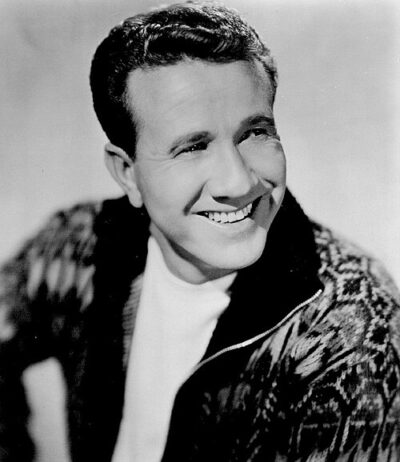
Marty Robbins
Marty Robbins was an American country singer. Born September 26, 1925, in Glendale. Died December 8, 1982, in Nashville. Educated at Glendale High School. Awards include star on Hollywood Walk of Fame and Grammy Awards.
Facts
30 facts · 2 confirmed by two sources · 6 cited · 22 from one source
Where this comes from
Papalocal keeps its own record. It started from these sources; what each one said is kept here as it was copied, so a change on their side never changes this page by itself. Tap one to read its version.
What Wikidata says · copied November 15, 2026 · revision 2563760227
- Described as
- American country singer (1925–1982)
- Born
- September 26, 1925 · 1 reference
- Died
- December 8, 1982 · 1 reference
- Born in
- Glendale
- Died in
- Nashville
- Buried in
- Tennessee
- Cause of death
- surgical complications
- Citizen of
- United States
- Occupation
- singer-songwriter; composer; racing automobile driver; singer · 1 reference; musician · 2 references; pop singer · 1 reference; bandleader · 1 reference; guitarist · 1 reference
- Education
- Glendale High School
- Sport
- auto racing
- Genre
- country music; western music
- Instrument
- guitar; voice
- Record label
- Columbia Records; Fontana Records; Philips Records; MCA Records
- Awards
- star on Hollywood Walk of Fame · 1 reference; Grammy Awards · 1 reference
- Field
- country music · 1 reference
- Military branch
- United States Navy
- Website
- http://www.martyrobbins.com/
- Wikipedias with a page
- 27
Wikidata item Q919565 (wikidata.org/wiki/Q919565), public domain (CC0). Copied November 15, 2026.
What Wikipedia says · copied November 15, 2026 · revision 1384783447
Martin David Robinson (September 26, 1925 – December 8, 1982), known professionally as Marty Robbins, was an American country and western singer and songwriter, as well as a professional stock car racing driver and team owner. He was one of the most popular and successful singers of his genre for most of his nearly four-decade career, which spanned from the late 1940s to the early 1980s. He was also an early outlaw country pioneer.
Born in Glendale, Arizona, Robbins taught himself guitar while serving in the U.S. Navy during World War II, and subsequently drew fame performing in clubs in and around his hometown. In 1952, he released his first number-one country song, "I'll Go On Alone". Four years later, he released his second number-one hit "Singing the Blues", and one year later, released two more number-one hits, "A White Sport Coat" and "The Story of My Life". In 1959, Robbins released his signature song, "El Paso", for which he won the Grammy Award for Best Country and Western Recording. The song began Robbins' association with Western balladry, a style that became a staple of his career. His later releases that drew critical acclaim include "Don't Worry", "Big Iron", "Devil Woman", and "Honkytonk Man", the last for which the 1982 Clint Eastwood film is named, and in which Robbins made his final appearance before his death.
Over the course of his career, Robbins recorded more than 500 songs and 60 albums, and won two Grammy Awards, was elected to the Country Music Hall of Fame and Nashville Songwriters Hall of Fame, and was named the 1960s Artist of the Decade by the Academy of Country Music. His songs "El Paso" and "Big Iron" were ranked by the Western Writers of America among the top-100 Western songs of all time. Robbins was a commercial success in both the country and pop genres, and his songs were covered by many other famous artists, including Johnny Cash, the Grateful Dead, and Elvis Presley. Johnny Cash noted, "there's no greater country singer than Marty Robbins." His music continues to have an influence in pop culture today, featuring prominently in several films, television shows, and video games.
- Born, in its opening lines
- September 26, 1925
- Died, in its opening lines
- December 8, 1982
From the Wikipedia article “Marty Robbins” (en.wikipedia.org/wiki/Marty_Robbins), by its contributors, under CC BY-SA 4.0 (creativecommons.org/licenses/by-sa/4.0/). Copied November 15, 2026; not changed.
Confirmed Two sources agree. Cited One source, and it names where it got it. One source One source, without a reference of its own. Sources disagree The sources disagree. We show the best-supported value and keep theirs below.
