
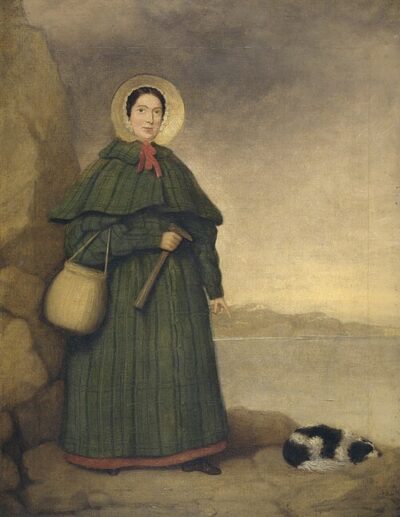
Mary Anning
Mary Anning was a British fossil collector and palaeontologist. Born May 21, 1799, in Lyme Regis. Died March 9, 1854, in Lyme Regis. Known for discovery and Gesamtverband der Deutschen Versicherungswirtschaft.
Facts
14 facts · 1 confirmed by two sources · 5 cited · 7 from one source · 1 where the sources disagree
What’s different
- Died: we show March 9, 1854 (Sources disagree). Wikipedia says March 9, 1847
Where this comes from
Papalocal keeps its own record. It started from these sources; what each one said is kept here as it was copied, so a change on their side never changes this page by itself. Tap one to read its version.
What Wikidata says · copied November 16, 2026 · revision 2568947664
- Described as
- British fossil collector and palaeontologist (1799–1847)
- Other names
- Anning
- Born
- May 21, 1799 · 8 references
- Died
- March 9, 1854 · 1 reference
- Born in
- Lyme Regis · 3 references
- Died in
- Lyme Regis · 1 reference
- Citizen of
- United Kingdom of Great Britain and Ireland
- Occupation
- paleontologist · 1 reference; trader of naturalia · 1 reference; fossil collector · 1 reference; scientific collector · 1 reference
- Known for
- discovery · 1 reference; Gesamtverband der Deutschen Versicherungswirtschaft
- Field
- paleontology · 1 reference
- Religion
- Congregational churches; Anglicanism
- Wikipedias with a page
- 64
Wikidata item Q230491 (wikidata.org/wiki/Q230491), public domain (CC0). Copied November 16, 2026.
What Wikipedia says · copied November 16, 2026 · revision 1384569873
Mary Anning (21 May 1799 – 9 March 1847) was an English fossil collector, dealer, and palaeontologist. She became known internationally for her discoveries in Jurassic marine fossil beds in the cliffs along the English Channel at Lyme Regis in the county of Dorset, South West England. Anning's findings contributed to changes in scientific thinking about prehistoric life and the history of the Earth.
Anning searched for fossils in the area's Blue Lias and Charmouth Mudstone cliffs, particularly during the winter months when landslides exposed new fossils that had to be collected quickly before they were lost to the sea. Her discoveries included the first correctly identified ichthyosaur skeleton when she was twelve years old; the first two nearly complete plesiosaur skeletons; the first pterosaur skeleton located outside Germany; and fish fossils. Her observations played a key role in the discovery that coprolites, known as bezoar stones at the time, were fossilised faeces, and she also discovered that belemnite fossils contained fossilised ink sacs like those of modern cephalopods.
Anning struggled financially for much of her life. As a woman, she was not eligible to join the Geological Society of London, and she did not always receive full credit for her scientific contributions. However, her friend, geologist Henry De la Beche, who painted Duria Antiquior, the first widely circulated pictorial representation of a scene from prehistoric life derived from fossil reconstructions, based it largely on fossils Anning had found and sold prints of it for her benefit.
Anning became well known in geological circles in Britain, Europe, and America, and was consulted on issues of anatomy as well as fossil collecting. The only scientific writing of hers published in her lifetime appeared in the Magazine of Natural History in 1839, an extract from a letter that Anning had written to the magazine's editor questioning one of its claims. After her death in 1847, Anning's unusual life story attracted increasing interest.
- Born, in its opening lines
- May 21, 1799
- Died, in its opening lines
- March 9, 1847
From the Wikipedia article “Mary Anning” (en.wikipedia.org/wiki/Mary_Anning), by its contributors, under CC BY-SA 4.0 (creativecommons.org/licenses/by-sa/4.0/). Copied November 16, 2026; not changed.
Confirmed Two sources agree. Cited One source, and it names where it got it. One source One source, without a reference of its own. Sources disagree The sources disagree. We show the best-supported value and keep theirs below.
