
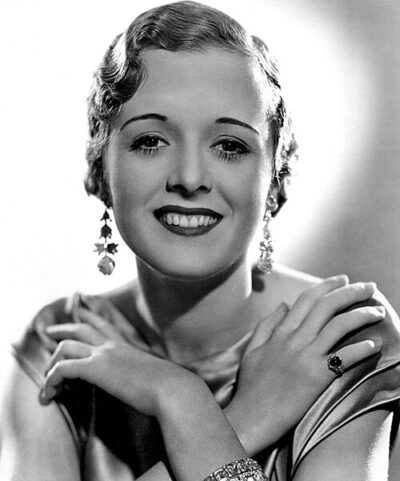
Mary Astor
Mary Astor was an American actress and author. Born May 3, 1906, in Quincy. Died September 25, 1987, in Woodland Hills. Known for The Great Lie. Awards include Academy Award for Best Supporting Actress and star on Hollywood Walk of Fame.
Facts
27 facts · 2 confirmed by two sources · 9 cited · 16 from one source
Where this comes from
Papalocal keeps its own record. It started from these sources; what each one said is kept here as it was copied, so a change on their side never changes this page by itself. Tap one to read its version.
What Wikidata says · copied November 13, 2026 · revision 2565610341
- Described as
- American actress and author (1906–1987)
- Other names
- Lucile Langhanke, Lucile Vasconcellos Langhanke, Astor, Mary Del Campo, Mary Hawks, Mary Thorpe, Mary Wheelock
- Born
- May 3, 1906 · 13 references
- Died
- September 25, 1987 · 10 references
- Born in
- Quincy · 1 reference
- Died in
- Woodland Hills · 1 reference
- Buried in
- Holy Cross Cemetery
- Cause of death
- cardiovascular disease
- Name at birth
- Lucile Vasconcellos Langhanke
- Citizen of
- United States
- Occupation
- novelist; stage actor; film actor; television actor; writer · 1 reference; actor · 1 reference
- Worked for
- Warner Bros. Entertainment
- Known for
- The Great Lie
- Awards
- Academy Award for Best Supporting Actress (1942); star on Hollywood Walk of Fame (1960) · 2 references
- Spouse
- Kenneth Hawks (1928–1930) · 1 reference; Manuel del Campo (1936–1941) · 1 reference; Franklyn Thorpe (1931–) · 1 reference; Thomas G. Wheelock (1945–) · 1 reference
- Children
- Marylyn Thorpe · 1 reference; Anthony Paul del Campo · 1 reference
- Father
- Otto Ludwig Wilhelm Langhanke · 1 reference
- Mother
- Helen Vasconcelles · 1 reference
- Religion
- Catholicism
- Wikipedias with a page
- 64
Wikidata item Q232109 (wikidata.org/wiki/Q232109), public domain (CC0). Copied November 13, 2026.
What Wikipedia says · copied November 13, 2026 · revision 1378359954
Mary Astor (born Lucile Vasconcellos Langhanke; May 3, 1906 – September 25, 1987) was an American actress. Although her career spanned several decades, she may be best remembered for her performance as Brigid O'Shaughnessy in The Maltese Falcon (1941).
Astor began her long motion picture career when a teenager in the silent movies of the early 1920s. When talkies arrived, her voice was initially considered too masculine and she was off the screen for a year. After she appeared in a play with her friend Florence Eldridge, film offers returned, and she resumed her career in sound pictures.
In 1936, Astor's career was nearly destroyed by scandal. She had an affair with the playwright George S. Kaufman and was branded an adulterous wife by her former husband during a custody fight over their daughter. Overcoming these stumbling blocks in her private life, she went on to greater film success, eventually winning an Academy Award for Best Supporting Actress for her portrayal of the concert pianist Sandra Kovak in The Great Lie (1941).
Astor was a Metro-Goldwyn-Mayer contract player through most of the 1940s and continued to work in film, television and on stage until her retirement in 1964. She authored five novels. Her autobiography was a bestseller, as was her later book, A Life on Film, which was about her career.
The director Lindsay Anderson wrote of Astor in 1990 that when "two or three who love the cinema are gathered together, the name of Mary Astor always comes up, and everybody agrees that she was an actress of special attraction, whose qualities of depth and reality always seemed to illuminate the parts she played."
- Born, in its opening lines
- May 3, 1906
- Died, in its opening lines
- September 25, 1987
From the Wikipedia article “Mary Astor” (en.wikipedia.org/wiki/Mary_Astor), by its contributors, under CC BY-SA 4.0 (creativecommons.org/licenses/by-sa/4.0/). Copied November 13, 2026; not changed.
Confirmed Two sources agree. Cited One source, and it names where it got it. One source One source, without a reference of its own. Sources disagree The sources disagree. We show the best-supported value and keep theirs below.
