
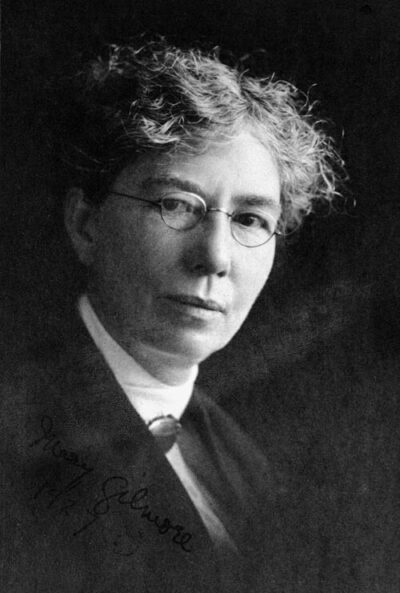
Mary Gilmore
Mary Gilmore was an Australian poet. Born August 16, 1865, in Goulburn. Died December 3, 1962, in Sydney. Known for Battlefields and Fourteen Men. Awards include Victorian Honour Roll of Women, Dame Commander of the Order of the British Empire and Australian Media Hall of Fame.
Facts
20 facts · 2 confirmed by two sources · 11 cited · 7 from one source
What’s different
- Born: we show August 16, 1865 (Confirmed). Wikidata also lists August 16, 1885
Where this comes from
Papalocal keeps its own record. It started from these sources; what each one said is kept here as it was copied, so a change on their side never changes this page by itself. Tap one to read its version.
What Wikidata says · copied November 18, 2026 · revision 2558160792
- Described as
- Australian poet (1865–1962)
- Other names
- Dame Mary Jean Gilmore, Dame Mary Jane Gilmore, Cameron, Mary Jean Cameron
- Born
- August 16, 1865 · 5 references; August 16, 1885 · 1 reference
- Died
- December 3, 1962 · 4 references
- Born in
- Goulburn · 1 reference
- Died in
- Sydney · 2 references
- Name at birth
- Mary Jean Cameron · 1 reference
- Citizen of
- Australia
- Occupation
- journalist · 1 reference; poet · 2 references; writer; social activist
- Political party
- Australian Labor Party
- Member of
- New Australia Co-operative Settlement Association · 1 reference
- Known for
- Battlefields · 1 reference; Fourteen Men
- Awards
- Victorian Honour Roll of Women (2001) · 1 reference; Dame Commander of the Order of the British Empire; Australian Media Hall of Fame · 1 reference
- Field
- poetry
- Religion
- Presbyterianism · 1 reference
- Lived in
- Paraguay (1895–1902) · 1 reference
- Wikipedias with a page
- 20
Wikidata item Q455761 (wikidata.org/wiki/Q455761), public domain (CC0). Copied November 18, 2026.
What Wikipedia says · copied November 18, 2026 · revision 1383854496
Dame Mary Jean Gilmore (née Cameron; 16 August 1865 – 3 December 1962) was an Australian writer and journalist known for her prolific contributions to Australian literature and the broader national discourse. She wrote both prose and poetry.
Gilmore was born in rural New South Wales, and spent her childhood in and around the Riverina, living both in small bush settlements and in larger country towns like Wagga Wagga. Gilmore qualified as a schoolteacher at the age of 16, and after a period in the country was posted to Sydney. She involved herself with the burgeoning labour movement and the Bulletin School of radical nationalists, and she also became a devotee of the utopian socialist views of William Lane. In 1893, Gilmore and 200 others followed Lane to Paraguay, where they formed the New Australia Colony. She started a family there, but the colony did not live up to expectations and they returned to Australia in 1902.
Drawing on her connections in Sydney, Gilmore found work with The Australian Worker as the editor of its women's section, a position she held from 1908 to 1931. She also wrote for a variety of other publications, including The Bulletin and The Sydney Morning Herald, becoming known as a campaigner for the welfare of the disadvantaged. Gilmore's first volume of poetry was brought out in 1910; she published prolifically for the rest of her life, mainly poetry but also memoirs and collections of essays. She wrote on a variety of themes, although the public imagination was particularly captured by her evocative views of country life. Her best known work is "No Foe Shall Gather Our Harvest", which served as a morale booster during World War II.
Gilmore's greatest recognition came in later life. She was the doyenne of the Sydney literary world, and became something of a national icon, making frequent appearances in the new media of radio and television. Gilmore maintained her prodigious output into old age, publishing her last book of verse in 1954, aged 89. Two years earlier she had begun writing a new column for the Tribune (the official newspaper of the Communist Party), which she continued for almost a decade. Gilmore died at the age of 97 and was accorded a state funeral, a rare honour for a writer. She has featured on the reverse of the Australian ten-dollar note since 1993.
- Born, in its opening lines
- August 16, 1865
- Died, in its opening lines
- December 3, 1962
From the Wikipedia article “Mary Gilmore” (en.wikipedia.org/wiki/Mary_Gilmore), by its contributors, under CC BY-SA 4.0 (creativecommons.org/licenses/by-sa/4.0/). Copied November 18, 2026; not changed.
Confirmed Two sources agree. Cited One source, and it names where it got it. One source One source, without a reference of its own. Sources disagree The sources disagree. We show the best-supported value and keep theirs below.
