
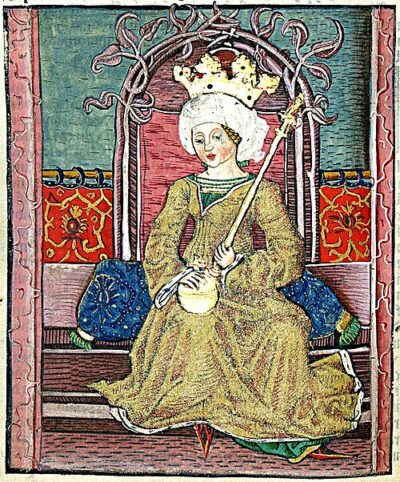
Mary I of Hungary
Mary I of Hungary was a Queen of Hungary. Born April 14, 1371, in Buda. Died May 17, 1395, in Buda. Positions held include Apostolic King of Hungary (1382–1385).
Facts
18 facts · 2 confirmed by two sources · 1 cited · 15 from one source
Where this comes from
Papalocal keeps its own record. It started from these sources; what each one said is kept here as it was copied, so a change on their side never changes this page by itself. Tap one to read its version.
What Wikidata says · copied November 16, 2026 · revision 2565411099
- Described as
- Queen of Hungary (1371-1395)
- Other names
- Mary I, Maria I, Mary of Anjou
- Born
- April 14, 1371
- Died
- May 17, 1395 · 1 reference
- Born in
- Buda · 1 reference
- Died in
- Buda
- Buried in
- Cathedral Basilica of St. Mary
- Cause of death
- childbirth
- Citizen of
- Poland; Hungary
- Occupation
- monarch; politician
- Positions held
- Apostolic King of Hungary (1382–1385)
- Political party
- politician before the emergence of political parties
- Spouse
- Sigismund (1385–) · 1 reference
- Children
- N. of Luxemburg, Prince of Hungary
- Father
- Louis I of Hungary · 1 reference
- Mother
- Elizabeth of Bosnia
- Siblings
- Catherine of Hungary; Jadwiga I of Poland
- Wikipedias with a page
- 48
Wikidata item Q154412 (wikidata.org/wiki/Q154412), public domain (CC0). Copied November 16, 2026.
What Wikipedia says · copied November 16, 2026 · revision 1375450134
Mary, also known as Maria of Anjou (Hungarian: Anjou Mária, Croatian: Marija Anžuvinska, Polish: Maria Andegaweńska; 1371 – 17 May 1395), reigned as Queen of Hungary and Croatia between 1382 and 1385, and from 1386 until her death. She was the daughter of Louis the Great, King of Hungary and Poland, and his wife, Elizabeth of Bosnia. Mary's marriage to Sigismund of Luxembourg, a member of the imperial Luxembourg dynasty, was already decided before her first birthday. A delegation of Polish prelates and lords confirmed her right to succeed her father in Poland in 1379.
Having no male siblings, Mary was crowned "king" of Hungary on 17 September 1382, seven days after Louis the Great's death. Her mother, who had assumed the regency, absolved the Polish noblemen from their oath of loyalty to Mary in favour of Mary's younger sister, Jadwiga (herself subsequently crowned "king" of Poland), in early 1383. The idea of a female monarch remained unpopular among the Hungarian noblemen, the majority of whom regarded Mary's distant cousin, Charles III of Naples, as the lawful heir. To strengthen Mary's position, the queen mother wanted her to marry Louis, the younger brother of Charles VI of France. Their engagement was announced in May 1385.
Charles III of Naples landed in Dalmatia in September 1385. Sigismund of Luxembourg invaded Upper Hungary (now Slovakia), forcing the queen mother to give 14-year-old Mary in marriage to him in October. However, they could not prevent Charles from entering Buda. After Mary renounced the throne, Charles was crowned king on 31 December 1385, but he was murdered at the instigation of Mary's mother in February 1386. Mary was restored, but the dead king's supporters captured her and her mother on 25 July. Queen Elizabeth was murdered in January 1387, but Mary was released on 4 June 1387. Mary officially remained co-ruler with Sigismund, who had meanwhile been crowned king, but her influence on the government was minimal. She and her premature son died after falling from a horse when the queen went on a hunting trip while she was pregnant.
- Born, in its opening lines
- 1371
- Died, in its opening lines
- May 17, 1395
From the Wikipedia article “Mary, Queen of Hungary” (en.wikipedia.org/wiki/Mary,_Queen_of_Hungary), by its contributors, under CC BY-SA 4.0 (creativecommons.org/licenses/by-sa/4.0/). Copied November 16, 2026; not changed.
Confirmed Two sources agree. Cited One source, and it names where it got it. One source One source, without a reference of its own. Sources disagree The sources disagree. We show the best-supported value and keep theirs below.
