
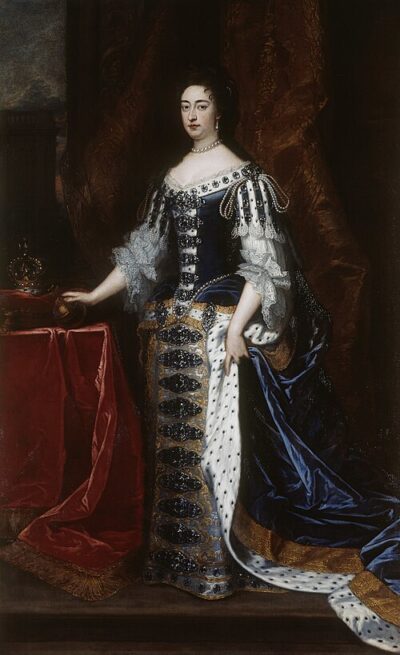
Mary II of England
Mary II of England was a Queen of England, Scotland, and Ireland from 1689 to 1694. Born April 30, 1662, in St James's Palace. Died December 28, 1694, in Kensington Palace. Positions held include queen regnant, Monarch of England (1689–1694) and Monarch of Scotland (1689–1694). Awards include Knight Companion of the Order of the Thistle and Knight of the Garter.
Facts
31 facts · 2 confirmed by two sources · 6 cited · 23 from one source
Where this comes from
Papalocal keeps its own record. It started from these sources; what each one said is kept here as it was copied, so a change on their side never changes this page by itself. Tap one to read its version.
What Wikidata says · copied November 16, 2026 · revision 2566335734
- Described as
- Queen of England, Scotland, and Ireland from 1689 to 1694 (1662-1694)
- Other names
- Lady Mary of England, Mary II Stuart, Mary II of Ireland, Mary Clorine, Mary II of Scotland, Queen Mary II, Mary, Princess of Orange, Mary Stuart, Lady Mary Stuart, The Lady Mary Stuart, The Lady Mary of England, Mary II, Queen of Great Britain
- Born
- April 30, 1662 · 8 references
- Died
- December 28, 1694 · 8 references
- Born in
- St James's Palace
- Died in
- Kensington Palace
- Buried in
- Westminster Abbey
- Cause of death
- smallpox
- Citizen of
- Kingdom of England
- Occupation
- politician; queen regnant; monarch · 1 reference
- Positions held
- queen regnant; Monarch of England (1689–1694); Monarch of Scotland (1689–1694); King of Ireland (1689–1694)
- Member of
- William and Mary
- Awards
- Knight Companion of the Order of the Thistle (1688); Knight of the Garter (1689)
- Spouse
- William III of England (1677–1694) · 2 references
- Father
- James II of England · 2 references
- Mother
- Anne, Duchess of York · 2 references
- Siblings
- Anne of Great Britain · 1 reference; Henrietta FitzJames; Louisa Maria Stuart; Princess Isabel of York; James FitzJames, 1st Duke of Berwick; Henry FitzJames; James Francis Edward Stuart, Prince of Wales · 1 reference; Prince James, Duke of Cambridge; Charles Stuart, Duke of Cambridge; Charles Stuart, Duke of Cambridge
- Religion
- Protestantism
- Wikipedias with a page
- 79
Wikidata item Q130812 (wikidata.org/wiki/Q130812), public domain (CC0). Copied November 16, 2026.
What Wikipedia says · copied November 16, 2026 · revision 1384833024
Mary II (30 April 1662 – 28 December 1694) was Queen of England, Scotland, and Ireland with her husband, King William III and II, from 1689 until her death in 1694. She was also Princess of Orange following her marriage on 4 November 1677. Her joint reign with William over Britain is known as that of William and Mary.
Mary was born during the reign of her uncle King Charles II. She was the eldest daughter of James, Duke of York and Albany (the future King James VII and II), and his first wife, Anne Hyde. Mary and her sister Anne were raised as Anglicans at the behest of Charles II, although their parents both converted to Roman Catholicism. Charles lacked legitimate children, making Mary second in the line of succession. At the age of 15, she married her cousin William of Orange, a Protestant. Charles died in 1685 and James became king, making Mary heir presumptive. James's attempts at rule by decree and the birth of his son from a second marriage, James Francis Edward (later known as "the Old Pretender"), led to his deposition in the Glorious Revolution of 1688/89 and the adoption of the English Bill of Rights.
William and Mary became king and queen regnant. Mary mostly deferred to her husband when he was in England. She did, however, act alone when William was engaged in military campaigns abroad, proving herself to be a powerful, firm, and effective ruler. Mary's early death from smallpox in 1694 at the age of 32 left William as sole ruler until his death in 1702, when he was succeeded by Mary's sister, Anne.
- Born, in its opening lines
- April 30, 1662
- Died, in its opening lines
- December 28, 1694
From the Wikipedia article “Mary II” (en.wikipedia.org/wiki/Mary_II), by its contributors, under CC BY-SA 4.0 (creativecommons.org/licenses/by-sa/4.0/). Copied November 16, 2026; not changed.
Confirmed Two sources agree. Cited One source, and it names where it got it. One source One source, without a reference of its own. Sources disagree The sources disagree. We show the best-supported value and keep theirs below.
