
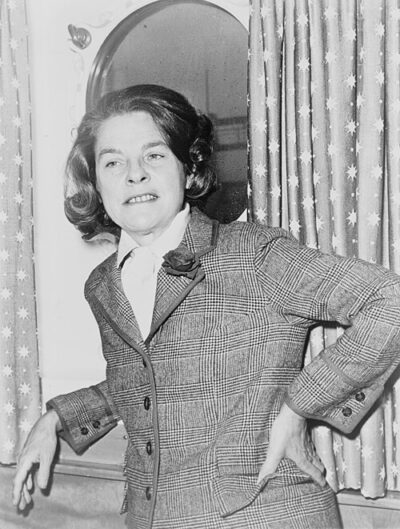
Mary McCarthy
Mary McCarthy was an American writer. Born June 21, 1912, in Seattle. Died October 25, 1989, in New York City. Positions held include Booker Prize judge (1973). Known for Memories of a Catholic Girlhood. Educated at Vassar College and Annie Wright School. Awards include Guggenheim Fellowship (2 times), Rome Prize and Fellow of the American Academy of Arts and Sciences.
Facts
30 facts · 2 confirmed by two sources · 9 cited · 19 from one source
Where this comes from
Papalocal keeps its own record. It started from these sources; what each one said is kept here as it was copied, so a change on their side never changes this page by itself. Tap one to read its version.
What Wikidata says · copied November 15, 2026 · revision 2558160961
- Described as
- American writer (1912–1989)
- Other names
- Mary Therese McCarthy
- Born
- June 21, 1912 · 15 references
- Died
- October 25, 1989 · 15 references
- Born in
- Seattle · 2 references
- Died in
- New York City · 1 reference
- Buried in
- Castine Cemetery · 1 reference
- Cause of death
- lung cancer
- Citizen of
- United States
- Occupation
- journalist; novelist; writer · 3 references; screenwriter; literary critic; autobiographer; critic · 1 reference; theatre critic · 1 reference
- Positions held
- Booker Prize judge (1973) · 1 reference
- Worked for
- Bard College · 1 reference
- Education
- Vassar College · 1 reference; Annie Wright School · 1 reference; Garfield High School
- Member of
- American Academy of Arts and Letters; American Academy of Arts and Sciences; Phi Beta Kappa Society
- Known for
- Memories of a Catholic Girlhood
- Awards
- Guggenheim Fellowship (2 times) (1949, 1959) · 1 reference; Rome Prize; Fellow of the American Academy of Arts and Sciences
- Spouse
- Edmund Wilson (1938–1946)
- Siblings
- Kevin McCarthy
- Religion
- atheism
- Wikipedias with a page
- 39
Wikidata item Q268147 (wikidata.org/wiki/Q268147), public domain (CC0). Copied November 15, 2026.
What Wikipedia says · copied November 15, 2026 · revision 1371387963
Mary Therese McCarthy (June 21, 1912 – October 25, 1989) was an American novelist, critic and political activist, best known for her novel The Group, her marriage to critic Edmund Wilson, her intimate friendship with her colleague Hannah Arendt and her storied feud with playwright Lillian Hellman. McCarthy was the winner of the Horizon Prize in 1949 and was awarded two Guggenheim Fellowships, in 1949 and 1959. She was a member of the National Institute of Arts and Letters and the American Academy in Rome. In 1973, she delivered the Huizinga Lecture in Leiden, the Netherlands, under the title Can There Be a Gothic Literature? The same year she was elected a Fellow of the American Academy of Arts and Sciences. She won the National Medal for Literature and the Edward MacDowell Medal in 1984. McCarthy held honorary degrees from Bard, Bowdoin, Colby, Smith College, Syracuse University, the University of Maine at Orono, the University of Aberdeen, and the University of Hull.
- Born, in its opening lines
- June 21, 1912
- Died, in its opening lines
- October 25, 1989
From the Wikipedia article “Mary McCarthy (American writer)” (en.wikipedia.org/wiki/Mary_McCarthy_(American_writer)), by its contributors, under CC BY-SA 4.0 (creativecommons.org/licenses/by-sa/4.0/). Copied November 15, 2026; not changed.
Confirmed Two sources agree. Cited One source, and it names where it got it. One source One source, without a reference of its own. Sources disagree The sources disagree. We show the best-supported value and keep theirs below.
