
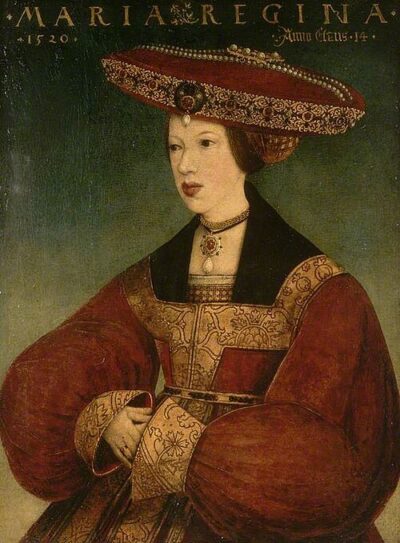
Mary of Hungary
Mary of Hungary was a governor of the Netherlands and queen consort of Hungary and Bohemia. Born September 15, 1505, in Brussels metropolitan area. Died October 18, 1558, in Cigales. Positions held include Consort of Hungary, Governor of the Spanish Netherlands (1531–1555) and Governor of the Habsburg Netherlands.
Facts
21 facts · 2 confirmed by two sources · 0 cited · 18 from one source · 1 where the sources disagree
What’s different
- Buried in: we show Royal Monastery of San Lorenzo de El Escorial (Sources disagree). Wikidata also lists Pantheon of the Infantes of the Royal Monastery of San Lorenzo de El Escorial
Where this comes from
Papalocal keeps its own record. It started from these sources; what each one said is kept here as it was copied, so a change on their side never changes this page by itself. Tap one to read its version.
What Wikidata says · copied November 16, 2026 · revision 2569841386
- Described as
- governor of the Netherlands and queen consort of Hungary and Bohemia (1505-1558)
- Other names
- Mary of Austria, Queen Maria of Hungary, Mary of Hungary (governor of the Netherlands), Maria of Hungary (governor of the Netherlands), Queen Mary of Hungary
- Born
- September 15, 1505 · 1 reference
- Died
- October 18, 1558 · 6 references
- Born in
- Brussels metropolitan area
- Died in
- Cigales
- Buried in
- Pantheon of the Infantes of the Royal Monastery of San Lorenzo de El Escorial; Royal Monastery of San Lorenzo de El Escorial · 1 reference
- Citizen of
- Crown of Castile
- Occupation
- regent
- Positions held
- Consort of Hungary; Governor of the Spanish Netherlands (1531–1555); Governor of the Habsburg Netherlands; Consort of Bohemia
- Spouse
- Louis II of Hungary (1521–1526) · 1 reference
- Father
- Philip I of Castile
- Mother
- Juana I of Castile
- Siblings
- Eleanor of Austria; Catherine of Austria, Queen of Portugal; Isabella of Austria; Ferdinand I, Holy Roman Emperor; Charles V, Holy Roman Emperor; Rietje Koane
- Religion
- Christianity
- Wikipedias with a page
- 44
Wikidata item Q157077 (wikidata.org/wiki/Q157077), public domain (CC0). Copied November 16, 2026.
What Wikipedia says · copied November 16, 2026 · revision 1363179563
Mary of Austria (German: Maria von Österreich; Czech: Marie Rakouská; Hungarian: Ausztriai Mária; Dutch: Maria van Oostenrijk; 15 September 1505 – 18 October 1558), also known as Mary of Hungary (German: Maria von Ungarn; Czech: Marie Uherská; Hungarian: Magyarországi Mária; Dutch: Maria van Hongarije), was Queen of Hungary and Bohemia as the wife of King Louis II, and was later governor of the Habsburg Netherlands.
The daughter of Queen Joanna and King Philip the Handsome of Castile, Mary married King Louis II of Hungary and Bohemia in 1515. Their marriage was happy but short and childless. Upon her husband's death following the Battle of Mohács in 1526, Queen Mary governed Hungary as regent in the name of the new king, her brother, Ferdinand I.
Following the death of their aunt Margaret in 1530, Mary was asked by her eldest brother, Charles V, Holy Roman Emperor, to assume the governance of the Netherlands and guardianship over their nieces, Dorothea and Christina of Denmark. As governor of the Netherlands, Mary faced riots and a difficult relationship with the Emperor. Throughout her tenure she continuously attempted to ensure peace between the Emperor and the King of France. Although she never enjoyed governing and asked for permission to resign several times, the Queen succeeded in creating a unity between the provinces, as well as in securing for them a measure of independence from both France and the Holy Roman Empire. After her final resignation, the very frail Queen moved to Castile, where she died.
- Born, in its opening lines
- September 15, 1505
- Died, in its opening lines
- October 18, 1558
From the Wikipedia article “Mary of Hungary (governor of the Netherlands)” (en.wikipedia.org/wiki/Mary_of_Hungary_(governor_of_the_Netherlands)), by its contributors, under CC BY-SA 4.0 (creativecommons.org/licenses/by-sa/4.0/). Copied November 16, 2026; not changed.
Confirmed Two sources agree. Cited One source, and it names where it got it. One source One source, without a reference of its own. Sources disagree The sources disagree. We show the best-supported value and keep theirs below.
