
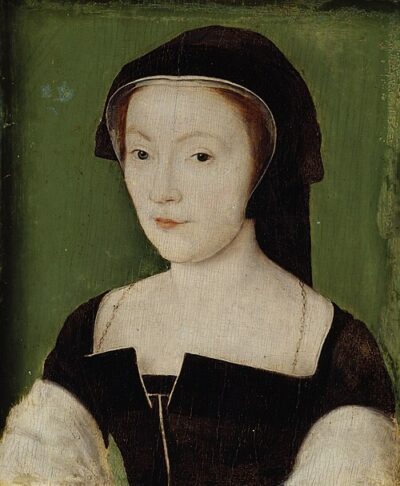
Mary of Lorraine
Mary of Lorraine was a Scottish Queen consort;. Born November 22, 1515, in Bar-le-Duc. Died June 11, 1560, in Edinburgh Castle. Positions held include regent.
Facts
29 facts · 2 confirmed by two sources · 20 cited · 7 from one source
Where this comes from
Papalocal keeps its own record. It started from these sources; what each one said is kept here as it was copied, so a change on their side never changes this page by itself. Tap one to read its version.
What Wikidata says · copied November 16, 2026 · revision 2561030088
- Described as
- Scottish Queen consort; (1515-1560)
- Other names
- Mary of Guise, Marie de Guise
- Born
- November 22, 1515 · 2 references
- Died
- June 11, 1560 · 2 references
- Born in
- Bar-le-Duc · 3 references
- Died in
- Edinburgh Castle · 1 reference
- Buried in
- Abbaye Saint-Pierre-les-Dames de Reims
- Cause of death
- edema
- Citizen of
- France; Kingdom of Scotland
- Occupation
- king · 1 reference; regent · 1 reference; monarch · 1 reference
- Positions held
- regent
- Field
- politics · 1 reference
- Spouse
- Louis II d'Orléans, Duke of Longueville (1534–) · 2 references; James V of Scotland (1538–1542) · 4 references
- Children
- Mary, Queen of Scots · 2 references; François III d'Orléans, Duke of Longueville; James, Duke of Rothesay · 1 reference; Louis de Longueville · 1 reference; Arthur Stewart, Duke of Albany · 1 reference
- Father
- Claude of Lorraine, duke of Guise · 2 references
- Mother
- Antoinette de Bourbon · 1 reference
- Siblings
- René of Lorraine, marquis of Elbeuf · 1 reference; Francis, Duke of Guise · 1 reference; Charles, Cardinal of Lorraine · 1 reference; Claude of Lorraine, duke of Aumale · 1 reference; Louis I of Lorraine, cardinal of Guise · 1 reference; Louise of Lorraine · 1 reference
- Religion
- Catholicism
- Wikipedias with a page
- 46
Wikidata item Q229846 (wikidata.org/wiki/Q229846), public domain (CC0). Copied November 16, 2026.
What Wikipedia says · copied November 16, 2026 · revision 1370137104
Mary of Guise (French: Marie de Guise; 22 November 1515 – 11 June 1560), also called Mary of Lorraine, was Queen of Scotland from 1538 until 1542, as the second wife of King James V. She was a French noblewoman of the House of Guise, a cadet branch of the House of Lorraine and one of the most powerful families in France. As the mother of Mary, Queen of Scots, she was a key figure in the political and religious upheaval that marked mid-16th-century Scotland, ruling the kingdom as queen regent on behalf of her daughter from 1554 until her death in 1560.
The eldest of the twelve children born to Claude, Duke of Guise, and Antoinette of Bourbon, in 1534 Mary was married to Louis II d'Orléans, Duke of Longueville, the Grand Chamberlain of France. The marriage was arranged by King Francis I of France, but proved shortlived. The Duke of Longueville died in 1537, and the widower kings of England and Scotland, Henry VIII and James V, both sought the Duchess of Longueville's hand. After much persuasion from Francis I and James V, who wrote a personal letter pleading for her hand and counsel, Mary eventually relented and agreed to marry the King of Scots. Following the new queen's arrival in Scotland, James and Mary were married in person in June 1538 at St Andrews Cathedral. Mary was crowned queen at Holyrood Abbey on 22 February 1540, and the marriage produced three children in quick succession: James, Duke of Rothesay; Robert, Duke of Albany; and Mary. Both sons died in April 1541, just 14 hours apart, and when James V himself died in December 1542, his only surviving heir, Mary, became Queen of Scots at the age of six days.
James V's death thrust Mary of Guise into the political arena as mother of the infant Queen of Scots, with the government of Scotland entrusted to James Hamilton, 2nd Earl of Arran, as regent during the early years of the minority and the Rough Wooing. With the Treaty of Haddington in 1548, the child queen Mary was betrothed to Francis, the Dauphin of France, and was sent to be brought up in France under the protection of King Henry II. Mary of Guise replaced Arran as regent in 1554, and her regency was dominated by her determination to protect and advance the dynastic interests of her daughter, maintain the Franco-Scottish alliance, and reassert the power of the Scottish crown. Throughout her regency, Mary displayed tolerance towards the religious reform movement, and implemented a policy of accommodation towards her Protestant subjects, though she was ultimately unable to prevent the Scottish Reformation.
- Born, in its opening lines
- November 22, 1515
- Died, in its opening lines
- June 11, 1560
From the Wikipedia article “Mary of Guise” (en.wikipedia.org/wiki/Mary_of_Guise), by its contributors, under CC BY-SA 4.0 (creativecommons.org/licenses/by-sa/4.0/). Copied November 16, 2026; not changed.
Confirmed Two sources agree. Cited One source, and it names where it got it. One source One source, without a reference of its own. Sources disagree The sources disagree. We show the best-supported value and keep theirs below.
