
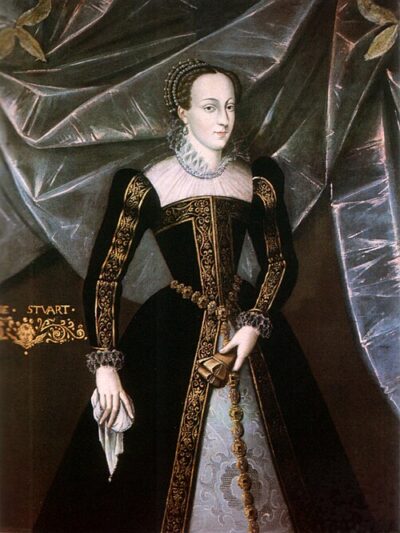
Mary, Queen of Scots
Mary, Queen of Scots was a Queen of Scotland from 1542 to 1567. Born December 8, 1542, in Linlithgow Palace. Died February 8, 1587, in Fotheringhay Castle. Positions held include Monarch of Scotland (1542–1567) and Queen Consort of France (1559–1560). Known for Oxburgh Hangings. Awards include Golden Rose.

Facts
38 facts · 2 confirmed by two sources · 12 cited · 24 from one source
Where this comes from
Papalocal keeps its own record. It started from these sources; what each one said is kept here as it was copied, so a change on their side never changes this page by itself. Tap one to read its version.
What Wikidata says · copied November 16, 2026 · revision 2567829962
- Described as
- Queen of Scotland from 1542 to 1567 (1542–1587)
- Other names
- Mary Stewart, Queen of Scots, Mary Stewart, Mary, Mary Stuart, Queen Mary, Mary, Queen of Scotland, Mary Queen of Scots, Queen of Scots Mary
- Born
- December 8, 1542 · 1 reference
- Died
- February 8, 1587 · 8 references
- Born in
- Linlithgow Palace · 1 reference
- Died in
- Fotheringhay Castle
- Buried in
- Westminster Abbey (1612–) · 1 reference
- Cause of death
- decapitation · 1 reference
- Citizen of
- Kingdom of Scotland
- Occupation
- politician; sovereign; aristocrat; queen regnant; queen consort; writer
- Positions held
- Monarch of Scotland (1542–1567) · 1 reference; Queen Consort of France (1559–1560)
- Known for
- Oxburgh Hangings
- Awards
- Golden Rose · 1 reference
- Spouse
- Francis II of France (1558–1560) · 2 references; Henry Stuart, Lord Darnley (1565–1567) · 4 references; James Hepburn, 4th Earl of Bothwell (1567–1578) · 3 references
- Children
- James VI and I · 2 references
- Father
- James V of Scotland · 2 references
- Mother
- Mary of Lorraine · 2 references
- Siblings
- François III d'Orléans, Duke of Longueville; Robert Stewart, 1st Earl of Orkney; James Stewart, 1st Earl of Moray; James, Duke of Rothesay; James Stewart; Adam Stewart; Robert Stewart; John Stewart, Commendator of Coldingham; Jean Stewart
- Religion
- Catholicism
- Lived in
- Scotland (–1548); Fotheringhay Castle; Chartley Castle; France (1548–1561) · 1 reference; Kingdom of Scotland (1561–) · 1 reference
- Wikipedias with a page
- 108
Wikidata item Q131412 (wikidata.org/wiki/Q131412), public domain (CC0). Copied November 16, 2026.
What Wikipedia says · copied November 16, 2026 · revision 1383269532
Mary, Queen of Scots (8 December 1542 – 8 February 1587), also known as Mary Stuart or Mary I of Scotland, was Queen of Scotland from 14 December 1542 until her forced abdication on 24 July 1567.
The only surviving legitimate child of King James V of Scotland, Mary was six days old when her father died, and she inherited the throne. During her childhood, Scotland was governed by regents, first by the heir to the throne, James Hamilton, Earl of Arran, and then by her mother, Mary of Guise. In 1548, she was betrothed to Francis, the Dauphin of France, and was sent to be brought up in France, where she would be safe from invading English forces during the Rough Wooing. Mary married Francis in 1558, becoming queen consort of France from his accession in 1559 until his death in December 1560. Widowed, Mary returned to Scotland in August 1561. The tense religious and political climate following the Scottish Reformation that Mary encountered on her return to Scotland was further agitated by prominent Scots such as John Knox, who openly questioned whether her subjects had a duty to obey her. The early years of her personal rule were marked by pragmatism, tolerance, and moderation. She issued a proclamation accepting the religious settlement in Scotland as she had found it upon her return, retained advisers such as James Stewart, 1st Earl of Moray (her illegitimate half-brother), and William Maitland of Lethington, and governed as the Catholic monarch of a Protestant kingdom.
In 1565, Mary married her half-cousin Henry Stuart, Lord Darnley; they had a son, James. Their marriage soured after Darnley orchestrated the murder of Mary's Italian secretary and close friend David Rizzio. In February 1567, Darnley's residence was destroyed by an explosion, and he was found murdered in the nearby garden. James Hepburn, 4th Earl of Bothwell, was generally believed to have orchestrated Darnley's death, but he was acquitted of the charge in April 1567 and in the following month, he married Mary. Following an uprising against the couple, Mary was imprisoned in Lochleven Castle. In July 1567, she was forced to abdicate in favour of her one-year-old son James VI. After an unsuccessful attempt to regain the throne, she fled southward seeking the protection of her first cousin once removed, Elizabeth I of England.
As a great-granddaughter of Henry VII of England, Mary had once claimed Elizabeth's throne as her own and was considered the legitimate sovereign of England by many English Catholics, including participants in a rebellion known as the Rising of the North. Perceiving Mary as a threat, Elizabeth had her confined in various castles and manor houses in the interior of England. After eighteen and a half years in captivity, Mary was found guilty of plotting to assassinate Elizabeth in 1586 and was beheaded the following year at Fotheringhay Castle. Mary's life and execution established her in popular culture as a romanticised historical figure.
- Born, in its opening lines
- December 8, 1542
- Died, in its opening lines
- February 8, 1587
From the Wikipedia article “Mary, Queen of Scots” (en.wikipedia.org/wiki/Mary,_Queen_of_Scots), by its contributors, under CC BY-SA 4.0 (creativecommons.org/licenses/by-sa/4.0/). Copied November 16, 2026; not changed.
Confirmed Two sources agree. Cited One source, and it names where it got it. One source One source, without a reference of its own. Sources disagree The sources disagree. We show the best-supported value and keep theirs below.
