
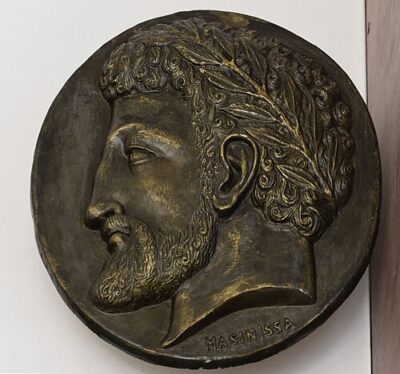
Massinissa
Massinissa was a first king of Numidia from 202 BC to 148 BC. Born 238 BC. Died 148 BC. Positions held include King of Numidia.
Facts
11 facts · 0 confirmed by two sources · 3 cited · 7 from one source · 1 where the sources disagree
What’s different
- Died: we show 148 BC (Sources disagree). Wikidata also lists 149 BC
Where this comes from
Papalocal keeps its own record. It started from these sources; what each one said is kept here as it was copied, so a change on their side never changes this page by itself. Tap one to read its version.
What Wikidata says · copied November 16, 2026 · revision 2558161501
- Described as
- first king of Numidia from 202 BC to 148 BC
- Other names
- Masensen, MSNSN, Masinissa
- Born
- 238 BC · 2 references
- Died
- 148 BC · 2 references; 149 BC · 2 references
- Citizen of
- Kingdom of Numidia · 1 reference
- Occupation
- monarch · 1 reference
- Positions held
- King of Numidia
- Spouse
- Sophonisba · 3 references
- Children
- Micipsa · 2 references; Mastanabal · 2 references; Gulussa · 2 references; Misagenes
- Father
- Gaya · 1 reference
- Wikipedias with a page
- 46
Wikidata item Q314685 (wikidata.org/wiki/Q314685), public domain (CC0). Copied November 16, 2026.
What Wikipedia says · copied November 16, 2026 · revision 1384722543
Masinissa (Numidian: MSNSN) (c. 238 BC – 148 BC), also spelled Massinissa, Massena and Massan, was an ancient Numidian king best known for leading a federation of Massylii Berber tribes during the Second Punic War (218–201 BC), ultimately uniting them into a kingdom that became a major regional power in North Africa, in what is largely present-day Algeria.
Much of what is known about Masinissa comes from Livy's History of Rome, and to a lesser extent Cicero's Scipio's Dream. As the son of a Numidian chieftain allied to Carthage, he fought against the Romans in the Second Punic War, but later switched sides upon concluding that Rome would prevail. With the support of his erstwhile enemy, he united the eastern and western Numidian tribes and founded the Kingdom of Numidia. As a Roman ally, Masinissa took part in the decisive Battle of Zama in 202 BC that effectively ended the war in Carthage's defeat; he also allowed his wife Sophonisba, a famed Carthaginian noblewoman who had influenced Numidian affairs to Carthage's benefit, to poison herself in lieu of being paraded in a triumph in Rome.
After inheriting a larger, more powerful kingdom now backed by Rome, Masinissa played a decisive role in provoking Carthage into triggering the Third Punic War, which ended in the city's complete destruction, and left Numidia the sole power in northwest Africa. He ruled for 54 years until his death at age 90. He was regarded as a staunch ally of Rome, and an unusually vigorous ruler, leading troops until his death and fathering some 44 sons. His tomb in Cirta (modern-day Constantine in Algeria) bears the inscription MSNSN, read Mas'n'sen, or "Their Lord".
The Greek historian Polybius, who wrote extensively about the Punic Wars and is reputed to have met Masinissa, described him as "the best man of all the kings of our time", writing that "his greatest and most divine achievement was this: Numidia had been before his time universally unproductive, and was looked upon as incapable of producing any cultivated fruits. He was the first and only man who showed that it could produce cultivated fruits just as well as any other country". In the following centuries, Numidia would become known as the breadbasket of Rome.
In addition to his legacy as a major figure in the Punic Wars, Masinissa is largely viewed as an icon by the Berbers, many of whom consider him their forefather.
From the Wikipedia article “Masinissa” (en.wikipedia.org/wiki/Masinissa), by its contributors, under CC BY-SA 4.0 (creativecommons.org/licenses/by-sa/4.0/). Copied November 16, 2026; not changed.
Confirmed Two sources agree. Cited One source, and it names where it got it. One source One source, without a reference of its own. Sources disagree The sources disagree. We show the best-supported value and keep theirs below.
