
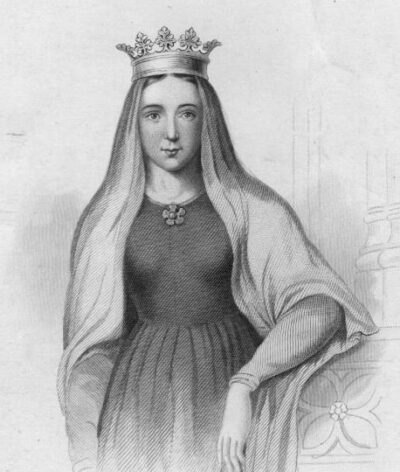
Matilda of Boulogne
Matilda of Boulogne was a Countess of Boulogne and Queen Consort of England. Born 1105, in Boulogne-sur-Mer. Died May 3, 1152, in Hedingham Castle. Positions held include queen consort.
Facts
16 facts · 2 confirmed by two sources · 7 cited · 7 from one source
Where this comes from
Papalocal keeps its own record. It started from these sources; what each one said is kept here as it was copied, so a change on their side never changes this page by itself. Tap one to read its version.
What Wikidata says · copied November 16, 2026 · revision 2558161999
- Described as
- Countess of Boulogne and Queen Consort of England (1105-1152)
- Born
- 1105 · 1 reference
- Died
- May 3, 1152 · 1 reference
- Born in
- Boulogne-sur-Mer
- Died in
- Hedingham Castle
- Cause of death
- fever
- Citizen of
- Kingdom of England
- Occupation
- politician
- Positions held
- queen consort
- Spouse
- Stephen, King of England · 2 references
- Children
- Eustace IV, Count of Boulogne; Marie I, Countess of Boulogne · 1 reference; William I, Count of Boulogne · 3 references; Baldwin de Boulogne · 2 references; Matilda de Blois · 2 references
- Father
- Eustace III, Count of Boulogne · 1 reference
- Mother
- Mary of Scotland, Countess of Boulogne · 1 reference
- Wikipedias with a page
- 44
Wikidata item Q229592 (wikidata.org/wiki/Q229592), public domain (CC0). Copied November 16, 2026.
What Wikipedia says · copied November 16, 2026 · revision 1369352453
Matilda of Boulogne (c. 1105 – 3 May 1152) was the countess of Boulogne in her own right from 1125 and queen of England as the wife of King Stephen from 1135 until her death. She supported Stephen in his struggle for the English throne against their mutual cousin Empress Matilda, a period known as the Anarchy. Historians attribute Stephen's continued hold on the throne to her courage and determination.
Matilda was the daughter of Count Eustace III of Boulogne, from whom she inherited the French County of Boulogne as well as vast estates in England. Her maternal uncle King Henry I of England arranged for her to marry his nephew Stephen of Blois. Henry had intended to be succeeded by his daughter Empress Matilda, but when he died in 1135, Stephen took the throne. Matilda of Boulogne was consequently crowned queen in 1136. Civil war broke out in 1138 when Earl Robert of Gloucester declared for his half-sister Empress Matilda, renouncing his allegiance to King Stephen. Queen Matilda joined her husband in an attempt to quell the rebellion, leading a successful siege of Dover. The conflict intensified in 1139 when Empress Matilda arrived in England to press her claim. Queen Matilda's initial role in the war was primarily that of a diplomat: she brokered peace with her uncle King David I of Scotland and concluded an alliance with King Louis VII of France.
After Stephen's capture at the battle of Lincoln in 1141, Matilda took up the leadership of their faction and began assembling an army. Despite her efforts, the kingdom's clergy recognized the empress as ruler. The empress established herself in London and was on the verge of victory when the queen allied with dissatisfied citizenry and led her army to retake the capital. The queen soon besieged the empress in Winchester and, in the subsequent rout, captured Robert of Gloucester, crippling the empress's war effort. By the end of 1141, she had traded Robert for Stephen.
Matilda continued to advise Stephen and take part in his government, and came to involve herself closely with church affairs. She patronized a variety of religious orders and founded the abbeys of Coggeshall, Faversham, and Lillechurch, as well as Cressing Temple, Temple Cowley and the hospital of St Katharine's by the Tower. She probably pushed Stephen to secure the succession of their son Eustace; after she died, Stephen recognized the empress's son Henry as his heir, ending the Anarchy.
- Born, in its opening lines
- c. 1105
- Died, in its opening lines
- May 3, 1152
From the Wikipedia article “Matilda of Boulogne” (en.wikipedia.org/wiki/Matilda_of_Boulogne), by its contributors, under CC BY-SA 4.0 (creativecommons.org/licenses/by-sa/4.0/). Copied November 16, 2026; not changed.
Confirmed Two sources agree. Cited One source, and it names where it got it. One source One source, without a reference of its own. Sources disagree The sources disagree. We show the best-supported value and keep theirs below.
