
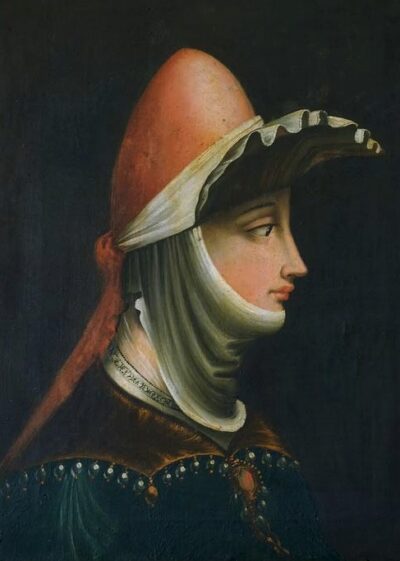
Matilda of Tuscany
Matilda of Tuscany was a Canossian dynasty countess of Tuscany (c.1046–1115). Born 1040s, in Mantua. Died July 24, 1115, in Bondeno di Roncore.
Facts
18 facts · 1 confirmed by two sources · 5 cited · 11 from one source · 1 where the sources disagree
What’s different
- Born: we show 1040s (Sources disagree). Wikipedia says c. 1046
Where this comes from
Papalocal keeps its own record. It started from these sources; what each one said is kept here as it was copied, so a change on their side never changes this page by itself. Tap one to read its version.
What Wikidata says · copied November 16, 2026 · revision 2568755417
- Described as
- Canossian dynasty countess of Tuscany (c.1046–1115)
- Other names
- Mathilda of Tuscany, Matilda of Canossa, Matilde of Tuscany, Matilde di Canossa, Maud d'Este, la Gran Contessa
- Born
- 1040s · 1 reference
- Died
- July 24, 1115 · 3 references
- Born in
- Mantua
- Died in
- Bondeno di Roncore
- Buried in
- St. Peter's Basilica
- Cause of death
- gout
- Occupation
- feudatory; politician; aristocrat; margrave · 1 reference
- Spouse
- Godfrey IV, Duke of Lower Lorraine (1070–) · 2 references; Welf II, Duke of Bavaria (1089–) · 1 reference
- Children
- Beatrice of Lower Lotharingia · 1 reference; unknown daughter (?) · 1 reference
- Father
- Boniface III, Margrave of Tuscany · 1 reference
- Mother
- Beatrice of Lorraine
- Siblings
- Frederick, Margrave of Tuscany
- Lived in
- Canossa Castle
- Wikipedias with a page
- 46
Wikidata item Q464162 (wikidata.org/wiki/Q464162), public domain (CC0). Copied November 16, 2026.
What Wikipedia says · copied November 16, 2026 · revision 1384997779
Matilda of Canossa (Italian: Matilde; c. 1046 – 24 July 1115) was the countess (or margravine) of Tuscany and ruler of much of central Italy from the 1070s until her death. Known as la Gran Contessa ("the Great Countess"), Matilda was one of the most important governing figures of medieval Italy. She reigned in a time of constant battles, political intrigues, and excommunications by the Church.
She ruled as a feudal margravine and, as a relative of the imperial Salian dynasty, she brokered a settlement in the so-called Investiture Controversy. In this extensive conflict with the emerging reform Papacy over the relationship between spiritual (sacerdotium) and secular (regnum) power, Pope Gregory VII dismissed and excommunicated King (later Emperor) Henry IV in 1076. At the same time, Matilda came into possession of a substantial territory that included present-day Lombardy, Emilia, Romagna, and Tuscany. She made the Canossa Castle, in the Apennines south west of Reggio Emilia, the centre of her domains.
After his famous penitential walk in front of Canossa Castle in January 1077, Henry IV was accepted back into the Church by the Pope. However, the understanding between the Emperor and the Pope was short-lived. In the conflicts with Henry IV that arose a little later, from 1080, Matilda put all her military and material resources into the service of the Papacy. Her court became a refuge for many displaced persons during the turmoil of the investiture dispute and enjoyed a cultural boom. Even after the death of Pope Gregory VII in 1085, Matilda remained a vital pillar of the Reform Church. Between 1081 and 1098, grueling disputes with Henry IV meant Canossan rule was in crisis. The historical record is sparse for this time. A turning point resulted from Matilda forming a coalition with the southern German dukes, who opposed Henry IV.
In 1097, Henry IV retreated past the Alps to the northern portion of the Holy Roman Empire, and a power vacuum developed in Italy. The struggle between regnum and sacerdotium changed the social and rulership structure of the Italian cities permanently, giving them space for emancipation from foreign rule and communal development. From autumn 1098, Matilda regained many of her lost domains. Until the end, she tried to bring the cities under her control. After 1098, she increasingly used the opportunities offered to her to consolidate her rule again. Since she was childless, in her final years, Matilda developed her legacy by focusing her donation activity on Polirone Abbey.
The account of Donizo reports that between 6 and 11 May 1111, Matilda was crowned Imperial Vicar and Vice-Queen of Italy by Henry V at Bianello Castle (Quattro Castella, Reggio Emilia). With her death, the House of Canossa became extinct in 1115. Well into the thirteenth century, popes and emperors fought over what was called the Terre Matildiche ("Matildine domains") as their rich inheritance.
The rule of Matilda and her influence became identified as a cultural epoch in Italy that found expression in the flowering of numerous artistic, musical, and literary designs and miracle stories and legends. Her legacy reached its apogee during the Counter-Reformation and the Baroque Period. Pope Urban VIII had Matilda's body transferred to Rome in 1630, where she was the first woman to be buried in Saint Peter's Basilica.
- Born, in its opening lines
- c. 1046
- Died, in its opening lines
- July 24, 1115
From the Wikipedia article “Matilda of Tuscany” (en.wikipedia.org/wiki/Matilda_of_Tuscany), by its contributors, under CC BY-SA 4.0 (creativecommons.org/licenses/by-sa/4.0/). Copied November 16, 2026; not changed.
Confirmed Two sources agree. Cited One source, and it names where it got it. One source One source, without a reference of its own. Sources disagree The sources disagree. We show the best-supported value and keep theirs below.
