
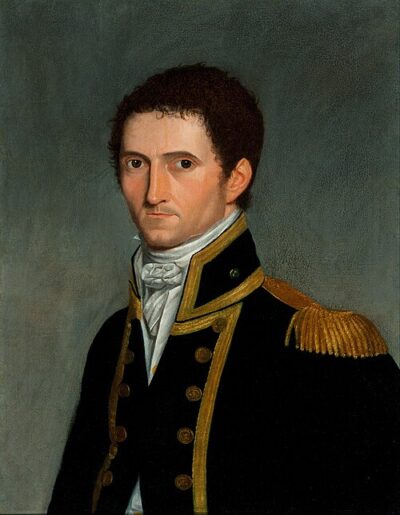
Matthew Flinders
Matthew Flinders was an English navigator and cartographer. Born March 16, 1774, in Donington. Died July 19, 1814, in London. Known for A Voyage to Terra Australis. Educated at The Thomas Cowley High School.
Facts
22 facts · 2 confirmed by two sources · 9 cited · 11 from one source
Where this comes from
Papalocal keeps its own record. It started from these sources; what each one said is kept here as it was copied, so a change on their side never changes this page by itself. Tap one to read its version.
What Wikidata says · copied November 16, 2026 · revision 2567634576
- Described as
- English navigator and cartographer (1774-1814)
- Other names
- Flinders
- Born
- March 16, 1774 · 12 references
- Died
- July 19, 1814 · 11 references
- Born in
- Donington
- Died in
- London · 1 reference
- Buried in
- Euston Station · 1 reference
- Citizen of
- United Kingdom of Great Britain and Ireland; Kingdom of Great Britain (–1801)
- Occupation
- explorer · 1 reference; cartographer · 2 references; botanist; navigator; seafarer · 1 reference
- Education
- The Thomas Cowley High School
- Known for
- A Voyage to Terra Australis
- Field
- botany; navigation
- Spouse
- Ann Chappelle · 1 reference
- Children
- Anne Flinders · 1 reference
- Father
- Matthew Flinders · 1 reference
- Mother
- Susannah Ward · 1 reference
- Military branch
- Royal Navy
- Military rank
- captain · 1 reference
- Wikipedias with a page
- 52
Wikidata item Q219895 (wikidata.org/wiki/Q219895), public domain (CC0). Copied November 16, 2026.
What Wikipedia says · copied November 16, 2026 · revision 1384184083
Captain Matthew Flinders (16 March 1774 – 19 July 1814) was a British Royal Navy officer, navigator and cartographer who led the first inshore circumnavigation of mainland Australia, then called New Holland. He is also credited as being the first person to utilise the name Australia to describe the entirety of that continent including Van Diemen's Land (now Tasmania), a title he regarded as being "more agreeable to the ear" than previous names such as Terra Australis.
Flinders was involved in several voyages of discovery between 1791 and 1803, the most famous of which are the circumnavigation of Australia and an earlier expedition when he and George Bass confirmed that Van Diemen's Land was an island. While returning to Britain in 1803, Flinders was arrested by the French at the colony of Isle de France. Although Britain and France were at war, Flinders thought the scientific nature of his work would ensure safe passage, but he remained under arrest for more than six years. In captivity, he recorded details of his voyages for future publication, and put forward his rationale for naming the new continent Australia, as an umbrella term for New Holland and New South Wales – a suggestion taken up later by Governor Macquarie.
Flinders' health had suffered, however, and although he returned to Britain in 1810, he did not live to see the success of his widely praised book and atlas, A Voyage to Terra Australis. The location of his grave had been lost by the mid-19th century, but archaeologists, excavating a former burial ground near London's Euston railway station for the High Speed 2 rail project, announced in January 2019 that his remains had been identified. On 13 July 2024, he was reburied in Donington, Lincolnshire, the village of his birth.
- Born, in its opening lines
- March 16, 1774
- Died, in its opening lines
- July 19, 1814
From the Wikipedia article “Matthew Flinders” (en.wikipedia.org/wiki/Matthew_Flinders), by its contributors, under CC BY-SA 4.0 (creativecommons.org/licenses/by-sa/4.0/). Copied November 16, 2026; not changed.
Confirmed Two sources agree. Cited One source, and it names where it got it. One source One source, without a reference of its own. Sources disagree The sources disagree. We show the best-supported value and keep theirs below.
